
McKinsey research across 354 top-team members found that companies with aligned, effective top teams were nearly twice as likely to achieve above-median financial performance. Yet those same teams scored just 44 out of 100 on overall effectiveness.
Retreats are one of the few tools that can close this gap — but most don't. They're planned around logistics (venue, dates, agenda slots) rather than outcomes. This article walks through how to design one that actually works, from diagnosing the alignment problem before you book anything to ensuring decisions stick after everyone flies home.
Key Takeaways
- Diagnose the specific alignment gap first — vision, decision rights, and trust each require different interventions
- Measurable outcomes, not themes, determine whether a retreat actually succeeded
- Facilitation quality is often the single biggest variable in retreat effectiveness
- Cognitively depleted leaders cannot engage in the collaborative thinking alignment requires
- Post-retreat integration determines whether the retreat drives lasting change or fades within weeks
How to Plan an Executive Retreat That Aligns Leadership
Step 1: Diagnose the Alignment Gap Before Booking Anything
Not all misalignment looks the same. Treating it as a single problem is the most common planning mistake — and it produces retreats that address the wrong issue entirely.
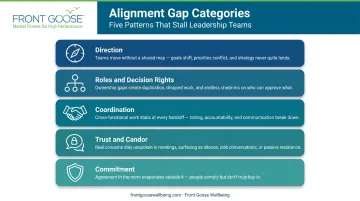
The Center for Creative Leadership's Direction-Alignment-Commitment (DAC) framework identifies at least three distinct categories. McKinsey's top-team research adds two more. Before an agenda can be designed, the planning team needs to know which gap actually exists:
| Alignment Gap | What It Looks Like |
|---|---|
| Direction | Leaders describe the company's top priorities differently |
| Roles & Decision Rights | Recurring conflict over who owns what |
| Coordination | Cross-functional work stalls at handoffs |
| Trust & Candor | Agreement in meetings, dissent in hallways |
| Commitment | Leaders protect their function over the collective |
Practical diagnostic approaches:
- One-on-one pre-retreat conversations with each executive (15-20 minutes)
- Anonymous survey on strategic priorities
- A simple written exercise: ask each leader independently to list the organization's top three priorities for the next 12 months — then compare answers
The diagnostic determines both the agenda structure and the facilitation approach needed. Skipping it means designing the retreat based on assumptions, which is exactly how you end up spending two days on vision alignment when the real problem is contested decision rights.
Step 2: Define Measurable Outcomes, Not Just Themes
"Strategic alignment" is a theme. It tells you nothing about whether the retreat worked.
A measurable outcome is specific enough to evaluate afterward. McKinsey's Top Team Program names concrete deliverables including documented working norms, aligned strategic priorities, a prioritized list of key decisions, and clear accountability for leadership behaviors. That's the standard to aim for.
Examples of well-written retreat outcomes:
- Every leader can articulate the top three organizational priorities for the next 12 months in identical terms
- Decision rights are documented for two contested areas, with named owners
- Each strategic initiative has a single accountable leader and a 90-day milestone
- The team has agreed on one organizational narrative for use externally and internally
Share these outcomes with all participants before the retreat. When everyone arrives knowing what success looks like, the conversations stay anchored to purpose rather than drifting into comfortable but inconclusive territory.
Step 3: Choose the Right Format, Duration, and Setting
Format should follow the depth of alignment work required — not venue availability or executive preference.
Duration tradeoffs by alignment type:
| Format | Best For |
|---|---|
| Half-day | Tactical priority-setting, single decision area, team already has strong trust foundation |
| Full day (off-site) | Strategic priority clarification, role and decision rights work |
| 2-day residential | Trust-building, values realignment, post-merger or post-crisis recovery, new leadership team formation |
SHRM's practitioner guidance recommends capping out-of-office retreats at two days to prevent work from accumulating and personal disruption from undermining participation quality.
On setting: the primary criteria should be privacy, minimal distraction, and low travel burden — not luxury amenities. A trust-building retreat benefits from a residential, nature-adjacent environment. A tactical strategy session can happen in any focused off-site meeting space. Choose the venue after you've defined the outcomes, not before.
Step 4: Design an Agenda That Balances Structure and Space
Over-programmed agendas are one of the most reliable ways to undermine alignment. Back-to-back presentations leave no room for the informal conversations where real alignment actually happens.
An effective agenda rhythm looks like this:
- Open with a grounding exercise or reflective check-in — not a status update. Something that orients participants to the work ahead and shifts them out of operational mode.
- Move into structured working sessions on 1-2 key alignment topics. Keep these interactive — participants should be grappling with the material, not receiving it.
- Break with shared experience — a meal together, a short walk, any activity that removes status cues and creates informal connection.
- Close each day with a synthesis conversation that explicitly names: what was agreed, what remains open, and what will be decided (and by whom) later.
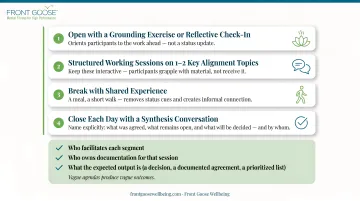
Every agenda should document:
- Who facilitates each segment
- Who owns documentation for that session
- What the expected output is (a decision, a documented agreement, a prioritized list)
Vague agendas produce vague outcomes. If the expected output of a session isn't named in advance, participants will fill that vacuum with their own interpretations — which is precisely the alignment problem you're trying to solve.
Step 5: Select and Prepare the Right Facilitator
The facilitator's job is not to present content. It's to surface the tensions that prevent alignment and work through them without letting the session derail.
This is harder than it sounds. A facilitator who defers to the most senior voice in the room, who avoids productive conflict, or who lacks understanding of executive team dynamics will actively undermine alignment — even inside a well-designed agenda.
Why internal facilitators often struggle: Participants filter what they say based on political dynamics. The CEO facilitating their own team's alignment conversation creates an inherent constraint on candor. The same is true for HR leaders who have organizational relationships at stake.
An external facilitator with no organizational stake can create more honest dialogue. For retreats where leadership mindset and cognitive performance are part of the alignment challenge, a facilitator who combines executive coaching credentials with neuroscience-based practice brings a specific capability: the ability to integrate mental fitness practices that measurably improve participants' capacity to think and engage during the retreat itself.

Megan Dittman of Front Goose Wellbeing works at exactly this intersection. Her 25 years as a corporate HR executive at organizations including GE and Kohler means she understands the political and strategic dynamics in the room — not just the facilitation mechanics. Combined with coaching certifications from The Neuroleadership Institute and the Chopra Institute, she can move from a breathwork session into a hard conversation about contested decision rights without losing the group's trust or momentum.
A facilitator briefing should include:
- Diagnostic findings from pre-retreat interviews or surveys
- Defined retreat outcomes (from Step 2)
- Specific tensions or fault lines in the group
- Any topics that are off-limits or require careful handling
Step 6: Build a Post-Retreat Integration Plan Before the Retreat Ends
Alignment achieved during a retreat will decay if it isn't immediately converted into documented commitments. Old patterns reassert themselves fast.
The final session of the retreat should be dedicated to this conversion work — not left for someone to handle afterward.
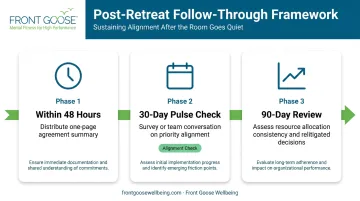
A simple post-retreat follow-through framework:
- Within 48 hours: Distribute a one-page summary of agreements — decisions made, owners assigned, open questions deferred and their resolution process
- 30-day pulse check: A brief survey or 30-minute team conversation: Are the stated priorities reflected in actual work? Are decisions holding?
- 90-day review: Are resource allocation decisions consistent with what was agreed? Have any agreements been relitigated?
SHRM's executive retreat case study required each leader to distribute a one-page strategy memo to their direct reports after the retreat — a simple mechanism that extended the retreat's decisions into the organization and created accountability for following through.
The Retreat Elements That Actually Drive Leadership Alignment
Alignment doesn't come from information transfer. It comes from shared experience, psychological safety, and the cognitive conditions that let leaders think past their functional silos.
Research from Edmondson's landmark team study connects psychological safety with team learning behavior — the willingness to surface information, ask questions, and acknowledge uncertainty. Without it, strategy conversations produce surface agreement while real dissent goes underground.
What creates those conditions during a retreat:
Structured vulnerability practices: Formats like "what I'm struggling with as a leader right now" or strengths/blind-spots sharing build the honest relational foundation strategy conversations require. These aren't soft additions — they're the prerequisite for productive disagreement.
Science-based mental fitness practices: Breathwork, mindfulness, and reflection exercises reduce the acute stress that impairs prefrontal cortex function. A 2016 meta-analysis of 51 studies found acute stress impairs working memory and cognitive flexibility — exactly the capacities needed for collaborative strategic thinking.
Shared physical experiences — a group hike, cooking together, any activity that strips away status cues. These build the kind of trust that structured sessions rarely produce. Design them into the agenda intentionally, not as optional recreation.
Synthesis sessions at the end of each major working block: the group explicitly names what was agreed, what remains unresolved, and what will be decided later. These prevent the most common retreat failure — participants leaving with different interpretations of the same conversation.
Front Goose Wellbeing's retreat programming builds mental fitness practices into the agenda as neurologically sound tools, creating the cognitive conditions where alignment becomes possible rather than accidental.
When Is an Executive Retreat the Right Tool?
A retreat draws on real resources: executive time, facilitation fees, travel, and two to three days pulled from operations. That investment is justified for the right problem — but it's not the right tool for every alignment challenge.
A retreat is warranted when:
- Leaders are consistently interpreting strategy differently in their own organizations
- There's recurring conflict around resource prioritization
- The team is navigating a significant transition — new CEO, merger, major strategy pivot, post-crisis recovery
- Decisions are being relitigated after they've been made
A retreat is not warranted when:
- The misalignment is purely informational (a well-run meeting or a clear memo would suffice)
- The team lacks the psychological readiness or trust to engage honestly in the retreat format
- The diagnostic work in Step 1 hasn't been done: without it, even a well-designed retreat can reinforce misalignment by validating each executive's existing interpretation
Common Planning Mistakes That Undermine Alignment
Most retreat failures are predictable — and they trace back to the same avoidable mistakes:
- Skipping the pre-retreat diagnostic. Designing the agenda on assumptions means sessions address surface symptoms, not the actual alignment gap.
- Running it as a presentation forum. When executives spend most of their time receiving information instead of wrestling with it together, the team builds no shared meaning.
- Choosing a facilitator on availability or cost. A facilitator who defers to the most senior voice, can't hold productive tension, or lacks executive-team experience will undermine alignment regardless of how well the agenda is designed.
- Leaving without a follow-through structure. No documented agreements, no assigned owners, no follow-up cadence — and organizational inertia quietly erases whatever alignment the retreat produced.
Frequently Asked Questions
How much does an executive retreat cost?
Costs vary widely based on group size, duration, venue, facilitation fees, and travel. A two-day residential retreat for 8–12 executives typically ranges from $15,000 to $60,000+ when all-in costs are factored in. Front Goose Wellbeing's executive retreat engagements are custom-quoted based on scope — a discovery call with Megan is the starting point.
Are executive retreats worth it?
Yes, when designed around specific alignment outcomes and followed up with structured integration. McKinsey's research found that aligned top teams were nearly twice as likely to achieve above-median financial performance, with role clarity and shared purpose showing the strongest correlations with team effectiveness.
How long should an executive retreat last?
It depends on the work. Tactical priority-setting can fit into a full day; trust-building and values alignment typically require at least one overnight, since informal relationship time between sessions matters as much as the structured agenda.
How do you measure whether an executive retreat produced alignment?
Three practical indicators: participants can independently articulate the same top priorities without prompting; decisions made during the retreat are not relitigated in the following 60 days; and resource allocation decisions post-retreat are consistent with the stated priorities.
What is the ideal group size for an executive retreat focused on alignment?
Six to twelve participants generally works best for deep alignment work — small enough for genuine dialogue and psychological safety, large enough to represent the key perspectives that need to be integrated.
How far in advance should you plan an executive retreat?
Eight to twelve weeks is a practical minimum. Executive calendars, diagnostic prep, agenda design, and venue logistics all require runway. Fewer than eight weeks typically forces preparation shortcuts that directly undermine the retreat's effectiveness.