

Introduction
Picture this: You're in a high-stakes board meeting. The questions get hostile, the data gets challenged, and every eye in the room turns to you. Your heart rate spikes. Your thinking narrows. You feel the pressure before you have a single word to say.
The gap between your technical capability and your mental readiness is where performance gets decided.
Most professionals spend years developing their skills and almost no time training the mental capacity to use those skills under pressure. That's the problem a real mental strength program solves.
Mental strength isn't a personality trait some people are born with. It's a trainable skillset, grounded in neuroscience, built the same way physical fitness is built: systematically, progressively, and with measurable outcomes.
This guide breaks down what that training actually looks like — the science behind it, the core pillars of breathwork, mindset, mindful awareness, and mental rehearsal, and how to build a practice that holds up when the pressure is real.
Key Takeaways
- Mental strength is a trainable skill — neuroplasticity means deliberate practice literally rewires the brain
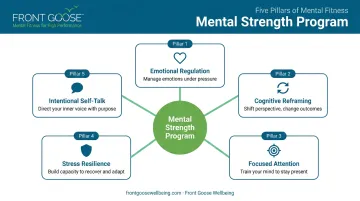
- A structured program builds five pillars: emotional regulation, cognitive reframing, attention, stress resilience, and intentional self-talk
- Short, consistent daily practices outperform occasional high-effort sessions for lasting neural change
- Skills trained in calm conditions must be applied under real pressure to become durable
- Professionals who train their minds alongside technical skills gain a measurable performance edge
What Mental Strength Actually Is (and What It Isn't)
Mental strength is the ability to regulate your emotions, direct your thoughts productively, and behave in alignment with your goals — regardless of circumstances. That definition matters because it's specific. It rules out two things people commonly confuse it with.
Willpower isn't the same thing. Willpower depletes under sustained demand — it's a finite resource. Mental strength is a trained capacity that stays functional when conditions get hard.
Suppression isn't toughness, either. Grinding through discomfort while ignoring your internal state leads to depletion, not resilience. Mental strength means responding deliberately to difficult emotions, not bypassing them.
Mental Strength vs. Mental Health
These terms are related but distinct. Mental health describes your overall psychological well-being — a spectrum everyone navigates. Mental strength is a trainable skill set built on top of that foundation.
You can have solid mental health and still fall apart in high-stakes negotiations. You can face genuine mental health challenges and still have a trained capacity to regulate your responses. The two are separate, and conflating them creates confusion about what mental fitness training actually addresses.
Why This Matters in Professional Settings
For business leaders and executives, poor mental strength shows up in concrete, costly ways:
- Reactive decision-making during high-pressure moments
- Diminished focus when cognitive demand peaks
- Slow recovery from setbacks, criticism, or failure
- Leadership behaviors under stress that erode team trust and performance
These are untrained mental patterns. And because they're patterns, they respond to deliberate practice — which is exactly what a structured mental strength program addresses.
The Neuroscience Behind Mental Toughness
Mental strength training isn't motivational theory. It's biology.
According to a 2023 NCBI clinical reference, neuroplasticity is the nervous system's ability to change its activity in response to internal or external stimuli by reorganizing its structure, functions, or connections. Every mental skill you practice — attention control, emotional regulation, cognitive reframing — physically changes the brain's architecture over time.
What Stress Does to Your Brain
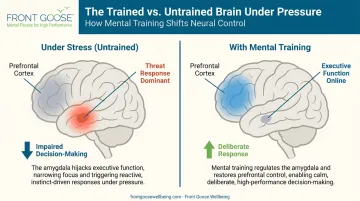
The prefrontal cortex (PFC) governs executive function: decision-making, impulse control, emotional regulation, and rational thinking. It's the part of your brain you most need in high-stakes professional situations.
Stress works directly against it. Research published in Nature Reviews Neuroscience by Arnsten (2009) shows that elevated stress hormones rapidly impair PFC operations and shift control toward the amygdala — the brain's threat-detection system.
Chronic stress is associated with PFC dendritic retraction and amygdala expansion. In plain terms: sustained pressure literally shrinks your access to the thinking you need most.
Daniel Goleman called this the "amygdala hijack" in Emotional Intelligence — when threat-detection overrides rational control and you react instead of respond.
For leaders, the practical consequence is direct: judgment gets biased toward fast, habitual reactions precisely when flexible reasoning is most valuable.
What Training Does Instead
Mental fitness practice reverses the dynamic. An eight-week mindfulness study by Hölzel et al., published in Psychiatry Research: Neuroimaging, found increased gray-matter concentration in the hippocampus and other regions associated with learning, memory, and emotional regulation among participants who completed an MBSR program, compared to controls.
A separate randomized controlled trial of 60 digital marketing employees found that a six-week mindfulness program produced measurable results compared to a half-day seminar control:
- Significantly reduced perceived stress
- Buffered declines in coping efficacy under sustained pressure
- Changed participants' functional stress response, not just their reported mood
The mechanism: consistent mental training strengthens the PFC's ability to stay online under pressure, creating a deliberate pause between stimulus and response. That pause is where better decisions live.
The Five Core Pillars of a Mental Strength Program
A legitimate mental strength program isn't a collection of random exercises. It's a structured approach targeting interconnected capacities. Front Goose Wellbeing's work with organizations like GE Aerospace, Kohler, and Woolpert is built on exactly this kind of architecture — each pillar developing a specific mental capacity that transfers directly to professional performance.
Pillar 1: Emotional Regulation
Emotional regulation is the trained ability to notice an emotional response and choose how to engage with it, rather than being driven by it. This is not suppression. It's the capacity to stay functional during discomfort — and keep performing while it's present.
For professionals, this shows up as:
- Maintaining composure in difficult conversations without shutting down
- Absorbing criticism without defaulting to defensiveness
- Making sound decisions while under pressure, rather than waiting until the pressure passes
Pillar 2: Cognitive Reframing
Cognitive reframing is the practice of deliberately shifting how you interpret a challenging situation: moving from threat perception to challenge perception. This is not toxic positivity. It's a grounded skill of finding accurate, useful perspectives on situations that feel overwhelming.
Consider a failed product launch. The instinct is to label it defeat. The reframe treats it as data: What worked? What didn't? What does the team know now that they didn't before? That shift isn't denial. It's what separates leaders who recover quickly from those who stay stuck in the loss.
Pillar 3: Focused Attention
Attention is the raw material of performance. What you direct it toward determines what gets built.
Microsoft's 2025 Work Trend Index, drawing on aggregated signals across 31,000 employees in 31 markets, found that 48% of employees and 52% of leaders experience their workday as chaotic and fragmented, with interruptions occurring roughly every two minutes during core hours. Under those conditions, the ability to return focus deliberately after disruption isn't a soft skill. It's the difference between high-output work and a day spent reacting.
Focused attention training builds the capacity to resist distraction, sustain concentration in high-cognitive-demand situations, and recover quickly after interruptions without accumulating the stress cost that fragmented work produces.
Pillar 4: Stress Resilience
Stress resilience is not the absence of stress. It's the ability to recover and adapt. The distinction between stress types matters here:
- Acute stress (a high-stakes presentation, a difficult conversation) is manageable and sometimes performance-enhancing when you're trained to work with it
- Chronic stress — sustained pressure without recovery — is erosive to both brain function and decision quality over time
This pillar includes both in-the-moment regulation techniques (breathwork, attentional anchoring) and deliberate recovery practices that restore mental capacity after high-demand periods.
Pillar 5: Intentional Self-Talk
Most professionals never audit their internal dialogue. That's a significant missed opportunity.
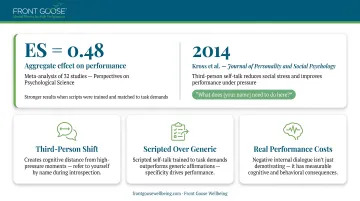
A meta-analysis of 32 studies published in Perspectives on Psychological Science found that self-talk interventions produced a moderate aggregate effect on performance (ES = 0.48), with stronger results when scripts were trained and matched to task demands. The brain processes self-directed language similarly to external instruction, meaning habitual negative self-talk creates measurable cognitive and behavioral consequences.
Research by Kross et al. (2014) in the Journal of Personality and Social Psychology added a practical tool: referring to yourself in the third person during introspection ("What does [your name] need to do here?") promoted psychological distance and improved performance under social stress. Key takeaways for practitioners:
- Third-person self-talk creates cognitive distance from high-pressure moments
- Scripted self-talk trained to task demands outperforms generic affirmations
- Negative internal dialogue isn't just demotivating — it has measurable performance costs
This isn't affirmation. It's a trainable cognitive tool.
How to Structure a Mental Strength Training Program
Start With a Baseline
Before any technique, you need awareness of your current mental patterns. Without a baseline, training lacks direction.
Useful starting questions:
- Where does pressure most consistently compromise my performance?
- What thought patterns show up when I'm under stress?
- What emotional states most frequently derail my decision-making?
This is Phase 1: Awareness. Most people skip it entirely, jumping straight to techniques — which reduces effectiveness because the training isn't targeted to their actual patterns.
Build a Layered Daily Practice
The structure that produces durable neural change is not occasional intensity. It's consistent brevity.
| Layer | Format | Examples |
|---|---|---|
| Daily foundation | 5–10 minutes | Breathwork, self-talk audit, attention anchoring |
| Weekly depth | 20–30 minutes | Extended reflection, visualization, reframing exercises |
| Real-world application | Ongoing | Deploying trained skills during actual high-pressure moments |
Phase 2 is Regulation — practicing specific techniques to shift unhelpful mental states. Phase 3 is Application — deploying those skills deliberately in real-world pressure moments. Each phase builds on the previous one.
Consider Structured Guidance
Self-directed practice builds the foundation. Structured guidance accelerates results — particularly for leaders and teams who need mental fitness to translate into measurable performance, not just personal wellness.
Megan Dittman at Front Goose Wellbeing designs programs grounded in neuroscience and built for workplace application. Her approach draws on certifications from the Chopra Institute and the Neuroleadership Institute, plus 25 years as a corporate HR executive at organizations including GE Aerospace, Kohler, University of Cincinnati, and Woolpert. Programs range from single-session workshops to multi-month cohort curricula.
Sustaining Mental Toughness Under Real-World Pressure
Pressure Inoculation
Mental strength trained in calm conditions must be tested under real pressure to become durable. The concept — Stress Inoculation Training, developed by Meichenbaum and Deffenbacher (1988) — involves three phases: conceptualization, skills acquisition and rehearsal, and application under graded pressure.
The practical application for leaders: treat high-stakes professional moments (important presentations, hostile questions, difficult decisions under time pressure) as training opportunities, not just performance tests. A brief, consistent pre-performance routine creates psychological anchoring that makes trained skills accessible precisely when you need them.
Recovery Is Training Too
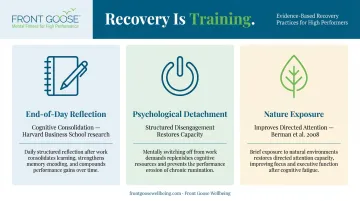
Just as physical muscles require rest to grow, mental capacity requires deliberate recovery. Three practices with solid evidence:
- End-of-day reflection — Research from Harvard Business School found that deliberate reflection improved subsequent learning performance compared to accumulating experience alone. This isn't journaling for wellness; it's cognitive consolidation.
- Psychological detachment — A meta-analysis found that structured interventions can improve employees' ability to disengage mentally from work during non-work time, which restores capacity for the next high-demand period.
- Nature exposure — Research by Berman, Jonides, and Kaplan (Psychological Science, 2008) found that brief nature walks or even viewing nature images improved directed-attention performance relative to urban conditions, supporting Attention Restoration Theory.
How Sustained Practice Rewires Your Baseline
Research comparing long-term meditators with short-term practitioners and controls (Kral et al., NeuroImage, 2018) found that sustained practice was associated with reduced amygdala reactivity to negative stimuli — a changed baseline, not just a temporary skill. Short-term training showed connectivity improvements; long-term practice showed structural change.
The implication is structural: sustained practice over months and years raises your resting floor — a baseline state of greater regulation, clarity, and resilience that persists even when you're not actively training.
Frequently Asked Questions
Can mental strength be trained?
Yes. Mental strength is trainable through neuroplasticity — the brain's ability to form and strengthen neural connections through repeated practice. Like physical fitness, it requires consistent, structured training rather than one-time effort. Measurable improvements in attention and stress response can appear within weeks of daily practice.
What is the difference between mental strength and mental health?
Mental health refers to overall psychological well-being across a spectrum that everyone navigates. Mental strength is a specific set of trainable skills — emotional regulation, cognitive reframing, focused attention — that anyone can develop regardless of their current mental health status. The two are related but distinct.
What are the 5 C's of mental toughness?
Clough's original MTQ model identifies four dimensions: Control, Commitment, Challenge, and Confidence. Some frameworks extend this to include Composure or Competitive spirit as a fifth element — though no single model is universally adopted.
What is mental strength therapy?
Mental strength therapy addresses underlying psychological barriers to resilience and performance. Mental strength training or coaching — like the work Front Goose Wellbeing delivers — is proactive and performance-focused, building mental fitness rather than treating clinical conditions. Both are valuable, but they serve different purposes and populations.
How long does it take to build mental strength?
Measurable improvements in attention, stress response, and emotional regulation can emerge within four to eight weeks of consistent daily practice. Brain structural changes associated with sustained mindfulness practice appear over longer timeframes — making mental strength an ongoing investment, not a one-time result.
What are the best daily exercises for mental toughness?
High-impact daily practices include diaphragmatic breathwork for nervous system regulation, intentional self-talk auditing, brief visualization or mental rehearsal, and end-of-day reflection. Short, consistent repetition matters more than the specific technique — five focused minutes daily produces more durable change than an occasional hour-long session.