
Introduction
It's 9 AM and you're already three meetings deep. Your inbox has 47 unread emails. Someone needs a decision by noon that you haven't had time to think through. Sound familiar?
For most working professionals, this isn't a bad day — it's Tuesday. And the standard advice to "just relax" or "take a deep breath" falls flat when your nervous system has been running at full throttle for months.
Chronic stress isn't a mindset problem — it's a neurological one. Mindfulness, not as a wellness trend but as a trainable cognitive skill, has decades of peer-reviewed research behind it demonstrating measurable changes in how the brain and body respond to pressure.
This article covers the neuroscience of why stress resists willpower alone, five techniques you can apply today, and how to build a daily practice that holds up under a real workload.
Key Takeaways
- Chronic stress physically shrinks the prefrontal cortex and enlarges the amygdala — making rational thinking harder when you need it most
- Regular mindfulness practice reverses these structural changes and lowers baseline cortisol
- Five to ten minutes of daily practice outperforms occasional longer sessions for long-term neurological change
- Mindful breathing, body scans, and the 3-3-3 method require no equipment and fit into any schedule
- Consistency beats intensity: small, repeatable habits drive lasting neurological change
Why Chronic Stress Demands More Than Willpower
What's Happening in Your Brain
When stress hits, your amygdala — the brain's threat-detection center — fires an alarm. Cortisol and adrenaline flood your system. Heart rate climbs. Muscles tighten. And critically, your prefrontal cortex — the part of the brain that governs rational thinking and emotional regulation — essentially goes offline.
Research published in Neuron confirms that acute stress impairs prefrontal cortex regulation by triggering high noradrenaline and dopamine release — making complex thinking genuinely harder, not just harder to access. You're not struggling to focus because you're weak. Your brain is doing exactly what evolution designed it to do.
The problem is what happens when this response never fully switches off.
The Long-Term Damage of Chronic Stress
Sustained stress exposure doesn't just feel exhausting — it restructures the brain. Studies on chronic stress effects show:
- Dendritic atrophy in the prefrontal cortex, reducing its capacity for clear thinking
- Volume loss in the hippocampus, impairing verbal memory and learning
- Hypertrophy of the amygdala, making the threat-detection system more reactive over time
- Elevated blood pressure, disrupted sleep, and suppressed immune function as downstream consequences
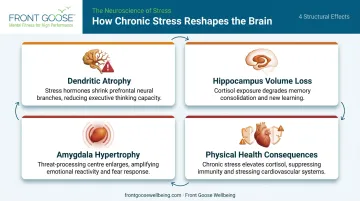
This creates a compounding loop: stress makes the brain worse at managing stress.
The Trainable Response
Here's the critical distinction — while some stress is unavoidable, your response to stress is not fixed. It's trainable. Neuroplasticity research bears this out consistently: mindfulness is a skill, not a personality trait. The brain physically changes as you train it — and that change is measurable.
How Mindfulness Rewires Your Brain's Stress Response
What Mindfulness Actually Is
Mindfulness is the practice of directing non-judgmental attention to the present moment. It has two core components: focused attention (deliberately directing where your mind goes) and acceptance (observing thoughts and sensations without reacting to them).
What it is not: clearing your mind completely, sitting still for hours, or achieving some state of blissful calm. Wandering attention is expected. Returning to focus is the practice.
The Neuroscience Behind It
The evidence for mindfulness as a brain-remodeling tool is substantial. A landmark study found that an 8-week MBSR program increased gray matter concentration in the hippocampus, posterior cingulate cortex, and temporo-parietal junction — regions tied to learning, memory, and self-awareness. Perceived stress reductions correlated directly with decreased gray matter density in the right basolateral amygdala.
Put plainly: the brain learns to pause before reacting.
Three additional effects emerge from the research:
- Mindfulness-based interventions significantly reduce salivary cortisol, with effects lasting up to four months
- Regular practice increases cortical thickness in areas governing body awareness and attention
- Present-moment awareness predicts stronger values-consistent behavior under pressure — meaning mindful people make better decisions when it's hardest to do so
MBSR and MBCT: The Evidence Base
Those neurological changes didn't emerge from casual practice — they came out of structured programs. Mindfulness-Based Stress Reduction (MBSR), developed at the University of Massachusetts Medical School, and Mindfulness-Based Cognitive Therapy (MBCT) are the two most rigorously studied formal frameworks. Dozens of meta-analyses confirm their effectiveness for reducing stress, anxiety, and depression. These aren't niche wellness experiments. They're evidence-based clinical tools now embedded in hospitals, corporations, and military training programs.
Why It Gets Easier Over Time
This is where neuroplasticity matters most. Every time you practice mindful attention, you strengthen specific neural pathways. The skill compounds. What feels effortful in week one feels automatic by month three. That shift is structural — measurable changes in gray matter density and cortical thickness, not just a better attitude. The practice builds on itself precisely because the brain adapts to whatever you repeatedly ask it to do.
Five Mindfulness Techniques for Daily Stress Relief
Mindful Breathing
The fastest entry point to the relaxation response is breathing — specifically, the extended exhale.
The basic technique: Inhale for a count of four, exhale for a count of six to eight. The extended exhale activates the parasympathetic nervous system, lowering heart rate within minutes. Two minutes at your desk before a difficult meeting can measurably shift your physiological state.
The 4-7-8 variation: Inhale for four counts, hold for seven, exhale for eight. Developed from yoga breathing principles, this structure is particularly useful for anxiety and pre-sleep wind-down. Research confirms that 4-7-8 breathing significantly decreases heart rate and systolic blood pressure in healthy adults.
Both approaches require nothing — no app, no equipment, no quiet room.
Body Scan Meditation
The body scan involves moving attention slowly from head to feet (or vice versa), noticing physical sensations without judgment. You're not trying to relax each body part; you're simply observing what's there.
Research on body scan practice found that an 8-week intervention decreased hair cortisol levels and the cortisol/DHEA ratio in participants — a meaningful physiological marker of stress reduction. Sessions run 10 to 20 minutes, making this practical for lunch breaks or evenings.
The 3-3-3 Grounding Technique
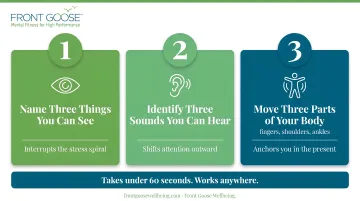
When stress or anxiety is acute — right before a presentation, mid-difficult conversation — the 3-3-3 method interrupts the spiral:
- Name three things you can see
- Identify three sounds you can hear
- Move three parts of your body (fingers, shoulders, ankles)
This snaps attention back to the present moment by engaging the senses rather than the ruminating mind. It takes under 60 seconds and works anywhere.
Mindful Movement
Yoga, tai chi, and mindful walking combine physical activity with present-moment awareness, activating both the relaxation response and endorphin release at once.
Harvard Health research on yoga supports its benefits for mental stress reduction, improved sleep quality, and chronic stress management. Mindful walking has shown significant reductions in perceived stress scores even in psychologically distressed individuals.
You don't need a studio or a mat. A 10-minute walk with deliberate attention to physical sensations — feet on ground, air temperature, sounds around you — counts.
Mindful Journaling
Where movement externalizes awareness, journaling turns it inward. A brief daily practice builds metacognitive awareness — the ability to observe your own thoughts rather than be consumed by them. A practical format:
- Note one or two stressors from the day
- Observe your emotional reactions without judgment
- Record three things you're genuinely grateful for
Research on brief gratitude writing interventions found decreased stress and negative affect even during high-stress periods. The mechanism is straightforward: writing trains the brain to observe its own patterns, which is the core skill all mindfulness practice builds.
Building a Daily Mindfulness Routine That Sticks
Start Smaller Than You Think You Should
Practice frequency predicts mental health outcomes more strongly than session duration. Research comparing 10-minute and 20-minute sessions found no significant difference in mindfulness gains between the two. Five consistent minutes beats 45 sporadic minutes.
The practical implication: don't wait until you have time. Start with one anchor habit.
A simple progression model for beginners:
| Timeframe | Practice |
|---|---|
| Weeks 1–2 | Two minutes of mindful breathing upon waking |
| Weeks 3–4 | Add a 10-minute body scan before sleep |
| Month 2 | Introduce mindful walking or evening journaling |
| Month 3+ | Experiment with longer sessions or formal guided meditation |
The goal is consistency over intensity — building a baseline practice that holds up even during high-pressure weeks.
Addressing the Common Barriers
Three objections come up consistently:
- "I don't have time" — Two minutes requires no schedule restructuring. Attach it to an existing routine: coffee, commute, or the gap between your last meeting and lunch.
- "My mind won't stop" — Correct. That's not a problem to fix. The practice is noticing when the mind wanders and gently returning. Each return is a rep.
- "I don't know if I'm doing it right" — If you're paying attention to the present moment and noticing when you're not, you're doing it right. There's no perfect form.
For professionals who want a structured framework with built-in accountability, working with a certified mindfulness instructor removes the guesswork. Front Goose Wellbeing's Mental Performance Coaching uses a three-phase model — Assessment, Education, and Strength Training — that builds mindful awareness, mindset, and mental rehearsal skills used by elite athletes, executives, and military operators.
Mindfulness at Work: Managing Stress in High-Performance Environments
The Business Case
The workplace is where most chronic stress originates, and it's also where mindfulness delivers some of its highest returns. The numbers from corporate implementations are difficult to ignore:
- Aetna reported an 11-to-1 ROI from its mindfulness program — gaining 62 minutes of productivity per week per employee (valued at $3,000 annually) while reducing healthcare costs by 7%
- SAP reported a 200% ROI, with each percentage point increase in their employee health culture index contributing up to €100 million to operating profit
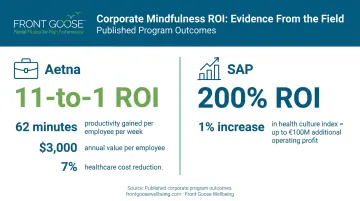
The financial returns are documented, repeatable, and tied to measurable business outcomes.
Three Micro-Mindfulness Habits for the Workday
No dedicated space required. These fit inside a normal workday:
Two-minute breathing reset between meetings — Before your next call starts, close the previous tab. Two minutes of extended-exhale breathing resets your nervous system so you enter the next conversation with full attention rather than residual frustration.
Single-task focus blocks — Turn off notifications. Give complete attention to one item for a defined interval (25–45 minutes). Switching costs are real — multitasking increases cognitive load and error rates. Single-tasking is a mindfulness practice in itself.
End-of-day transition ritual — Before shutting down, spend three minutes writing tomorrow's top three priorities and noting one thing that went well. This creates a mental boundary between work and personal time — a boundary that chronic stress tends to dissolve.
Building It at the Organizational Level
Organizations that build mindfulness into their culture see compounding returns. The skills transfer across contexts: leadership decisions, team communication, and stress recovery — in ways that a single workshop rarely sustains.
Front Goose Wellbeing's corporate programs, which have served clients including GE Aerospace and Kohler Corp, deliver structured, science-backed curricula that build mental fitness capacity across teams over weeks and months — not a one-day event and done.
Frequently Asked Questions
What is the 3-3-3 rule of mindfulness?
The 3-3-3 rule is a grounding technique where you name three things you can see, identify three sounds you can hear, and move three parts of your body. It anchors attention in the present moment and interrupts anxiety or stress spirals by engaging the senses rather than ruminating thoughts.
What are the 5 C's of mindfulness?
One widely cited framework includes Consciousness, Compassion, Confidence, Courage, and Community. Each quality develops through regular mindfulness practice, building from self-awareness inward toward compassion and outward toward connection with others.
What is the role of mindfulness in stress management?
Mindfulness reduces stress by lowering amygdala reactivity, decreasing cortisol production, and training the brain to pause before reacting automatically. With consistent practice, that pause grows — and so does a person's ability to respond deliberately rather than react on instinct.
How long does it take for mindfulness to reduce stress?
Research on MBSR programs shows measurable reductions in perceived stress within 4–8 weeks of consistent daily practice. Even a single session of mindful breathing can produce immediate short-term relief, though lasting neurological change requires sustained repetition over weeks.
Can mindfulness be practiced at work?
Yes — and the workplace may be the most practical place to use it. Breathing resets between meetings, single-tasking focus blocks, and brief end-of-day transition rituals take only minutes and require no special space or equipment. These micro-practices directly address the stress patterns most common in professional settings.