Introduction
A typical hospital shift involves hundreds of micro-decisions, sustained emotional labor with patients and families in crisis, and the ever-present weight of knowing that mistakes carry consequences most professionals never face. That kind of pressure doesn't just feel exhausting — it reshapes the brain over time.
Chronic, unrelenting stress that outpaces recovery isn't a personal failing. It's a physiological process, and in healthcare, the conditions for it are built into the job.
CDC data show that burnout among health workers reporting "often or very often" rose from 32% in 2018 to 46% in 2022. That trajectory points to a systemic problem — one that practical, evidence-based intervention can address.
This article covers the burnout crisis in healthcare, how mindfulness works neurologically, practical techniques designed for clinical schedules, and what organizations can do to make mental fitness a structural priority rather than a personal burden.
Key Takeaways
- Healthcare burnout rates nearly doubled between 2019 and 2021, threatening patient safety and staff retention.
- Mindfulness is a clinically studied practice that reduces stress and strengthens emotional regulation.
- Micro-practices lasting 2–5 minutes can be embedded into existing clinical routines without requiring dedicated downtime.
- Organizational commitment and individual practice are both required — neither works without the other.
- Healthcare leaders who model mindful behavior create the cultural permission that makes team-wide adoption possible.
The Burnout Crisis in Healthcare: Understanding the Scale of the Problem
How Bad Has It Gotten?
The numbers are stark. A national physician burnout survey from the AMA found that 45.2% of US physicians had at least one burnout symptom in 2023 — down from a COVID peak of 62.8% in 2021, but still higher than the 43.9% reported in 2017.
Nurses are tracking similarly. HRSA data show daily burnout rose from 11.8% in 2019 to 25.7% in 2021 — more than double in two years.
These aren't abstract statistics. They describe colleagues, department heads, and entire units operating in a state of chronic depletion.
The Three Dimensions of Clinical Burnout
The Maslach Burnout Inventory — the standard clinical tool for measuring burnout — identifies three distinct dimensions:
- Emotional exhaustion — the feeling of being drained beyond what rest can restore; common among nurses after back-to-back high-acuity shifts
- Depersonalization — a detachment or cynicism toward patients; a protective psychological response that erodes the patient-provider relationship
- Reduced personal accomplishment — a diminished sense of meaning or effectiveness, even when clinical outcomes are objectively good
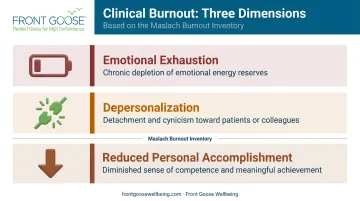
Each of these shows up differently depending on role, specialty, and setting — but all three tend to compound each other over time.
The Downstream Consequences
When those three dimensions compound unchecked, the effects reach well beyond the individual provider. Burnout doesn't stay contained. A BMJ review of 170 studies involving 239,246 physicians associated burnout with patient-safety incidents (OR 2.04), low professionalism (OR 2.33), and patient dissatisfaction (OR 2.22). A separate meta-analysis of 13 studies found burned-out physicians were 2.72 times more likely to self-report medical errors.
The financial toll compounds the clinical one. One published cost model puts physician burnout's annual cost to the US healthcare system at approximately $4.6 billion — driven by turnover and reduced clinical hours alone. That figure doesn't account for litigation exposure, recruitment costs, or the quieter drain of disengaged providers who stay.
What Is Mindfulness and Why Does It Work for Healthcare Workers?
A Precise Definition
Mindfulness is the intentional, moment-by-moment awareness of thoughts, feelings, and bodily sensations, practiced with non-judgmental acceptance. It's an active mental training discipline requiring deliberate attention — which is precisely why it resonates with results-driven, evidence-oriented professionals who are skeptical of anything that sounds like "just relax."
Its clinical roots trace to 1979, when Jon Kabat-Zinn developed Mindfulness-Based Stress Reduction (MBSR) at the University of Massachusetts Medical Center — an 8-week structured program that has since generated hundreds of peer-reviewed studies across medical and occupational settings.
The Neuroscience Behind It
Research using fMRI has identified specific brain-level changes associated with mindfulness practice:
- Prefrontal cortex activation increases — this region governs decision-making, focused attention, and emotional regulation
- Amygdala reactivity decreases — the amygdala drives the threat response; in healthcare environments, it is effectively in a near-constant state of mild activation
In a study of 49 healthy adults, brief mindfulness instruction increased prefrontal activation during anticipation of stressful stimuli and reduced right-amygdala activation (P=.024). A separate NeuroImage study found lower amygdala reactivity and greater prefrontal connectivity after short-term mindfulness training.
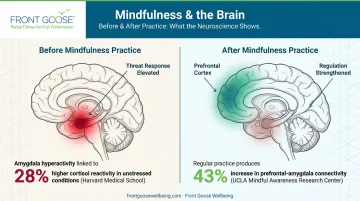
For healthcare workers operating in sustained alertness, this matters. Mindfulness doesn't eliminate the stress response — it trains the brain to regulate it more effectively, preserving the clarity needed for sound clinical decisions. That distinction also addresses one of the practice's most common misconceptions.
Not "Emptying the Mind"
Mindfulness does not require mental stillness. The practice involves noticing thoughts as they arise and returning attention to a chosen anchor:
- Breath — the most accessible starting point, requiring no equipment or setting
- Sensation — grounding attention in physical feeling (touch, temperature, tension)
- Movement — deliberate motion used as a focus point during walking or activity
This makes mindfulness far more accessible for clinicians who rarely experience mental quiet and might otherwise dismiss meditation as impractical.
Science-Backed Benefits of Mindfulness for Healthcare Workers
Stress and Emotional Exhaustion
A randomized workplace trial at the NIH Clinical Center enrolled 82 healthcare professionals and found that a 5-week mindfulness program produced statistically significant reductions in self-reported stress scores (PSS-10: 17.29 intervention vs. 18.54 control, P=.02). A separate 8-week MBSR trial with 148 medical residents did not eliminate emotional exhaustion outright, but did produce meaningful secondary gains:
- Improved personal accomplishment (d=.24)
- Increased mindfulness (d=.33)
- Greater self-compassion (d=.35)
Mindfulness isn't a universal fix for burnout's most severe dimension, but it reliably strengthens the underlying capacities that support recovery.
Focus, Attention, and Clinical Decision-Making
An uncontrolled 8-week study of 36 nurses found attendance-related improvements in sustained attention as measured by EEG alpha-power changes and P3 amplitude. For a field where lapsed attention has direct patient consequences, even modest attention improvements matter.
Empathy Without Overwhelm
A 6-week mindfulness intervention with 48 oncology nurse completers found significant reductions in compassion fatigue (F=18.60, P<.001), along with lower burnout and stress. This addresses one of healthcare's most persistent dynamics: providers who care deeply often absorb patient suffering until they have nothing left to give.
Mindfulness supports the ability to stay emotionally present with patients without crossing into emotional overwhelm — a clinically meaningful distinction.
Provider-Patient Communication
A multicenter study of 45 clinicians and 437 patients found that the highest-mindfulness clinicians were more than three times as likely to conduct patient-centered visits (adjusted OR 3.36). They were also associated with significantly higher patient satisfaction scores (adjusted prevalence ratio 1.45). More mindful providers listen differently. Patients notice.
Organizational ROI
Those individual clinical outcomes translate directly to organizational returns. Structured mindfulness training programs consistently demonstrate business-level results: SAP has reported 200% ROI on its corporate mindfulness investment, though these figures are company-reported and not independently audited.
The pattern across multiple large-scale programs is consistent — facilitated, structured training outperforms ad hoc self-help approaches in both adoption rates and measurable outcomes. For healthcare organizations weighing program design, that distinction matters as much as the underlying science.
Front Goose Wellbeing's corporate mindfulness programs are built on four mental fitness pillars — Mindful Awareness, Breathwork, Meditation, and Mental Rehearsal — and delivered by certified instructors with direct experience designing programs for high-demand professional environments.
| Study | Population | Key Finding |
|---|---|---|
| NIH Clinical Center RCT | 82 healthcare professionals | Significant stress reduction (PSS-10, P=.02) after 5-week program |
| MBSR Trial | 148 medical residents | Improved personal accomplishment, mindfulness, and self-compassion |
| EEG Attention Study | 36 nurses | Improved sustained attention (alpha-power, P3 amplitude) |
| Oncology Nurse Intervention | 48 nurses | Reduced compassion fatigue (F=18.60, P<.001); lower burnout and stress |
| Multicenter Communication Study | 45 clinicians, 437 patients | 3x more patient-centered visits; 1.45x higher patient satisfaction |
Practical Mindfulness Techniques Built for Healthcare Schedules
Healthcare workers don't have 45 minutes for seated meditation between patient rooms. These techniques are designed for clinical reality.
Micro-Breathing Practices
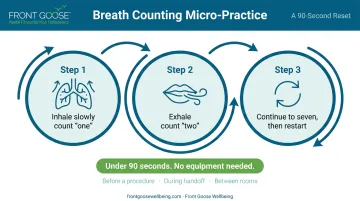
Breath counting is the most accessible entry point. The method:
- Inhale slowly and count "one"
- Exhale and count "two"
- Continue to seven, then restart
This takes under 90 seconds. No app, no quiet room, no prior experience required. Use it before a difficult procedure, during a handoff, or in the 30 seconds between rooms. Slowing the breath directly activates the parasympathetic nervous system, reducing the acute stress response.
Grounding and Body Scan Practices
Micro-breathing handles acute spikes. When a stress spiral takes hold mid-shift, a grounding exercise interrupts it without requiring you to leave the floor:
- Notice the physical sensation of your feet on the ground
- Feel the weight of your hands at rest
- Take three slow breaths, noticing the physical sensation of air moving in and out
The goal isn't relaxation — it's re-anchoring attention to present physical reality rather than a loop of mental projections about what might go wrong next.
Mindful Transitions
Every shift contains dozens of natural transition moments: walking between patient rooms, riding an elevator, washing hands. These are usually spent mentally racing ahead to the next task. Instead, treat them as 30-second mindfulness anchors.
During handwashing, for example: pay deliberate attention to the temperature of the water, the sensation of soap, the sound. Done consistently, this interrupts cognitive overload before it compounds — without adding a single minute to your shift.
Mindful Movement and End-of-Shift Decompression
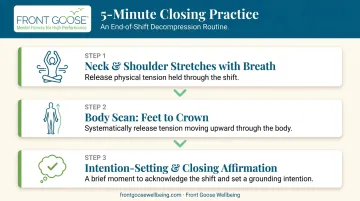
Transitions manage accumulation during the shift. The end-of-shift is where carried stress either gets released or gets taken home. A 5-minute closing practice helps draw that line:
- Simple neck and shoulder stretches synchronized with slow breath
- A body scan moving from feet upward, releasing tension consciously at each point
- A brief intention-setting moment: "The shift is over. I can let it go."
This creates a psychological threshold between professional and personal space. That boundary matters most over the long run, where shift-by-shift emotional residue is the primary driver of chronic burnout.
How Healthcare Organizations Can Build a Culture of Mindfulness
Why Individual Practice Alone Isn't Enough
Mindfulness is a meaningful tool. It is not a structural fix. When systemic stressors — chronic understaffing, inadequate administrative support, impossible caseloads — remain unaddressed, asking individuals to meditate their way through them is neither fair nor effective. The CDC/NIOSH and The Joint Commission both emphasize organization-level interventions as essential complements to individual resilience-building.
Organizational mindfulness support genuinely helps when it's taken seriously. Leaders who model mindful behavior — arriving to meetings grounded, listening without interrupting, holding boundaries around after-hours communication — send a clear cultural signal that well-being is a professional value, not a personal indulgence.
Concrete Steps for Healthcare Organizations
These are practical, low-barrier starting points:
- Open team huddles with 60 seconds of intentional breathing — normalizes the practice and takes zero extra time
- Designate a quiet decompression space: even a repurposed office signals institutional commitment
- Make well-being check-ins a standing leadership agenda item — "how is the team doing, really?" as routine, not crisis response
- Offer structured mindfulness training: single-session introductions build awareness; sustained change requires multi-week cohort programs with certified instructors
Structured Training vs. Ad Hoc Self-Help
There's a meaningful difference between sending staff a link to a meditation app and providing a structured, facilitated program grounded in published evidence. Structured programs give healthcare teams evidence-based techniques taught by credentialed instructors — that credibility matters in clinical cultures where staff evaluate everything through an evidence lens. Front Goose Wellbeing offers customizable in-person and virtual formats, from single sessions through multi-month curricula, designed to fit healthcare team realities.
CHROs, Chief People Officers, and healthcare HR leaders can start with a discovery call with Megan Dittman to scope what a program would look like for their teams.
The Organizational Return
The workplace mindfulness ROI evidence is consistent:
- Reduced self-reported stress and burnout symptoms in staff participating in structured programs
- Associations between clinician mindfulness and improved patient satisfaction scores
- Reduced compassion fatigue, which directly affects retention and care quality
These outcomes aren't just individual benefits — they show up on workforce metrics that healthcare organizations track and report.
Frequently Asked Questions
How can healthcare workers practice mindfulness during a busy shift?
Micro-practices — breath counting between rooms, mindful handwashing, a 30-second grounding exercise before a difficult conversation — require no dedicated time away from patients. The key is treating existing transition moments as deliberate reset opportunities rather than gaps to fill mentally.
How long does it take for mindfulness to reduce burnout symptoms?
Research on MBSR shows measurable stress reduction within 5–8 weeks of consistent practice — the NIH Clinical Center trial produced significant results in just 5 weeks. More severe emotional exhaustion may require longer sustained engagement before meaningful recovery takes hold.
What is the difference between burnout and everyday stress in healthcare?
Stress is acute and situational — it resolves when the stressor passes. Burnout is a chronic state defined by emotional exhaustion, depersonalization, and a diminished sense of accomplishment that doesn't recover with a weekend off. It requires deliberate, sustained recovery strategies.
Can mindfulness improve patient care outcomes?
A multicenter study found the highest-mindfulness clinicians were over three times more likely to conduct patient-centered visits and earn higher patient satisfaction scores. That attentiveness shows up directly in the quality of the clinical encounter.
How can healthcare organizations implement mindfulness programs for their teams?
Start with leadership buy-in, then embed short practices into existing team structures — huddles, shift transitions, pre-rounding check-ins. Partner with certified mindfulness training providers rather than relying on self-guided app subscriptions, which have significantly lower adoption and retention rates.
Is mindfulness effective for all types of healthcare workers, not just clinicians?
Research demonstrates benefits across physicians, nurses, administrative staff, and healthcare executives. Burnout is not exclusive to bedside roles — administrative and operational staff face their own sustained stressors. The practices simply need to be tailored to the specific pressures and rhythms of each role.