
Introduction
Most organizations know their people are stressed. Gallup's 2026 State of the Global Workplace report — drawing on data from over 141,000 workers — found 39% of employees and managers experience daily stress, rising to 46% among senior leaders. Yet most workplace responses follow a familiar, ineffective script: roll out a meditation app, book a one-off yoga session, check the wellness box.
The tools aren't the problem — the approach is. Yoga apps and one-off sessions don't build the cognitive capacity high-performing organizations actually need:
- Sustained focus under pressure
- Emotional regulation in high-stakes moments
- Clear decision-making in ambiguous situations
- Composed leadership instead of reactive management
That's the case for corporate mindfulness — not as a soft perk, but as a structured mental fitness discipline with a documented evidence base. Organizations including GE, SAP, Intel, and Aetna have deployed structured programs with measurable results.
This guide covers what corporate mindfulness actually is, the neuroscience behind it, the business case for leadership investment, practical techniques for any workday, and a step-by-step implementation roadmap.
Key Takeaways
- Corporate mindfulness is a science-based mental fitness practice, not a relaxation technique or wellness perk
- Research supports reduced stress and improved emotional regulation within 6–8 weeks of consistent practice
- Leadership modeling is non-negotiable — culture change cannot be delegated to an HR program alone
- Measure outcomes — stress levels, engagement, burnout rates — not just participation headcount
- Durable results come from building a mindful culture, not just a standalone mindfulness program
What Corporate Mindfulness Really Is (And What It Isn't)
Corporate mindfulness trains employees and leaders to be fully present, aware of their thoughts and environment without judgment, and capable of responding to situations rather than reacting on autopilot. It's grounded in neuroscience and decades of clinical research — not in any spiritual or religious tradition.
Meditation vs. Mindfulness: A Useful Distinction
These terms are related but not interchangeable:
- Meditation is the formal training practice — the equivalent of going to the gym
- Mindfulness is the mental skill that practice builds — the muscle you develop over time
Corporate programs use both formal sessions (guided meditation, structured courses) and informal micro-practices woven into the existing workday. Neither approach alone is sufficient; together, they create the conditions for durable change.
What Corporate Mindfulness Is Not
The most persistent misconception among skeptical business leaders: mindfulness is about relaxation or escaping pressure. It isn't.
Corporate mindfulness builds the cognitive capacity to perform under pressure — sharpening clarity, emotional control, and decision-making when the stakes are highest. The same mental fitness techniques used by Olympic athletes, military operators, and elite performers translate directly to corporate leadership performance. That's the foundation of Front Goose Wellbeing's approach.
The Spectrum of Practice
Corporate mindfulness exists on a spectrum:
| Practice Type | Examples | Time Required |
|---|---|---|
| Formal | Guided meditation, MBSR courses, breathwork sessions | 10–45 minutes |
| Informal | STOP technique, mindful listening, meeting "minute to arrive" | 60 seconds to 5 minutes |
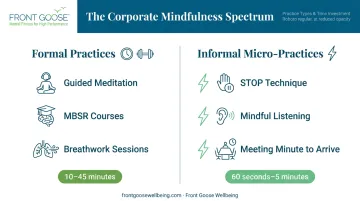
Both have measurable workplace impact. Informal practices are often the fastest entry point — they require no budget, no scheduling, and leaders can model them immediately.
The key framing: mindfulness works best when treated as a mental fitness system, not an isolated wellness benefit. The organizations seeing the greatest returns — SAP, Aetna, General Motors — didn't treat it as a one-off perk. They embedded it into how leaders operate.
The Business Case: Why Corporate Leaders Are Investing in Mindfulness
The performance argument for corporate mindfulness rests on two levels: what it does for individual employees, and what those individual changes aggregate into at the organizational level.
Employee-Level Benefits
Consistent mindfulness practice produces measurable individual improvements in:
- Stress and anxiety reduction
- Focus, concentration, and cognitive clarity
- Emotional regulation under pressure
- Resilience following setbacks or disruption
- Self-awareness and interpersonal effectiveness
These aren't soft outcomes. When enough people in an organization build these capacities, the collective result is a more adaptive, collaborative, and high-performing workforce.
Retaining that workforce is where the financial stakes become harder to ignore.
The Talent Retention Angle
Psychological safety and employer wellbeing investment are increasingly decisive in talent decisions. The APA's 2023 Work in America Survey found that 92% of U.S. workers say it's important to work for an organization that values their emotional and psychological well-being. Meanwhile, SHRM data shows 45% of burned-out workers are actively looking for another job — making burnout prevention a direct retention lever.
Why Most Wellness Programs Underperform
A 2019 randomized JAMA trial across 32,974 employees at 160 worksites found no significant effect on clinical measures, health spending, absenteeism, or job performance after 18 months — despite program rollout. Critically, only 35.2% of employees completed even one wellness module.
The lesson: participation metrics are not impact metrics. Tracking how many people attended a session tells you nothing about whether stress levels dropped, burnout risk decreased, or engagement improved.
Programs that sustain executive support — and produce real results — measure the right things:
- Changes in self-reported stress levels
- Shifts in employee engagement scores
- Absenteeism and presenteeism trends
- Reductions in burnout indicators
What you measure determines what you manage. The organizations seeing lasting results treat mindfulness as a cultural practice — tracked, iterated, and tied to specific business outcomes.
ROI: What the Evidence Actually Shows
Corporate mindfulness ROI figures circulate widely — Aetna, SAP, and General Motors numbers appear regularly in vendor materials. The underlying primary-source documentation for some of these figures is limited, and organizations should treat published benchmarks as directional indicators rather than guaranteed outcomes.
What's more useful: establishing your own baseline metrics before any program launches, so impact can be measured against your specific organizational context rather than generalized claims.
The Neuroscience Behind Mindfulness: Why It Actually Works
The business case for mindfulness isn't just behavioral — it's neurological. Regular practice produces measurable changes in brain structure and function that translate directly into the skills organizations need from their leaders.
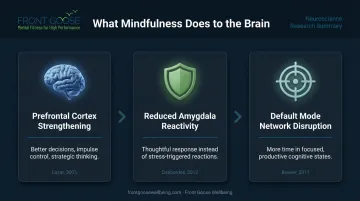
Three Key Brain Changes
1. Prefrontal cortex strengthening Research by Lazar et al. (2005) found that experienced meditators showed greater cortical thickness in prefrontal regions associated with attention and decision-making. A stronger prefrontal cortex supports better prioritization, impulse control, and strategic thinking — exactly what high-pressure leadership demands.
2. Reduced amygdala reactivity The amygdala is the brain's threat-detection center (the structure that triggers reactive, defensive responses under stress). A study by Desbordes et al. (2012) found that after 8 weeks of mindful-attention training, participants showed reduced amygdala response even outside of meditation practice. Leaders with lower amygdala reactivity respond thoughtfully instead of firing off defensive reactions in high-stakes moments.
3. Default mode network disruption When the mind isn't actively engaged, it defaults to distraction, rumination, and future-planning — the default mode network (DMN). Research by Brewer et al. (2011) found that experienced meditators showed significantly lower DMN activity than controls. An overactive DMN is a productivity drain. Mindfulness training builds the capacity to return to presence, where focused, high-quality work actually happens.
From Brain to Business Performance
These neurological changes aren't laboratory curiosities. They have direct workplace equivalents:
- Less amygdala reactivity → fewer reactive leadership decisions in high-stakes moments
- Stronger prefrontal cortex → better judgment under uncertainty
- Reduced DMN activation → more time in focused, productive cognitive states
This is the distinction between wellness programming and mental fitness training. Megan Dittman of Front Goose Wellbeing draws on her coaching certification from the Neuroleadership Institute, which builds neuroscience of leadership principles directly into corporate program design, alongside her Chopra Institute meditation instructor credentials. The combination bridges performance science with applied mindfulness practice rather than treating them as separate disciplines.
Mindfulness Practices That Fit Into a Busy Workday
Formal Practices for Corporate Settings
These structured practices are appropriate for weekly sessions, lunchtime series, or facilitated workshops:
- Breathing meditation (5–10 minutes): A focused attention practice directing awareness to the breath. Even brief sessions build the capacity to interrupt stress cycles and return to present-moment focus.
- Body scan: A structured practice directing attention sequentially through physical sensations, building body awareness and reducing physical tension associated with chronic stress.
- Guided seated meditation: Facilitated by an instructor or via audio, covering focused attention and open monitoring techniques — accessible to employees at any experience level.
These formal practices work best as components of a broader program, not standalone fixes. Research supporting stress reduction in workplace settings — including Allexandre et al.'s 8-week corporate call center study and Chin et al.'s digital marketing firm RCT — embedded short practices within a structured course rather than testing isolated sessions alone.
That structure matters. But for organizations not yet running a formal program, the highest-leverage starting point is often simpler.
Informal Micro-Practices for Daily Integration
These require no dedicated time block or budget:
- STOP technique: Stop, Take a breath, Observe, Proceed. A four-step pattern interrupt for stress cycles, useful before difficult conversations or high-stakes decisions.
- Mindful listening: Full presence during conversations — no phone checking, no mentally composing your response while the other person speaks. Improves both relationship quality and information retention.
- Minute to arrive: Beginning meetings with 60 seconds of silence or a single grounding breath before the agenda starts. Signals to the team that presence is valued and reduces carryover stress from the previous meeting.
- Pausing between tasks — rather than moving immediately from email to call to meeting — to close one context and open the next with intention.
Senior leaders can model these practices starting today — no budget, no vendor, no scheduling required. When leadership demonstrates presence visibly, it shifts what the organization treats as normal.
Building a Mindful Culture vs. Rolling Out a Mindfulness Program
Most organizations launch a mindfulness program. Far fewer build a mindful culture. The gap between those two outcomes determines whether the investment sticks.
A mindfulness program is a scheduled activity. It can be canceled, de-funded, or quietly dropped when the next initiative arrives.
A mindful culture is an organizational operating norm: where present-moment awareness and thoughtful response become default behaviors. Cultures sustain themselves because they're embedded in how work gets done, not added on top of it.
Why Leadership Modeling Is Non-Negotiable
Culture change cannot be delegated to HR. When senior leaders visibly practice mindfulness — opening meetings with a brief pause, acknowledging their own stress responses openly, speaking authentically about what the practice does for their decision-making — it creates psychological permission for everyone else to participate.
Without visible modeling from the top, even well-designed programs stall at voluntary participation from the people who were already on board. Leadership buy-in is what moves the practice from a niche interest to an organizational norm.
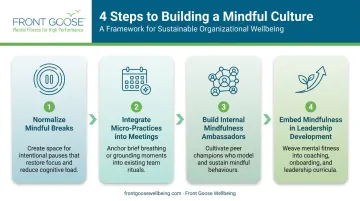
Four Practical Steps Toward a Mindful Culture
- Normalize mindful breaks without guilt : signal organizationally that stepping away to reset is a performance behavior, not a productivity failure
- Integrate micro-practices into existing meeting structures : the minute-to-arrive practice and STOP technique require no new calendar time
- Build internal mindfulness ambassadors : identify employees who engage deeply and equip them to model and share practices with peers
- Make mindfulness language part of leadership development vocabulary : when concepts like emotional regulation, present-moment awareness, and reflective response appear in performance reviews and leadership frameworks, they carry real organizational weight
How to Implement Corporate Mindfulness: A Practical Roadmap
Step 1: Secure Leadership Buy-In
Frame mindfulness as a strategic performance investment, not a wellness add-on. The language that moves C-suite decision-makers:
- Productivity improvement
- Retention and reduced turnover cost
- Healthcare cost reduction
- Engagement score improvement
Identify an internal champion — ideally at the C-suite or VP level — who will model participation publicly, not just sponsor it nominally.
Step 2: Audit Your Specific Pressure Points
Generic templates don't move the needle. Before designing anything, identify what's actually driving performance problems:
- Is the primary issue chronic stress and burnout?
- Communication breakdown and reactive leadership?
- Focus and cognitive load from information overload?
- High turnover in specific functions or leadership tiers?
The diagnostic step ensures the program addresses real organizational pain rather than a generalized version of corporate stress.
Step 3: Design a Flexible, Accessible Program Structure
Start smaller than feels necessary. A weekly 10-minute guided session or a four-week lunchtime series generates early data, builds momentum, and allows for adjustment before scaling.
Offer multiple formats to meet employees where they are:
- Live facilitated sessions (in-person or virtual)
- Brief daily micro-practices embedded in team routines
- On-demand content for asynchronous access
Organizations looking for a structured, science-backed approach can partner with specialists like Front Goose Wellbeing, whose programs are grounded in Neuroleadership Institute principles and certified mindfulness instruction. With clients including GE Aerospace, Kohler Corp, and the University of Cincinnati, Front Goose Wellbeing delivers everything from single-session workshops to multi-month cohort curricula — shaped around what each organization actually needs.
Step 4: Measure What Actually Matters
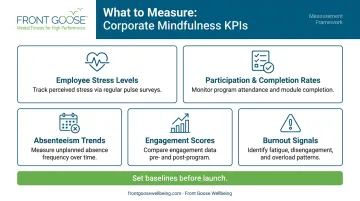
Set KPIs before the program launches. Impact metrics worth tracking:
- Employee stress levels via pulse surveys before, during, and after the program
- Participation and completion rates as a leading indicator (not the primary outcome)
- Absenteeism trends across departments with and without program exposure
- Engagement scores benchmarked against pre-program baseline
- Burnout signals caught through manager check-ins or anonymous survey tools
Without pre-set benchmarks, it's nearly impossible to connect program activity to business outcomes — and that connection is what keeps executive support alive through the next budget cycle.
Frequently Asked Questions
What are the 4 types of mindfulness?
The four types are focused attention (anchoring on breath or a single object), open monitoring (observing thoughts without attachment), loving-kindness (building compassion toward self and others), and body awareness (tuning into physical sensations). Corporate programs draw from all four depending on whether the goal is focus, emotional regulation, relationship quality, or stress recovery.
What is corporate mindfulness and how is it different from personal meditation practice?
Corporate mindfulness refers to structured, workplace-integrated programs teaching mindfulness and meditation skills in a business context — designed to improve performance, resilience, and team dynamics. Unlike personal practice, it is built around organizational goals, delivered in group formats, and evaluated against business outcomes rather than individual wellbeing alone.
How do you build a mindful culture rather than just a mindfulness program?
Culture change requires three things:
- Leadership modeling — senior leaders visibly practicing and normalizing mindfulness
- Language integration — mindfulness concepts embedded in performance and development frameworks
- Structural embedding — micro-practices woven into existing meetings and workflows
Scheduling sessions alone won't produce cultural change.
How long does it take to see results from a corporate mindfulness program?
Workplace and neuroscience studies detect measurable changes in stress levels, focus, and emotional regulation after 6–8 weeks of consistent practice. Organizational-level shifts — engagement scores, absenteeism trends, retention improvements — typically become visible over 3–6 months with sustained commitment and ongoing measurement.
What ROI can companies expect from corporate mindfulness training?
ROI varies by program design and organizational context — published figures from programs at companies like SAP and Aetna range from 200% to over 1,000%, but results depend heavily on how outcomes are defined and measured. The most reliable approach: establish baseline metrics before launch (stress scores, engagement, absenteeism) and track changes against them over time.
How do you get skeptical executives to support a corporate mindfulness initiative?
Lead with business performance language — productivity, retention costs, healthcare spending, engagement scores — and reference peer-company examples from Fortune 500 organizations. Offer a brief experiential practice before asking for commitment, so skeptics feel the cognitive effect firsthand. Then propose a small, measurable pilot rather than full-scale investment upfront.