
Introduction
Olympic sprinters do it in the call room before the gun fires. Navy SEALs do it before missions. Elite surgeons do it before picking up a scalpel. The shared practice isn't a warm-up routine or a pre-performance ritual. It's a structured cognitive discipline called mental rehearsal.
Most professionals prepare for high-stakes moments the wrong way. They review the deck one more time, rehearse talking points in the shower, or simply hope their experience carries them through. What they skip entirely is deliberate mental preparation — the kind that actually changes how the brain performs under pressure.
That gap is expensive. Whether you're walking into a board presentation, a critical negotiation, or a difficult leadership conversation, the neural wiring you bring into that room was built long before you stepped through the door.
Here's what the science says — and what to do with it.
Key Takeaways
- Mental rehearsal activates the same neural circuits as physical action — grounded in neuroscience, not self-help philosophy
- Process visualization consistently outperforms outcome visualization in controlled research
- Vividness and consistency matter more than session length — short, focused daily practice compounds
- Mental rehearsal applies to cognitive and emotional performance, not just physical skills
- A structured, personalized protocol accelerates results faster than self-directed practice alone
What Happens in Your Brain During Mental Rehearsal
The Neural Overlap Is Real
When you vividly imagine performing an action, your brain activates many of the same regions engaged during actual execution. A meta-analysis by Hetu et al. combining 75 neuroimaging studies found that motor imagery consistently recruited a frontoparietal network, subcortical regions, and the cerebellum — the same network used during physical movement.
One important nuance: the primary motor cortex (M1) is not consistently activated during imagery the way it is during execution. The overlap is substantial and real, but not identical. Anyone claiming mental rehearsal is "the same as doing it" is overstating the evidence. What the research does confirm is that the functional overlap is extensive enough to drive measurable skill improvements.
How Mental Practice Rewires the Brain
In a landmark study, Pascual-Leone et al. had participants practice a piano sequence through mental practice alone over five days. The result: TMS measurements showed expanded motor cortical maps and lower activation thresholds for task-relevant muscles. After just one physical practice session, the mental-practice group matched the performance of participants who had practiced physically for the full five days.
This is the Hebbian mechanism in action — "neurons that fire together, wire together." Repeated, coordinated neural firing during mental rehearsal strengthens the pathways used during real execution. The brain doesn't require a physical movement to initiate plasticity. It just requires sufficiently vivid, repeated simulation.
What does this look like in practice? The same mechanism applies across skill types:
- Motor skills: Musicians, surgeons, and athletes use imagery to groove technique without physical repetition
- Cognitive sequences: Executives rehearse presentations, negotiations, or high-stakes conversations mentally before executing them live
- Emotional regulation: Repeated simulation of staying composed under pressure trains the brain's response to actual stress
The Role of the Prefrontal Cortex
Mental rehearsal isn't only useful for physical skills. Research on episodic future thinking shows that the prefrontal cortex (particularly the ventromedial and medial regions, responsible for decision-making and emotional integration) integrates anticipated emotions, social context, and complex sequences during mental simulation.
This is why cognitive rehearsal works for executives navigating difficult conversations or leading teams through change. The brain is simulating not just movements, but decisions, contingencies, and emotional responses — which means the neural pathways built through rehearsal are just as relevant in a boardroom as on a playing field.
Mental Rehearsal Techniques That Actually Work
Not all mental rehearsal produces equal results. Vague positive visualization is not the same as structured mental practice. Technique selection matters.
First-Person Motor Imagery
This technique involves closing your eyes and mentally performing a skill from the inside: feeling the kinesthetic sensations, hearing relevant sounds, sensing the environment as if you're actually there.
Research comparing imagery perspectives shows that first-person imagery preferentially recruits somatosensory and inferior-parietal regions more associated with motor execution, while third-person imagery engages different networks tied to observation.
Two principles sharpen this technique:
- Multisensory engagement — recruit as many senses as possible (sight, sound, touch, proprioception). Kinesthetic imagery in particular activates motor-associated brain structures more strongly than visual imagery alone
- Temporal matching — research supports pacing your mental rehearsal to match the real-world timing of the action, rather than running through it in fast-forward. Dynamic imagery that mirrors actual movement duration produces higher technical quality ratings than static or motionless imagery
For procedural or physical skills — a sales pitch delivery, a precise surgical technique, an athletic movement — first-person motor imagery is the most neurologically engaged approach.
Process Visualization vs. Outcome Visualization
Outcome visualization — imagining the standing ovation, the signed contract, the trophy — feels motivating. Research suggests it may actually undermine performance. Kappes and Oettingen found that positive fantasies about idealized futures reduced energization, producing lower systolic blood pressure and less reported motivation than engaging with current obstacles. The proposed mechanism: the brain partially "enjoys" the imagined reward and reduces the drive to pursue it.
Process visualization produces the opposite effect. In Pham and Taylor's study, students who visualized the study process studied 16.07 hours on average versus 11.57 hours for outcome-focused students, and scored 80.60% versus 72.57% on their exams. The mediating factors were better planning and reduced anxiety — not a vague motivational boost.
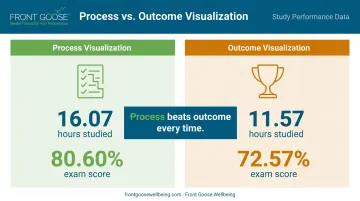
The rule: rehearse the steps, decisions, and behaviors — not just the outcome.
Cognitive Rehearsal for High-Stakes Situations
This is mental rehearsal adapted for non-physical, high-pressure performances: board presentations, difficult feedback conversations, negotiations, team conflict. The protocol:
- Map the scenario chronologically — from the opening moment through likely decision points
- Rehearse contingencies — mentally walk through "if this happens, I do this" branches
- Include emotional rehearsal — specifically visualize yourself feeling calm and composed at the moments where anxiety typically peaks
The stress inoculation component is well-documented. Arora et al.'s surgical study found that structured mental practice before simulated procedures produced median cortisol levels of 2.26 vs. 3.85 nmol/L, average heart rate of 72 vs. 88 bpm, and lower subjective stress scores. All results favored the mental rehearsal group.
The mechanism is familiarity: rehearsed scenarios feel less novel when they arrive, which reduces the acute stress response.
For corporate professionals, this translates directly. Mentally rehearsing a difficult performance conversation, including the employee's likely reactions and your planned responses, is precisely what elite athletes do before competition. The domain differs; the cognitive process is the same.
How to Build a Mental Rehearsal Practice
Session Structure
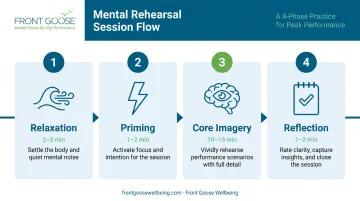
A practical session follows four phases:
- Relaxation (2-3 minutes) — slow breathing or a brief body scan to calm the nervous system
- Priming (1-2 minutes) — a short physical or mental warm-up tied to your target task
- Core imagery (10-15 minutes) — apply your chosen technique with full sensory engagement
- Reflection (1-2 minutes) — rate imagery vividness on a 1-10 scale and track progress over time
Note: research confirms that even abbreviated relaxation (progressive muscle relaxation or slow breathing) meaningfully improves imagery vividness — especially for people with higher baseline anxiety.
Frequency and Vividness
Research protocols support practicing several sessions per week for effects to accumulate meaningfully. A meta-analysis by Paravlic et al. found that protocols around three sessions per week over four weeks produced moderate strength gains from motor imagery alone. A separate study found that four 13-minute sessions per week outperformed three or five sessions for a specific motor task.
What both findings point to: consistency outweighs any single session. Vividness also improves with practice — beginners often find imagery flat or hard to sustain. Rating your vividness after each session creates a feedback loop that speeds up development.
Matching Technique to Goal
| Goal Type | Recommended Technique |
|---|---|
| Physical or procedural skill | First-person motor imagery |
| Goal pursuit, complex project | Process visualization |
| Upcoming high-pressure event | Cognitive rehearsal |
| Combined goals | Two techniques, one session |
For executives applying these techniques to high-stakes corporate moments, Front Goose Wellbeing's 1:1 Mental Performance Coaching builds a personalized protocol through three structured phases — Assessment, Education, and Strength Training. Coaching adds accountability and shortens the time it takes to build a reliable practice, which matters most when the pressure is real and the margin for error is small.
Mental Rehearsal for Business Leaders and Executives
The same neurological mechanisms that sharpen an Olympic athlete's performance apply directly to the cognitive demands of executive leadership. The brain doesn't distinguish between a podium and a boardroom — it responds to vivid, deliberate rehearsal the same way.
Concrete Corporate Applications
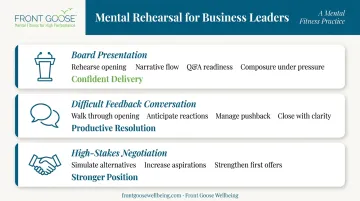
- Board presentation — mentally rehearse the opening, the narrative arc, the Q&A, and specifically the two or three questions most likely to surface. Rehearse your composure during a difficult challenge from a board member
- Difficult feedback conversation — walk through the conversation chronologically: your opening, the employee's likely reaction, your response to emotional pushback, the close
- High-stakes negotiation — research by Schaerer et al. found that mentally simulating strong alternatives increased negotiators' aspirations and first offers, producing more profitable agreements — particularly for negotiators in lower-power positions
The Team Dimension
Mental rehearsal also scales to teams. A review of eight studies covering 268 participants found that pre-event mental rehearsal in surgical teams significantly improved teamwork and nontechnical skill outcomes. Three studies in the review showed significant results for team coordination (p < .01 for nontechnical skills, p = .036 for delay/danger incidents).
For leadership teams facing major organizational events — a restructuring announcement, a high-stakes client pitch, a critical all-hands — structured pre-event cognitive rehearsal can reduce collective performance anxiety and increase execution consistency.
Business Outcomes
The neuroplasticity mechanisms driving athletic performance gains are the same ones driving productivity, focus, and stress resilience in corporate settings. That's why mental rehearsal is one of four core pillars in Front Goose Wellbeing's Corporate Mindfulness Training programs, alongside Mindful Awareness, Breathwork, and Meditation. Leaders who train this capacity deliberately don't just feel more prepared — they perform measurably better when the pressure is real.
Common Mental Rehearsal Mistakes to Avoid
Mistake 1: Visualizing the Outcome Instead of the Process
Picturing the applause, the signed contract, or the promotion feels like rehearsal — it isn't. Process-first rehearsal builds the neural pathways for the behaviors that produce the outcome. Research in sports psychology shows that outcome-only visualization can actually reduce the motivational energy available to pursue the goal.
Mistake 2: Skipping the Relaxation Phase Before Imagery
Jumping straight into imagery without settling the nervous system first produces low-vividness, unfocused rehearsal. Two to three minutes of slow breathing before beginning is not optional prep — it changes the neurological quality of what follows. The nervous system needs a settled baseline to generate vivid, effective mental imagery.
Mistake 3: Quitting During the Invisible Progress Phase
Neural changes accumulate before performance changes become visible — the same pattern as any physical training program. Most people who abandon mental rehearsal do so in the first two to three weeks, precisely when the underlying rewiring is occurring but hasn't yet surfaced as observable improvement. Consistent practice through this early phase is what separates those who improve from those who quit.
Frequently Asked Questions
What is mental rehearsal?
Mental rehearsal is the structured practice of vividly imagining yourself performing a task — engaging multiple senses to simulate the experience before it happens in real life. Unlike casual daydreaming, it is sensory-rich and tied to specific performance goals.
Why do athletes use mental rehearsal?
Research confirms it activates many of the same motor and cognitive neural circuits as physical practice, building pathways that improve real-world execution. It also reduces pre-performance anxiety by making the scenario feel familiar before it actually occurs.
What is mental rehearsal also called?
Mental rehearsal is also referred to as visualization, mental imagery, guided imagery, and cognitive rehearsal. The terms are largely interchangeable, though each may emphasize a slightly different application; kinesthetic imagery, for instance, emphasizes physical sensation over visual detail.
How long should a mental rehearsal session be?
Most research protocols use 10-20 minutes, but five focused minutes of high-vividness rehearsal outperforms longer, unfocused sessions. Consistency and imagery quality matter more than raw duration.
Can mental rehearsal help with workplace performance?
Yes. Mental rehearsal improves performance in any domain involving cognitive sequences or emotional regulation, including presentations, negotiations, leadership under pressure, and decision-making. The brain processes imagined and real scenarios through overlapping neural circuits, which is why the transfer to real-world performance is measurable.
What is the difference between mental rehearsal and positive thinking?
Positive thinking focuses on believing in a favorable outcome. Mental rehearsal involves actively simulating the specific steps, decisions, and sensations involved in achieving it. One is an attitude; the other is a structured neurological training practice with documented research support.