

Mental fitness is the ongoing practice of building cognitive sharpness, emotional steadiness, and resilience through deliberate habits. It's not about treating mental illness; it's closer to conditioning the brain the way an athlete conditions the body — proactively, consistently, and with measurable results.
This article covers the neuroscience that makes mental fitness trainable, six evidence-backed daily practices, and what it means to build resilience as a skill rather than inherit it as a personality trait.
Key Takeaways
- Mental fitness is a trainable skill — the brain rewires itself through repeated practice, a process called neuroplasticity
- Resilience isn't toughness; it's the built capacity to respond rather than react under pressure
- Daily habits — not occasional interventions — create lasting improvements in focus, stress tolerance, and decision-making
- Both individuals and organizations see real returns: companies that invest in mental fitness training report productivity gains of 20–37% and stress reductions of 30–40%
What Is Mental Fitness — and Why High Performers Can't Ignore It
Mental Fitness vs. Mental Health
Mental health refers to the presence or absence of psychological conditions — anxiety, depression, burnout. Mental fitness is something different: proactive training that builds peak psychological performance before problems arise.
The analogy is direct. You don't wait until you're injured to start exercising — you build physical capacity ahead of demand. Mental fitness applies the same logic to the brain, and like physical training, it works across multiple dimensions.
The Four Core Dimensions
Research points to four interconnected dimensions of mental fitness:
- Emotional — self-regulation, resilience, emotional awareness
- Cognitive — focus, working memory, decision-making quality
- Social — communication, connection, relational intelligence
- Physical — sleep, exercise, and nutrition as the foundation that makes the others possible
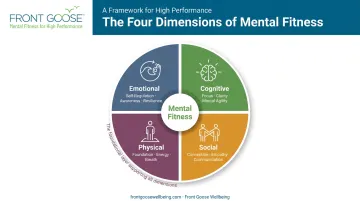
None of these operates in isolation. Poor sleep degrades emotional regulation. Chronic stress impairs decision-making. Strong social connection buffers stress responses. The dimensions reinforce or erode each other constantly.
Why Leaders Can't Run on Default
Leaders face a specific set of cognitive demands that expose weak mental fitness quickly: high-stakes decisions under time pressure, sustained attention across long days, managing team dynamics while regulating their own reactions. A brain that's untrained and chronically depleted becomes a liability in that environment — not a leadership asset.
According to the APA's 2023 Work in America survey, 57% of US workers reported at least one burnout-associated effect, including emotional exhaustion, reduced motivation, and lower productivity. Meanwhile, Gallup's 2026 State of the Global Workplace report estimates that global employee disengagement now costs $10 trillion — roughly 9% of global GDP — in lost productivity.
Mental fitness is the capacity to stay clear, focused, and effective even when stress is present — and at the leadership level, stress is nearly always present. That's precisely why building it proactively matters.
The Neuroscience Behind Mental Fitness: How Your Brain Actually Changes
Neuroplasticity in Plain Language
The brain is not fixed. It forms and reorganizes neural pathways based on repeated thoughts, behaviors, and experiences — a property called neuroplasticity. Every mental fitness habit you practice shapes the brain's structure and function over time.
Think of a field with no defined path. Walk the same route repeatedly, and a clear trail emerges. The more often a thought pattern or stress response is triggered, the more automatic it becomes. This is both the problem and the opportunity.
Automatic negative reactions — snapping under pressure, catastrophizing, freezing on hard decisions — are well-worn neural trails. Mental fitness training is the deliberate practice of forging new ones.
The Stress-Brain Connection
When you perceive a threat, the amygdala activates and floods the system with stress hormones. Short-term, that response is useful. The problem is chronic activation.
Research by Arnsten shows that uncontrollable stress-related signaling rapidly weakens prefrontal cortex function — the brain region responsible for rational thinking, decision-making, and emotional regulation — while strengthening amygdala-driven reactive responses. Under chronic stress, the brain defaults to habitual, emotionally reactive behavior precisely when clear thinking is most needed.
What Training Actually Does
Mental fitness practices work by interrupting automatic, unhelpful neural loops and replacing them with deliberate ones. The goal is to make thoughtful, regulated responding the brain's new default — especially under pressure.
Practices that build this capacity include:
- Mindfulness — trains present-moment attention, reducing amygdala reactivity over time
- Single-tasking — rebuilds sustained focus disrupted by chronic multitasking and stress
- Intentional self-awareness — creates the pause between stimulus and response where choice lives
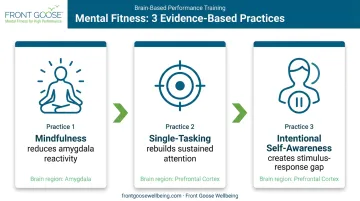
Consistent practice matters more than occasional effort. That's not metaphor — it's how neural change actually works.
Mental Fitness Tips to Train Your Brain Daily
These aren't one-off interventions. Practiced consistently, they compound into measurable cognitive and emotional strength.
Mindfulness Meditation
Mindfulness meditation has the strongest research support of any mental fitness practice for building focus, emotional regulation, and stress resilience.
A study by Basso et al. found that 13 minutes of daily meditation for eight weeks — but not four weeks — improved attention, working memory, mood, and reduced anxiety in healthy novice meditators. The finding matters: brief daily practice accumulates into meaningful change, but only with consistency.
How to start if you've never meditated:
- Sit quietly with your back supported
- Focus attention on the sensation of breathing — the breath entering, the breath leaving
- When the mind wanders (it will), notice that it has wandered
- Gently return attention to the breath
That act of noticing and returning is the training. Each redirect is a mental rep. The mind wandering isn't failure — it's the exercise.
Single-Tasking and Focused Attention
Multitasking fragments cognitive performance. Research on task-switching shows it increases stress, frustration, and time pressure — and the cognitive costs of switching between tasks are real, even when the tasks feel routine.
Single-tasking — giving one task your full, uninterrupted attention — trains the prefrontal cortex and builds sustained focus as a skill.
Two implementation strategies that work:
- Time-block in focused sprints — 25 to 50-minute intervals of single-task work, with no switching
- Engineer your environment — phone in another room, notifications off, one browser tab open
The environment either supports focus or undermines it. High performers often absorb far more disruption than their output reflects — until they don't.
Intentional Rest and Mind-Wandering
When the brain is not focused on a task, it activates the default mode network — regions involved in creativity, memory consolidation, and problem-solving. Deliberately giving the brain unstructured downtime isn't laziness — it's how the brain integrates what it's learned.
Build 5–10 minutes of intentional mind-wandering into each day: no phone, no input, no agenda. Just sitting with your own thoughts.
This is where high performers push back hardest. Doing nothing feels unproductive. What's actually happening: your brain is processing, connecting, and consolidating the inputs you've been feeding it all day. The stillness is doing work.
Physical Exercise
Cardiovascular exercise increases blood flow to the brain, triggers release of BDNF (brain-derived neurotrophic factor), and stimulates dopamine and serotonin production. A meta-analysis of 29 studies found that a single exercise session increased circulating BDNF with a Hedges' g of 0.46 — a meaningful effect on the molecule most associated with neuron growth and brain connectivity.
The cognitive benefits of acute exercise are real, though modest on average. What matters for mental fitness is consistency, not intensity. Choose movement you'll actually sustain:
- Walking or hiking (low barrier, high compliance)
- Yoga or Pilates (adds flexibility and breath training)
- Cycling or swimming (joint-friendly, easily scheduled)
The habit that sticks produces the results. A punishing regimen abandoned after three weeks produces none.
Quality Sleep
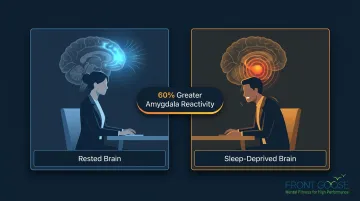
Sleep is when the brain consolidates memories, clears metabolic waste including stress hormones, and restores the prefrontal cortex's capacity for rational thinking. Chronic sleep deprivation is one of the fastest ways to erode mental fitness.
A landmark experiment found that sleep deprivation produced 60% greater amygdala reactivity — meaning a sleep-deprived brain is dramatically more emotionally reactive and far less capable of regulated, thoughtful response.
Three sleep hygiene practices for high performers:
- Set a consistent sleep and wake time, including weekends
- Create a wind-down routine that excludes screens for at least 60 minutes before bed
- Treat sleep as a non-negotiable performance input — not a luxury to sacrifice when the calendar fills up
Gratitude Practice and Cognitive Reframing
The brain has a negativity bias — it weights threats and losses more heavily than equivalent positives. Gratitude practice works against this default by deliberately activating neural circuits associated with positive emotion.
Writing down three specific things you're grateful for each day isn't soft self-help. Research by Emmons and McCullough found that gratitude groups reported better subjective well-being compared to control groups who focused on neutral or negative events. The effect is dose-dependent: specificity matters more than volume.
Pair gratitude with cognitive reframing — the practice of viewing challenges as temporary, solvable, or growth-producing rather than catastrophic. Carol Dweck's decades of mindset research show this shift isn't just motivational framing; practiced consistently, it rewires the automatic interpretive patterns your brain applies under pressure. That's where resilience actually lives.
Building Resilience: The Mental Fitness Skill That Matters Most
What Resilience Actually Is
The APA defines resilience as "the process and outcome of successfully adapting to difficult or challenging life experiences, involving mental, emotional, and behavioral flexibility." That means adapting while under pressure — staying functional, clear-headed, and action-oriented while the stress is still active, not just recovering after the fact.
That's a trainable capacity, not a personality trait. And it's built before crisis hits, not improvised in the moment.
Practice Your Reactions Before You Need Them
Resilience skills must be rehearsed when you're calm, not invented in the moment of crisis. A study of 81 military officer cadets found that resilience training delivered before an acute stress exercise produced meaningfully better stress appraisal and lower cortisol levels afterward compared to controls — the strongest effects came from preparation, not reaction.
This means:
- Identify your personal stress triggers in advance
- Write down specific coping phrases or grounding strategies that work for you
- Run through them regularly so they're accessible when the pressure is real
That last point is where structured practice becomes a performance tool. At Front Goose Wellbeing, Mental Rehearsal formalizes this process: pre-experiencing high-stakes moments with composure and clarity before they happen, a technique used by Olympic athletes, military special operations, and performing musicians that translates directly to executive performance.
Two Daily Resilience Habits
1. Pause for emotional check-ins. Two or three times a day, scan how you're feeling mentally and physically. Use the breath to release tension before it accumulates. This prevents the slow build of unaddressed stress that eventually produces reactive, impaired behavior.
2. Seek purposeful discomfort. Deliberately do small things outside your comfort zone: a difficult conversation you've been avoiding, a new physical challenge, a presentation without notes. Each instance trains the brain's threat-response system to be less reactive to the unfamiliar. Over time, the threshold for what triggers a stress response rises.
Mental Fitness for High-Performing Teams and Organizations
Individual mental fitness creates the foundation. When organizations build it systematically across teams, the cumulative effect shows up in business metrics: stronger decision-making, reduced absenteeism, lower stress-related turnover, and sustained focus under pressure.
Workplace mindfulness programs consistently show improvements in perceived stress, burnout, and self-reported productivity. Corporate-level data supports the investment: Aetna reported an 11:1 ROI on its mindfulness programs, while SAP documented 200% ROI — figures that span prevention and broader support, not mental fitness training alone.
What Mental Fitness-Forward Teams Do Differently
- Leaders model self-regulation and emotional awareness — not just expect it from their teams
- Team norms protect focus time and recovery, rather than rewarding constant availability
- Practices like mindfulness, intentional communication, and stress management are treated as professional skills, not personal wellness choices

The distinction matters. When mental fitness is framed as an individual wellness perk, uptake is low and impact is scattered. When it's embedded in how the team operates and led from the top, it changes organizational behavior.
That's the model Megan Dittman of Front Goose Wellbeing works from: 25 years as a corporate HR executive at organizations including GE, Kohler, and Woolpert, paired with certifications from the Neuroleadership Institute and Chopra Institute. The training is grounded in both neuroscience and operational reality — built for how leadership teams actually function, not how generic wellness programs are designed.
CHROs, L&D leaders, and executives can schedule a discovery call with Megan through the Front Goose Wellbeing website to explore a program designed around their organization's specific needs.
Frequently Asked Questions
What are the 7 pillars of mental fitness?
The pillars vary by framework, but commonly include emotional regulation, focus, resilience, social connection, physical health, sleep, and purpose. None of these operate in isolation — strengthening one reliably lifts the others.
How is mental fitness different from mental health?
Mental health refers to the presence or absence of psychological conditions. Mental fitness is the proactive, ongoing practice of building cognitive and emotional strength. They're related but distinct — similar to how physical health and physical fitness are connected but not the same thing.
How long does it take to build mental fitness?
Improvements in focus, stress tolerance, and emotional regulation can be noticeable within weeks of consistent daily practice. Meaningful, lasting change in neural pathways requires months of sustained habit-building — the same timeline you'd expect from physical conditioning.
Can mental fitness improve performance at work?
Corporate mindfulness programs at companies like Google, SAP, and Aetna have shown documented gains in productivity, focus, and creativity alongside reductions in stress-related absenteeism. The results are real — and they scale with the quality and consistency of the program.
What are the signs of poor mental fitness?
Common indicators include difficulty concentrating, emotional reactivity, persistent fatigue despite adequate sleep, feeling overwhelmed by routine demands, and recurring negative thought loops. These are signals to begin training (not diagnoses), and consistent practice is exactly what moves the needle on each one.