Introduction
Ray Dalio meditates twice a day and credits it as the single most important reason for his success at Bridgewater. Steve Jobs studied Zen Buddhism throughout his career and used it to sharpen creative focus. Jeff Weiner, former CEO of LinkedIn, treats his daily meditation block as untouchable. When three leaders operating at that level share one habit, it's worth understanding why.
Entrepreneurship extracts a specific cognitive toll. You're making dozens of high-stakes calls daily, managing people and uncertainty simultaneously, and doing it without the organizational buffer that employees have. That sustained mental load degrades the brain functions you rely on most — measurably and progressively.
This is where meditation enters — not as a relaxation habit, but as a performance tool with documented neurological effects. Research shows it produces structural changes in the brain regions governing focus, decision-making, and emotional regulation. For entrepreneurs, those aren't wellness benefits. They're competitive advantages.
This article covers the science, the specific business benefits, how top leaders actually apply it, and how to build a practice that fits an impossible schedule.
Key Takeaways
- Regular meditation produces measurable changes in brain regions critical to leadership: decision-making, stress response, and creative thinking
- Research shows even a single 15-minute session can reduce bias and improve decision quality under pressure
- Ray Dalio and Jeff Weiner have both credited daily meditation as central to how they lead under pressure
- Consistency matters more than duration — five minutes daily builds measurable cognitive gains
- Structured, science-based programs accelerate results for leaders seeking guided, accountable practice
Why Entrepreneurs Face Unique Mental Demands
Unlike employees, founders absorb the full cognitive load of strategy, operations, people, and vision — all at once, every day. There's no manager to escalate to, no safety net when a decision goes wrong. That structural reality creates a specific kind of mental depletion that generic stress advice doesn't address.
One concrete manifestation: decision quality degrades over sustained periods of high-stakes choices. Research on judicial decisions found that favorable rulings dropped substantially before breaks compared to after them — a pattern that suggests cognitive fatigue shapes outcomes regardless of a case's merits. For entrepreneurs making dozens of consequential calls each day, this isn't abstract.
The mental health data on founders is sobering. A survey of 242 entrepreneurs published in Small Business Economics found significantly elevated lifetime rates compared to non-entrepreneurs:
- Depression: 30% of founders vs. general population norms
- ADHD: 29% lifetime prevalence
- Bipolar disorder: 11% — with 32% reporting two or more conditions
- Mental exhaustion: 16.2% of self-employed individuals reported feeling often or always depleted
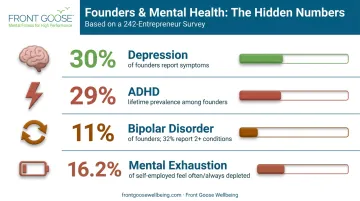
That chronic low-level stress directly impairs the cognitive functions founders rely on most. Research on acute burnout shows measurably reduced executive function during high-stress periods — and recovery isn't guaranteed without deliberate intervention.
The Neuroscience Behind Meditation for Business Success
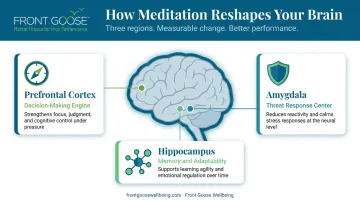
Meditation is not relaxation. It produces structural and functional changes in the brain through neuroplasticity — consistent practice literally rewires neural architecture. Three regions matter most for leaders.
The Prefrontal Cortex: Your Decision-Making Engine
The prefrontal cortex governs executive function: planning, focus, impulse control, and deliberate decision-making. A landmark study by Lazar et al. found greater cortical thickness in prefrontal regions among experienced meditators compared to matched controls. That was a cross-sectional finding, so pre-existing differences can't be ruled out. But it aligns with functional attention and working-memory improvements documented in controlled training studies. For a leader making dozens of high-stakes calls daily, a stronger prefrontal cortex isn't abstract. It's the difference between deliberate choices and reactive ones.
The Amygdala: Getting Out of Threat Mode
The amygdala is the brain's threat-detection center. Chronic stress keeps it in near-constant activation, which hijacks rational thinking and narrows perspective. In an eight-week MBSR study, Hölzel et al. found that reductions in perceived stress correlated with decreased gray-matter density in the right basolateral amygdala. Longer-term practitioners show a different reactivity pattern still — research comparing meditators averaging 9,081 lifetime hours found lower amygdala reactivity, particularly to negative stimuli. The practical implication: meditation trains leaders to respond to setbacks rather than react to them.
The Hippocampus: Memory, Learning, and Adaptability
Prolonged cortisol elevation — the biochemical signature of chronic stress — is associated with smaller hippocampal volume and worse memory performance. The hippocampus is where memory consolidates, where learning takes hold, and where the ability to update your thinking when circumstances shift actually lives. An eight-week mindfulness program showed increased gray-matter concentration in the left hippocampus compared to a wait-list control group. For an entrepreneur who needs to learn fast from failure and adapt strategy quickly, hippocampal health is the difference between getting stuck and getting better.
Stronger prefrontal function, a calmer amygdala, and a more resilient hippocampus don't operate in isolation. Under pressure, they work together — and that's exactly where leadership performance is won or lost.
5 Ways Meditation Drives Entrepreneurial Growth
Sharper Focus and Sustained Attention
Distraction is expensive. In a business environment saturated with notifications, competing priorities, and back-to-back meetings, the ability to stay locked on high-priority work is a measurable competitive advantage.
Controlled studies support meditation's role here:
- A three-month intensive retreat study found significantly improved perceptual discrimination and vigilance on sustained attention tasks
- A randomized trial of meditation-naive participants found improved accuracy and attention-related brain activity after a brief focused-breathing session
- Two weeks of mindfulness training improved working-memory capacity and reading comprehension while reducing mind-wandering
The populations in these studies were mostly students, not executives — so direct extrapolation has limits. But the attention mechanisms being trained are the same ones founders rely on for complex problem-solving and strategic thinking.
Smarter Decision-Making Under Pressure
Stress narrows thinking. It increases susceptibility to cognitive shortcuts and escalation of commitment — the tendency to throw good money after bad because you've already invested heavily.
Research from INSEAD and Wharton found that a single 15-minute focused-breathing session reduced sunk-cost bias compared to mind-wandering, with mediation analyses linking the result to reduced past-and-future focus and lower negative affect. For entrepreneurs who face irreversible resource decisions regularly, this is a specific and actionable finding — not just a general wellness benefit.
Enhanced Creativity and Innovation
Not all meditation styles produce the same cognitive effects. This distinction matters for entrepreneurs.
Research from Leiden University found that open-monitoring meditation — a style that observes thoughts without attaching to them — improved divergent thinking performance, specifically fluency and flexibility. Focused-attention meditation didn't produce the same effect. A separate randomized trial found that seven days of integrative body-mind training improved divergent thinking more than relaxation training.
If innovation is the priority, style matters. Open-monitoring practice generates the loose associative thinking behind new ideas; focused-attention practice sharpens concentration for execution. Build both into your practice depending on what the week demands.
Resilience and Emotional Regulation
Resilience isn't a fixed personality trait. It's a trainable capacity — and meditation builds it by strengthening the neural pathways governing emotional regulation.
For founders, this shows up in specific, high-stakes scenarios:
- Processing a failed product launch without catastrophizing or overreacting
- Having a difficult conversation with a co-founder or investor without defensiveness
- Staying grounded during uncertainty so you don't project anxiety onto your team
A well-regulated stress response keeps you out of reactive mode — and that's where the real advantage compounds. Founders who can stay composed under pressure make faster, cleaner decisions when it matters most.
Stress Reduction That Protects Long-Term Performance
The emotional regulation built through meditation practice connects directly to how your body handles stress over time. Acute stress sharpens performance. Chronic, unmanaged stress destroys it — through burnout, deteriorating health, and progressive cognitive decline.
A meta-analysis of meditation interventions found that meditation reduced cortisol, with stronger effects in at-risk samples than healthy ones. Effects varied by study design and population, so a universal reduction percentage would overstate the evidence — but the direction is consistent. For entrepreneurs whose baseline stress is chronically elevated, even a modest cortisol reduction compounds into meaningful protection over the long arc of building a business.
How Top CEOs and Executives Actually Use Meditation
The business leaders who have publicly championed meditation represent some of the most successful operators in recent history — and they treat it as seriously as any strategic discipline.
| Leader | Practice | Attributed Benefit |
|---|---|---|
| Ray Dalio (Bridgewater Associates) | Transcendental Meditation, twice daily | Open-mindedness, equanimity, creativity, higher-level perspective |
| Steve Jobs (Apple) | Zen-influenced mindfulness | Focus, simplicity, intuition — credited by biographer Walter Isaacson as shaping his design thinking |
| Jeff Weiner (LinkedIn, former CEO) | Daily mindfulness practice | Compassionate management, clarity under pressure |

Ray Dalio has been the most direct. His published principles state that TM is "the single most important reason" for his success — a personal attribution rather than a controlled study, but a meaningful one from the architect of the world's largest hedge fund.
Corporate adoption has moved well beyond individual executives. Aetna conducted a randomized trial of 239 highly stressed employees and found both mind-body intervention groups reduced perceived stress compared to control. The widely repeated per-employee savings figures of $2,000 in healthcare costs and $3,000 in productivity are executive estimates, not outcomes from that study — worth noting before citing them as verified ROI.
Google's Search Inside Yourself program was evaluated in a study of 123 employees across three offices, showing gains in mindfulness and emotional intelligence. A promising result, though the study lacked a randomized control design.
The consistent pattern across these leaders isn't the specific technique. It's the intentionality. Meditation is treated as a consistent, non-negotiable mental fitness practice the same way competitive athletes treat physical training.
How to Build a Meditation Practice That Fits a Leader's Schedule
The most common objection is time. It's also the easiest to dismantle. Research on meditation benefits shows measurable cognitive and emotional improvements from as little as five to ten minutes of daily practice. The compounding returns in decision quality and focus more than offset the time cost — but only if the practice is consistent.
Start with One of These Approaches
Three styles suit business leaders well:
Focused attention / breath meditation — The simplest entry point. Anchor attention on the breath, return it when it wanders. Builds concentration and regulates the stress response. No experience required.
Body scan or mindfulness check-in — A 3–5 minute reset between high-pressure meetings. Useful for interrupting the stress-accumulation cycle mid-day rather than trying to recover at the end of it.
Open-monitoring meditation — Less structured; the practitioner observes whatever arises without directing attention. Supports creative thinking and perspective-taking. Better suited to leaders with some baseline practice.
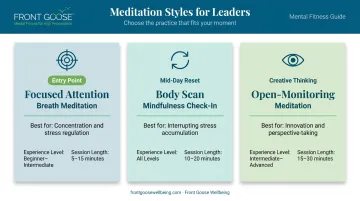
These are starting points, not rigid prescriptions. The best practice is the one you'll actually do.
Build Consistency, Not Duration
The research on meditation benefits is most pronounced with consistent daily practice — even at low durations — rather than occasional long sessions. Three practical strategies for making it stick:
- Anchor to an existing routine. Morning coffee, before opening email, post-commute. Attaching a new habit to an existing one dramatically increases follow-through.
- Use a transition moment as a cue. The five minutes before a key meeting, or after hanging up from a difficult call, is a natural insertion point.
- Track the practice. Even a simple calendar mark creates accountability and makes the streak visible — consistency compounds faster when it's measurable.
When to Consider Structured Guidance
Self-directed practice works for many leaders, particularly with a focused technique and genuine commitment. For leaders who want to accelerate that progress, structured programs provide technique instruction, accountability, and a framework tied to measurable performance outcomes — advantages that are hard to replicate through self-directed practice alone.
Front Goose Wellbeing's corporate mental fitness programs are built for that context. Megan Dittman — Certified Meditation Instructor from the Chopra Institute, executive coach credentialed through the Neuroleadership Institute, and a 25-year corporate HR executive at organizations including GE and Kohler — designs programs around the neuroscience of leadership performance. The content is grounded in how leaders actually operate under pressure, not adapted from a consumer wellness curriculum.
That operational fluency changes how the work lands with executive audiences.
A discovery call is the first step for every engagement. You can schedule one at frontgoosewellbeing.com.
Frequently Asked Questions
What is meditation in business?
Meditation in business refers to the intentional use of mindfulness and focused-attention techniques in a professional context to improve performance outcomes — including focus, decision-making, stress management, and leadership effectiveness. Treated as mental fitness training, it's a performance discipline — not a wellness indulgence.
Do CEOs meditate?
Many of the world's most successful CEOs practice meditation regularly. Ray Dalio, Steve Jobs, and Jeff Weiner are among the most documented examples. Meditation is increasingly viewed as a strategic performance habit rather than a personal wellness practice.
Can meditation improve decision-making for entrepreneurs?
Yes. Meditation reduces the stress-induced cognitive interference that drives reactive and biased decisions. Research from INSEAD and Wharton found that even a single 15-minute mindfulness session meaningfully improved resistance to sunk-cost bias under pressure.
How long should a business leader meditate each day?
Research shows benefits begin with as little as five to ten minutes of daily practice. Consistency matters more than session length — brief daily practice compounds into measurable cognitive and emotional improvements over time.
Which mantra is powerful for business success?
Practices like Transcendental Meditation and Primordial Sound Meditation — both used by leaders like Ray Dalio — use personally assigned mantras to quiet mental activity and build deep focus. Front Goose Wellbeing's retreat curriculum includes a Primordial Sound Meditation course with a personal mantra ceremony for this reason. Ultimately, the specific mantra matters less than practicing it consistently.
What are the 4 R's of meditation?
Many teachers use a 4 R's mnemonic to help practitioners redirect wandering attention — common elements include Recognize, Release, Relax, and Return. Sequences vary slightly across traditions, but the purpose is consistent: a structured cue to notice distraction and return to focus without self-judgment.