According to APA's 2023 Work in America Survey, 77% of U.S. workers experienced work-related stress in the previous month. That's not a fringe problem. It's a near-universal one.
This guide breaks down what actually causes workplace stress, how it damages both individual health and team performance, and what employees and leaders can do about it. You'll also find a quick-reference checklist at the end — designed to work as a printable or PDF resource — along with answers to the questions people search most on this topic.
Key Takeaways
- Workplace stress falls into identifiable categories — recognizing the source is half the solution
- Unmanaged stress degrades health, decision-making, and team output — all at once
- Mindfulness, breathwork, and boundary-setting have measurable, science-backed impact on stress reduction
- Leaders shape their team's stress levels more than most realize
- Structured mental fitness training produces resilience that holds under sustained pressure
What Causes Stress in the Workplace?
Workplace stress follows predictable patterns. Researchers and occupational health bodies have mapped the root causes clearly — and understanding them is the first step to addressing them.
The Four Root Categories
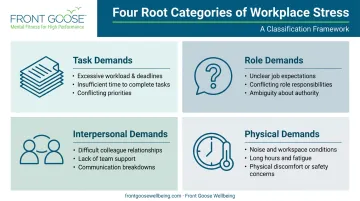
The UK Health and Safety Executive's Management Standards framework organizes work stressors into six domains — demands, control, support, relationships, role, and change — which map neatly onto four root-cause categories:
- Task demands — excessive workload, job insecurity, unrealistic deadlines
- Role demands — unclear expectations, conflicting responsibilities
- Interpersonal demands — difficult relationships, leadership style, personality friction
- Physical demands — poor workspace, long hours, inadequate recovery time
The Most Common Stressors Employees Report
When workers report their own experience, the same stressors surface repeatedly:
- Excessive workloads with no slack in the system
- Low autonomy — little control over how or when work gets done
- Unclear performance expectations
- Poor or inconsistent communication from leadership
- Limited growth opportunities
- Inadequate social support at work
Acute vs. Chronic Stress
These stressors don't all hit the same way — and the distinction matters for how organizations respond.
Acute stress — triggered by a deadline or a difficult conversation — is short-term. The body mobilizes, the threat passes, and recovery follows.
Chronic stress is different. It's ongoing, systemic, and often invisible until it compounds into something harder to address. For both individuals and organizations, chronic workplace stress is what drives burnout, erodes decision-making quality, and quietly hollows out retention.
How Workplace Stress Impacts Performance and Health
Stress doesn't confine itself to one area. It degrades cognitive performance first, then physical health, and eventually shows up on the organizational balance sheet.
Short-Term Cognitive Effects
Under stress, the brain prioritizes survival over complex thinking. The result:
- Difficulty concentrating on multi-step tasks
- Impaired decision-making — reactive choices instead of deliberate ones
- Reduced creativity — the ability to generate novel solutions drops
- Shorter fuse — interpersonal friction increases
A 2016 meta-analysis of 51 studies confirmed that acute stress significantly impairs working memory and cognitive flexibility. For leaders managing high-stakes decisions, that's not a minor inconvenience.
Long-Term Health Consequences
When stress stays elevated without adequate recovery, the physiological damage accumulates:
- Elevated anxiety and increased risk of clinical depression
- Chronic insomnia and disrupted sleep architecture
- High blood pressure and cardiovascular strain
- Weakened immune response
WHO and ILO data found that working 55+ hours per week — versus a standard 35–40 — was associated with a 35% higher stroke risk and 17% higher risk of death from ischemic heart disease. Stressed employees also tend to cope through behaviors — poor diet, alcohol, disengagement — that compound the underlying problem.
The Organizational Cost
Stress is a business issue, not just a personal one. The financial consequences are direct and measurable:
- Absenteeism rises as stress-related illness pulls employees offline
- Presenteeism — showing up but underperforming — often costs more than absences
- Turnover accelerates when chronic stress goes unaddressed, triggering replacement costs that Gallup estimates at 50–200% of annual salary
- Team performance erodes as disengagement spreads across peer groups
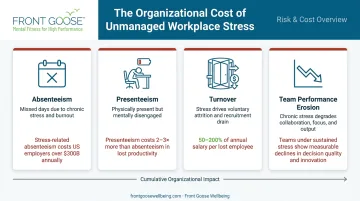
Organizations absorb these costs regardless of whether they attribute them to stress.
Practical Strategies for Employees to Manage Workplace Stress
Identify and Track Your Stressors
Keep a brief stress journal for one to two weeks. Note which situations, people, or tasks consistently trigger a stress response — and what time of day they tend to cluster.
The goal isn't venting. It's pattern recognition. When you can name what stresses you and when, your brain shifts from automatic, reactive mode into deliberate problem-solving mode. That shift alone changes how you respond.
Set Boundaries and Protect Recovery Time
In an always-on work culture, recovery doesn't happen by accident. It requires deliberate structure:
- No-email rules after a set hour — decide when work communication ends
- Hard stops at the end of the workday — a defined end time, not "when things slow down"
- Intentional use of vacation time — actual disconnection, not checking in from the beach
Recovery isn't a luxury. Neurologically, the brain uses downtime to consolidate learning and restore emotional regulation — and skipping it carries compounding performance costs.
Practice Evidence-Based Relaxation Techniques
Three accessible techniques that have research support:
Box breathing — inhale for 4 counts, hold for 4, exhale for 4, hold for 4. This directly activates the parasympathetic nervous system, countering the stress response within minutes. Usable at a desk, before a meeting, or mid-crisis.
Mindfulness — observing present-moment experiences without judgment. Regular practice links to reduced perceived stress and improved job satisfaction. It doesn't require an app or a cushion — even brief, intentional attention to breath or surroundings counts.
Body scan or progressive muscle relaxation — a systematic practice of noticing and releasing tension held in different muscle groups. Effective as a desk-break reset or an end-of-day wind-down.
Manage Energy, Not Just Time
Time management alone doesn't solve the stress problem — energy does. The distinction matters because a packed calendar feels different depending on your physical and emotional state.
Practical applications:
- Take breaks every 90–120 minutes, aligned with natural ultradian rhythms rather than arbitrary willpower
- Eat lighter meals during the workday to avoid the afternoon cognitive dip
- Use breathing techniques to regulate emotional reactions before they escalate
- Build a transition ritual at the end of the workday — a short walk, a change of clothes, a few minutes of quiet — that signals to your nervous system that work is done
Reframe Your Relationship with Stress
Research by Crum, Salovey, and Achor, published in Journal of Personality and Social Psychology (2013), found that people who viewed stress as enhancing — rather than debilitating — reported better health, higher performance, and different physiological responses. A 2024 meta-analysis reinforced this, confirming a statistically significant performance benefit (d = 0.23) from stress-reappraisal interventions.
The practical framework from Stanford's Mind and Body Lab uses three steps:
- See it — name the stress rather than suppress or deny it
- Own it — recognize that stress signals something that matters to you
- Use it — channel the heightened arousal toward the task, rather than fighting the feeling
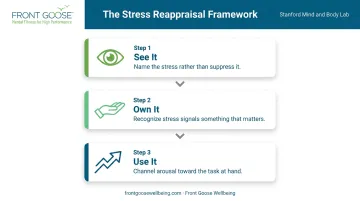
The framework doesn't minimize the difficulty. It gives you a repeatable way to move through stress rather than stall in it.
The Science Behind Stress: Why Mental Fitness Techniques Work
Understanding what happens in the brain under stress explains why generic "stress tips" often fail — and why training the brain differently produces lasting change.
What Happens Under Stress
When the brain perceives a threat, the amygdala fires an alarm signal. Cortisol floods the system. The prefrontal cortex (responsible for planning, emotional regulation, and sound decision-making) becomes less effective. That's why stress makes people reactive, impulsive, and creatively stuck. The brain is in survival mode, not strategic mode.
This is also why telling someone who's overwhelmed to "just breathe" without any actual practice behind it rarely works. Under real pressure, untrained stress responses run on autopilot.
Neuroplasticity: How the Brain Changes
Neuroplasticity — the brain's capacity to rewire itself through repeated practice — is the foundation of mental fitness training. This isn't metaphor; it's documented physiology.
Research by Holzel et al. (2011) found that eight weeks of mindfulness-based stress reduction produced measurable increases in gray matter density in the hippocampus and other regions linked to learning, emotional regulation, and self-awareness.
A companion study by Desbordes et al. (2012) found that the same training altered amygdala responses to emotional stimuli — even when participants weren't actively meditating.
Consistent mental fitness practice changes the brain's default stress-response patterns, not just the symptoms.
Mindfulness in the Workplace: What the Research Shows
A 2019 meta-analysis by Bartlett et al., covering 23 randomized controlled trials, found that workplace mindfulness training reduced perceived stress with a moderate effect size (Hedges' g = 0.56). A broader 2020 synthesis covering 56 RCTs found improvements across perceived stress, psychological distress, and wellbeing.
These are meaningful results — especially because they come from controlled trials, not self-selected wellness enthusiasts.
Where Science Meets Corporate Application
That research base is what separates structured mental fitness training from generic wellness initiatives — and it's the foundation Front Goose Wellbeing builds every program on.
Founder Megan Dittman combines mindfulness, breathwork, meditation, and mental rehearsal into programs designed specifically for high-performing corporate teams. Her credential stack spans:
- Certified Meditation Instructor, Chopra Institute
- Board Certified Health & Wellness Coach (NBC-HWC)
- Executive Coach certified through The Neuroleadership Institute
Organizations including GE Aerospace, Kohler Corp, and the University of Cincinnati have worked with Front Goose to deliver science-based mental fitness training to their leadership teams and broader workforces. The goal is training the brain to perform under pressure.
What Leaders and Organizations Can Do to Reduce Team Stress
Individual coping strategies only go so far. The structure of work itself — how it's designed, communicated, and supported — shapes stress levels more than any personal technique.
Create Psychological Safety and Open Communication
Leaders set the emotional tone. When employees feel safe raising concerns without fear of judgment or retaliation, stress surfaces earlier — and gets addressed before it compounds into turnover or health crises.
Practical steps:
- Have proactive conversations about workload and role clarity outside of formal performance reviews
- Ask direct questions: "What's getting in your way?" is more useful than waiting for someone to raise a problem
- Model the behaviors you want — a leader who sends emails at midnight signals that "off hours" aren't real
Design Work to Prevent Stress, Not Just React to It
There's a meaningful difference between reactive and proactive organizational approaches:
| Reactive (Symptoms) | Proactive (Root Causes) |
|---|---|
| EAP and counseling referrals | Job redesign and workload review |
| Stress management workshops | Clear role expectations from the start |
| Mental health days | Flexible scheduling and sustainable pacing |
| Leadership coaching after burnout | Conflict protocols before disputes escalate |
Counseling programs have real value — but they treat downstream damage. The table above makes the distinction clear: organizations that redesign work conditions (demands, control, support, role clarity) address stress at the source rather than managing its symptoms.
Invest in Organizational Wellness Programs
Effective corporate wellness initiatives operate on two levels simultaneously:
- Mindfulness training, resilience workshops, breathwork, and mental performance coaching that build individual capacity
- Culture shifts, workload policies, and leadership development that change the conditions producing stress
Deloitte UK's 2024 analysis found an average return of £4.70 per £1 invested in employer mental health interventions — driven by reduced absenteeism, lower turnover, and measurable productivity gains. The business case holds across geographies: the underlying drivers of ROI are the same whether you're measuring in pounds or dollars.

Organizations like GE Aerospace, Kohler Corp, and the University of Cincinnati have partnered with Front Goose Wellbeing to deliver this kind of two-level approach — combining individual mental fitness training with organizational support structures built around each team's specific stressors and culture.
Workplace Stress Management: Your Quick-Reference Checklist
Use this as a printable or PDF reference — post it at your desk, share it with your team, or drop it into a manager toolkit.
✅ Daily & Weekly Individual Habits
- Log stressors — what triggered them, when, and how intense
- Step away every 90–120 minutes to recover attention
- Practice one mindfulness or breathing technique daily: box breathing, a body scan, or five quiet minutes
- Define when work ends and honor that boundary
- Write down open loops at day's end before closing the laptop — it frees the mind for genuine rest
- Protect transition time between work and home by limiting after-hours email
✅ Organizational Actions for Leaders
- Put role expectations in writing and review them regularly — don't assume alignment
- Hold one-on-ones that cover workload and wellbeing, not just performance
- Review team workloads every quarter; unsustainable pacing is a structural problem, not a personal failing
- Model the boundaries you want the team to keep — behavior carries more weight than policy
- Know what your EAP offers and communicate it actively, not just during open enrollment
Frequently Asked Questions
Frequently Asked Questions
How can employees manage stress in the workplace?
Start by tracking stressors to identify patterns, then set clear work-life boundaries including hard stops and after-hours limits. Build in evidence-based techniques like box breathing or mindfulness, and reach out to a manager or employee assistance program when stress becomes unmanageable.
What are the 5 causes of stress in the workplace?
The five most commonly reported causes are excessive workload, low control over decisions, unclear role expectations, poor interpersonal relationships or inadequate leadership support, and limited opportunities for growth or career advancement.
What are the signs of workplace stress?
Physical signs include headaches, chronic fatigue, and sleep disturbances. Behavioral and cognitive signs include difficulty concentrating, increased irritability, disengagement from work, and a rise in errors or missed details — all indicators that stress has moved beyond manageable.
How does stress affect productivity at work?
Stress impairs the prefrontal cortex, reducing focus, decision-making quality, and creative problem-solving. At the organizational level, chronic stress drives absenteeism, accelerates turnover, and produces measurable productivity losses — costs that show up directly in retention budgets and output per employee.
What can managers do to reduce stress on their team?
Clarify expectations, hold regular workload conversations, and model healthy boundaries before pacing becomes unsustainable. Structured mental fitness programs — not one-off wellness days — produce more durable, measurable results.
Can mindfulness really help with workplace stress?
Yes. Research consistently shows mindfulness training reduces perceived stress with a moderate effect (Hedges' g = 0.56 across 23 RCTs). That effectiveness is grounded in neuroplastic changes to brain structure and stress-response pathways — measurable outcomes, not just a sense of calm.