
Introduction
Most leadership development programs cover the same core curriculum: strategy, execution, stakeholder management, communication frameworks. Those competencies matter. But they address the visible, external layer of leadership while leaving the internal layer — how a leader actually thinks and responds under pressure — almost entirely untrained.
That internal layer is what determines whether a leader's skills hold up when it counts. Pressure is the operating condition, not the exception.
According to Gallup's State of the Global Workplace 2026, 45% of managers globally experienced significant stress on any given day — slightly higher than the 39% reported by individual contributors. The job itself creates the conditions for reactive, degraded leadership.
Leadership mindfulness skills are a performance strategy for operating through that stress with clarity and intention. This article covers what those skills are, the neuroscience behind them, and how to start building them this week.
Key Takeaways
- Mindfulness in leadership is a trainable skill set, not a personality trait, rooted in neuroscience and attention training
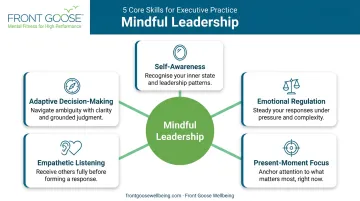
- Five core skills drive mindful leadership: self-awareness, emotional regulation, present-moment focus, empathetic listening, and adaptive decision-making
- Regular practice physically changes the brain — reducing stress reactivity and strengthening prefrontal function
- 13 minutes of daily practice for 8 weeks produces measurable cognitive and emotional benefits
- Leaders build these skills through short, consistent daily habits — structured programs accelerate results but aren't required to start
What Leadership Mindfulness Skills Actually Are
Leadership mindfulness skills are not the same as general mindfulness or meditation practice. The distinction matters.
General mindfulness is a personal awareness practice. Leadership mindfulness skills are the applied ability to use present-moment awareness and emotional regulation to improve leadership decisions, communication, and team outcomes — in real time, under real pressure.
The Inner Game Gap
Most leadership development programs train the outer game: communication frameworks, strategic planning, performance management. What they rarely address is the inner game — the cognitive and emotional regulation capacity that determines how all those outer tools get deployed when the stakes are high.
A leader can know every conflict-resolution model in existence and still escalate a difficult conversation because their emotional regulation failed first.
This gap is why organizations continue to invest in leadership development while seeing limited behavior change in the moments that matter most.
Why "Soft" Is the Wrong Word
Fortune 500 companies and military organizations integrate mindfulness training because the data supports it as a performance lever — not as a calming exercise.
The results are measurable:
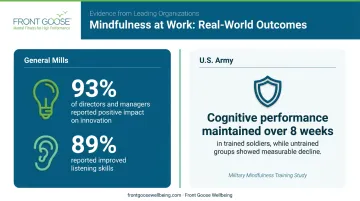
- General Mills: 93% of directors and managers who completed a mindful leadership program reported a positive effect on innovation; 89% reported improved listening skills
- U.S. Army: Mindfulness-based Mind Fitness Training kept cognitive performance sharp in active-duty soldiers over eight weeks — while untrained groups declined
The distinguishing feature of a mindful leader is the trained ability to pause between stimulus and response. To see situations clearly rather than through the filter of urgency or ego. To make choices that serve the team rather than protect the self.
That shift — from reactive to intentional leadership — is the foundation of Front Goose Wellbeing's mental fitness training. The programs Megan Dittman has delivered to organizations like GE Aerospace and Kohler Corp are designed to train the inner game: the regulation capacity that determines how leaders perform when pressure is highest.
The Neuroscience That Makes Mindfulness a Performance Tool
Leadership stress is not just uncomfortable. It's cognitively expensive.
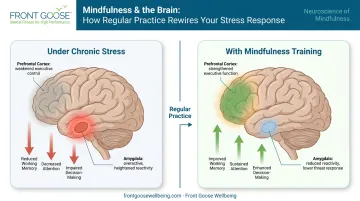
Research published in Progress in Neuro-Psychopharmacology and Biological Psychiatry found that chronic stress affects prefrontal cortex-supported functions including working memory, attention, response inhibition, and set shifting — the exact capabilities leaders need most. Under sustained pressure, the brain's executive function degrades while its threat-detection systems become hyperactive.
The result is predictable: shorter fuses, narrower thinking, worse decisions.
What Mindfulness Does Neurologically
Regular mindfulness practice counteracts this degradation through two primary mechanisms:
- Structural change: An 8-week MBSR program was associated with increased gray-matter concentration in the left hippocampus and changes in regions linked to self-awareness and perspective-taking (Holzel et al., 2011)
- Reduced amygdala reactivity: Both short-term and long-term mindfulness training are associated with lower amygdala reactivity to negative stimuli — meaning the brain's threat response becomes less trigger-happy
A 2024 meta-analysis of 111 randomized controlled trials and 9,538 participants found small-to-moderate effects of mindfulness on global cognition, executive attention, working memory accuracy, and sustained attention. These are not peripheral benefits — they're the cognitive infrastructure of effective leadership.
The Practical Implication
A leader who has trained their attention and emotional regulation is neurologically better equipped to make clear decisions under pressure, de-escalate conflict, and sustain focused performance. That capacity isn't a personality trait — it's a trained skill, built through deliberate practice that changes how the brain processes stress in real time.
5 Core Mindfulness Skills That Make Leaders More Effective
These are not personality traits. Each one is a trainable skill that builds on neuroplasticity and develops through deliberate practice.
Self-Awareness
Self-awareness is the foundation — the ability to recognize one's own emotional states, cognitive biases, and behavioral triggers before they contaminate a decision or interaction.
Leaders without it default to unconscious habit. Self-awareness shifts that to conscious intention.
The distinction that matters: this isn't just retrospective reflection. It's real-time monitoring of how your internal state is shaping your behavior right now — in this meeting, during this conversation, under this deadline.
Emotional Regulation
Emotional regulation is the trained ability to remain clear-headed under pressure. The goal isn't suppressing emotions; it's preventing them from driving reactive choices.
This skill is most critical during:
- High-stakes conversations where tone determines outcome
- Team conflict that requires calm arbitration
- Organizational change where anxiety is contagious and leaders set the emotional temperature
Leaders without this skill don't just suffer personally. They amplify stress throughout their teams.
Present-Moment Focus
Present-moment focus is the ability to give full, undivided attention to what's actually happening, rather than ruminating on last quarter's miss or catastrophizing about next month's board meeting.
The leadership cost of its absence is real. A manager who is mentally elsewhere during a one-on-one signals to their direct report that they're not valued. That signal erodes trust faster than almost any other leadership failure.
Empathetic Listening
Empathetic listening means listening with the intent to understand, not to evaluate or prepare a rebuttal.
Mindful leaders who listen this way:
- Surface problems earlier, before they become crises
- Build the psychological safety that encourages honest feedback
- Make team members feel genuinely valued — which directly affects retention
That requires actively quieting the internal monologue most people run during conversation.
Adaptive Decision-Making
Adaptive decision-making is the capacity to assess situations with clarity rather than urgency-driven reactivity, pausing to gather information, consider second-order effects, and make choices aligned with both immediate needs and long-term vision.
Research by Hafenbrack, Kinias, and Barsade (Psychological Science, 2014) found that a 15-minute focused-breathing meditation reduced susceptibility to sunk-cost bias: participants were less likely to throw good resources after bad decisions simply because they'd already committed. Mindfulness created cognitive space for clearer assessment.
Practical Techniques to Build Mindfulness Skills as a Leader
Research supports this clearly: short, consistent daily practice is sufficient to generate meaningful cognitive and emotional benefits. Basso et al. (2019) found that 13 minutes of guided meditation daily for 8 weeks improved attention, working memory, mood, and anxiety — but the same effects were not present after just 4 weeks. Consistency is the active ingredient.
Pause-and-Breathe Before High-Stakes Moments
Before any significant meeting, difficult conversation, or major decision: take 60–90 seconds of deliberate, slow breathing.
The mechanism is physiological. Slow breathing — particularly near six breaths per minute — increases heart rate variability and activates the parasympathetic nervous system, shifting the body out of stress-response mode. This isn't a metaphor. It's vagal stimulation, and it works quickly enough to matter before you walk into the room.
Daily Reflective Check-In
Spend five minutes at the end of each day reviewing key leadership moments:
- Where did you respond deliberately vs. react automatically?
- Where did self-awareness serve you?
- Where did reactivity show up — and what triggered it?
This practice builds the self-monitoring skill that makes real-time mindfulness possible. You can't regulate what you haven't first learned to notice.
Mindful Meeting Presence
Start team meetings with 60 seconds of silent grounding — no phones, no agenda review. Then commit to active listening throughout: no multitasking, no preparing your response while someone else is still speaking.
This habit does two things simultaneously. It makes you a better listener. And it models the behavior you want from your team. Leaders who demonstrate presence signal that presence is a cultural expectation, not just a personal preference.
Structured Mindfulness Training for Teams
Individual habit formation is powerful. But structured, science-based training accelerates skill development in ways self-guided practice can't replicate, and it builds shared language across the entire leadership team.
Front Goose Wellbeing has delivered this kind of programmatic training to organizations including GE Aerospace and Kohler Corp. The curriculum is neuroscience-grounded and framed for executive audiences — not generic wellness content. When a full leadership team shares vocabulary, practices, and context, the result isn't just better individual performance. It's a measurable shift in how the team operates under pressure.
The Business Case: Measurable Outcomes of Leadership Mindfulness
The downstream effects of leader mindfulness extend well beyond the individual.
Field research by Reb, Narayanan, and Chaturvedi linked supervisor mindfulness with higher follower job satisfaction, lower emotional exhaustion, and stronger performance. Those outcomes operated through improvements in relationship quality, perceived fairness, and reduced employee stress. When leaders model presence and emotional regulation, those behaviors shape what becomes normal for the team.
The Retention Argument
Leadership behavior is a primary driver of voluntary turnover — and turnover is expensive.
Gallup estimates replacement costs at approximately 200% of salary for leaders and managers, and reports that 42% of voluntary leavers believed their manager or organization could have done something to prevent their departure.
Reactive, conflict-escalating leadership behavior is a direct contributor to that 42%. Developing emotional regulation and empathetic listening in leaders is a retention strategy with a quantifiable cost basis.
The Cascade Effect
When mindful leadership becomes a shared organizational practice:
- Teams report higher psychological safety and greater willingness to surface concerns
- Collaboration improves as reactive conflict decreases
- Leaders make fewer impulsive decisions that require costly course corrections
- The culture becomes self-reinforcing — presence and intentionality become norms, not exceptions
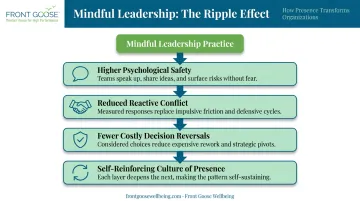
The business case for leadership mindfulness rests on outcomes CHROs and operations leaders can measure: decision quality, conflict frequency, and voluntary turnover — all of which shift when leaders develop the capacity to respond rather than react.
Frequently Asked Questions
What is the difference between mindfulness and leadership mindfulness skills?
General mindfulness is a personal awareness practice — developing the capacity to notice your thoughts and emotions without being driven by them. Leadership mindfulness skills are the applied version: using that same present-moment awareness and emotional regulation to make better decisions, communicate more effectively, and produce stronger team outcomes in professional contexts.
How does mindfulness improve decision-making for leaders?
Mindfulness reduces amygdala-driven reactivity — the hair-trigger threat response that narrows thinking under pressure — while strengthening prefrontal cortex function, which governs judgment and impulse control. Leaders with trained mindfulness skills have more cognitive space between stimulus and response, allowing for clearer, more deliberate choices rather than urgency-driven reactions.
How long does it take to see results from practicing mindfulness as a leader?
Research points to 13 minutes of daily practice as the effective threshold — but duration matters as much as frequency. Benefits in attention, working memory, mood, and stress reactivity weren't observed at 4 weeks; they emerged consistently at the 8-week mark. Expect meaningful change around weeks 6–8 of sustained daily practice.
Can mindfulness training benefit an entire leadership team, not just individuals?
Yes. When implemented as a shared program, mindfulness creates a common leadership culture — shared language, consistent practices, and measurable improvements in communication, trust, and psychological safety across the team.
What are the most important mindfulness skills for leaders under pressure?
Emotional regulation and present-moment focus are the most immediately impactful in high-pressure moments. Emotional regulation prevents the amygdala from hijacking judgment; present-moment focus keeps attention on what's actually happening rather than catastrophic projections. Together, they allow leaders to respond with clarity rather than react from fear or urgency.
Do I need to meditate to become a more mindful leader?
Formal meditation is one pathway — not the only one. Structured breathing, brief end-of-day reflection, and intentional listening habits all build the same core skill of deliberate attention, and each fits within a demanding executive schedule when practiced consistently.