
Introduction
It's 2:47 PM. You have three deliverables due before end of day, your inbox has 47 unread messages, and your brain feels like it's running through sand. Sound familiar?
This isn't a personal failure — it's workplace stress doing exactly what it's designed to do neurologically. And it's widespread. According to APA's 2023 Work in America Survey, 77% of U.S. workers reported work-related stress in the previous month, with 31% experiencing emotional exhaustion and 20% reporting lower productivity as direct effects.
The problem isn't that people lack willpower. The problem is that most stress advice doesn't account for what's actually happening in the brain — so the techniques people try fail to address the underlying neurological response.
This article explains the neuroscience behind why stress derails performance, and walks through six evidence-based techniques that high performers actually use to manage it.
Key Takeaways
- Workplace stress physically impairs the brain's decision-making center, making it harder to think clearly under pressure
- Controlled breathing, single-tasking, and cognitive reframing work by interrupting the stress response at the neurological level
- Resilience isn't a personality trait — it's a trainable skill, and consistent practice produces measurable brain changes
- Leaders must reduce systemic stressors — not just teach employees to cope with them
- Individual techniques work best inside organizations that actively support psychological safety and recovery
The Hidden Cost of Workplace Stress
Stress doesn't clock out when you do. Unmanaged workplace stress shows up physically — headaches, disrupted sleep, weakened immune function, and over time, elevated cardiovascular risk. A large individual-participant meta-analysis found that job strain is associated with a 23% higher coronary heart disease hazard. Psychologically, it degrades emotional regulation and sharpens reactivity — slowing decision cycles and narrowing the risk tolerance that executive judgment requires.
The organizational cost is equally concrete. Gallup estimates that poor employee mental health costs the U.S. economy $47.6 billion annually in lost productivity from unplanned absences — and that figure reflects only absence, not the quieter drain of presenteeism.
Common Workplace Stressors Worth Recognizing
Before exploring solutions, it helps to name what's actually triggering the response. The most common organizational stressors include:
- Excessive workloads with unrealistic timelines
- Unclear role expectations and shifting priorities
- Limited autonomy over how work gets done
- Always-on digital culture with no psychological off-switch
- Poor work-life boundaries and the pressure to be perpetually available
Naming the source matters because the techniques that work target specific mechanisms — not stress as a vague concept, but the physiological and cognitive patterns driving it.
The Neuroscience of Stress: What's Happening in Your Brain at Work
The stress techniques that actually work aren't just good habits — they target specific neurological mechanisms. Here's what's happening in your brain when workplace pressure hits.
The Amygdala and the Thinking Brain
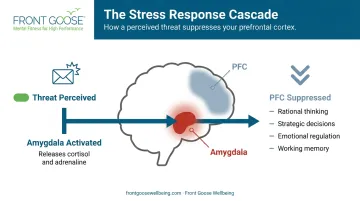
When you perceive a threat — a hostile email, a surprise presentation request, a missed deadline — the amygdala (the brain's threat-detection center) fires first. It floods the body with cortisol and adrenaline, triggering fight-or-flight. That response is fast and automatic.
The cascade doesn't stop there. It also suppresses the prefrontal cortex (PFC) — the region responsible for rational thinking, strategic decision-making, and emotional regulation. Research on stress signaling pathways shows that elevated norepinephrine and dopamine at high-stress levels actively weaken PFC network connections, including working memory. Stress doesn't just feel bad. It structurally impairs the cognitive functions leaders depend on most.
Acute vs. Chronic Stress
Not all stress is harmful. Acute stress — a tight deadline, a high-stakes presentation — can sharpen focus in the short term. The issue is chronic stress, which is what the always-on workplace reliably produces. Sustained cortisol exposure is associated with structural remodeling of PFC and amygdala circuits — shifting the brain away from flexible, strategic thinking and toward habitual, reactive responses. The difference matters: one sharpens performance, the other quietly erodes it.
Why Techniques Actually Work: Neuroplasticity
The brain changes in response to deliberate practice — this is neuroplasticity, the ability to form new neural pathways through repeated behavior. It's the scientific basis for why stress management isn't feel-good advice. When practiced consistently, techniques like mindfulness and controlled breathing produce measurable changes in brain structure and connectivity, restoring the balance toward PFC control rather than amygdala reactivity.
Each technique in the sections below targets one of these neurological pressure points — which is why they work when generic "wellness tips" don't.
Stress Management Techniques That Actually Work at Work
1. Track Your Stressors
Awareness comes before intervention. Keep a brief stress journal for one week — note what triggered stress, how you responded, and what followed. Patterns emerge quickly. You'll likely find that two or three recurring triggers are responsible for most of your stress load, and that awareness alone shifts how you respond to them.
2. Single-Task Instead of Multitask
The brain cannot deeply focus on multiple tasks simultaneously — what we call multitasking is actually rapid task-switching, and it carries a cost. In a 48-person simulated office experiment, interruptions produced faster task completion but significantly greater stress, frustration, and cognitive load. Single-tasking isn't slower — it's smarter. Block time for focused work, close unneeded tabs, and let non-urgent messages wait.
3. Establish Clear Work-Life Boundaries
Workplace telepressure — the compulsion to respond immediately to work messages — predicts poorer sleep quality and more absences, beyond the actual volume of after-hours email. Psychological detachment from work is a real recovery mechanism, not a luxury.
Concrete examples:
- No email after a defined hour each evening
- A consistent end-of-day ritual (a short walk, shutting the laptop with intention)
- Work messages off personal devices during weekends
4. Use Intentional Breathing to Reset
Controlled breathing activates the parasympathetic nervous system — the physiological opposite of the stress response. A randomized controlled trial of 108 adults found that five minutes per day of cyclic sighing improved mood and reduced respiratory rate more than mindfulness meditation alone. Diaphragmatic breathing has also been shown to reduce cortisol and improve sustained attention.
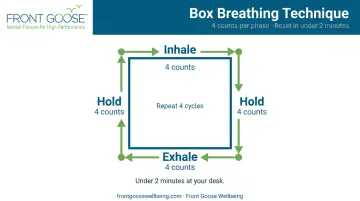
Box breathing (four counts in, hold four, out four, hold four) takes under two minutes at your desk. It's one of the most accessible in-the-moment tools available because it works directly on the cortisol response rather than around it.
5. Prioritize Recovery: Sleep and Movement
Sleep is the brain's primary stress-recovery mechanism. One night without sleep produced more than 60% greater amygdala reactivity in laboratory research, and restricting sleep to six hours or fewer for 14 consecutive days produced cognitive deficits equivalent to two nights of total sleep deprivation. Poor sleep doesn't just make you tired. It dismantles the PFC-amygdala regulation your stress management depends on.
Movement matters too. Even a 10-minute walk releases endorphins and reduces cortisol. These are mechanisms, not wellness platitudes — this is how the brain resets its stress thermostat.
6. Reframe, Don't Suppress
Suppressing stressful thoughts doesn't eliminate their effect — it just delays it. Cognitive reframing, rooted in cognitive behavioral science, involves consciously shifting your interpretation of a stressor. Research shows that reinterpreting physiological arousal as functional (rather than threatening) produces more adaptive cardiovascular stress responses and reduces threat-related attention bias.
In practice, that means treating a tight deadline as a contained challenge with a defined endpoint, and a difficult conversation as a performance skill under test. That shift in framing isn't denial. It changes what the brain does with the stress signal.
Mindfulness and Mental Fitness: The Science-Backed Edge High Performers Use
Mindfulness gets dismissed as soft. That's a mistake.
What the Research Actually Shows
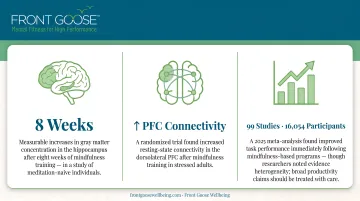
Regular mindfulness practice strengthens the prefrontal cortex, builds emotional regulation, and improves focus under pressure. After eight weeks of mindfulness training, participants showed measurable increases in gray matter concentration in the hippocampus and other regions compared to controls — in a study of meditation-naive individuals. A separate randomized trial found increased resting-state connectivity in the dorsolateral PFC after mindfulness training in stressed adults.
A 2025 meta-analysis of 99 studies involving 16,054 participants found improved task performance immediately following mindfulness-based programs — though researchers noted evidence heterogeneity, so broad productivity claims should be treated with care.
Accessible Practices That Fit a Workday
Frequency and consistency matter more than duration:
- Two minutes of focused breathing before a high-stakes meeting
- A brief body scan during a lunch break to reset tension
- A mindful transition ritual between tasks — even 60 seconds of intentional stillness
Each is a deliberate interruption to the stress accumulation cycle, not a long meditation.
When Individual Practice Isn't Enough
For organizations serious about performance, individual apps and ad hoc habits don't build consistent team-wide resilience. Science-based mental fitness programs — like those delivered by Front Goose Wellbeing — offer structured, research-grounded frameworks that teams apply consistently.
Built on four pillars (Mindful Awareness, Breathwork, Meditation, and Mental Rehearsal), these programs address the specific pressures of high-performance work environments, not generic wellness audiences.
Companies like GE Aerospace and Kohler Corp have invested in this type of structured training. Deloitte Canada's analysis across seven large employers found a median return of CA$1.62 per CA$1 invested in workplace mental health programs, rising to CA$2.18 for programs running at least three years. The ROI case compounds the longer the program runs.
What Leaders and Organizations Can Do Differently
Individual techniques only go so far when the organization keeps generating excessive stress. Leaders have a genuine responsibility here.
Four Concrete Actions Leaders Can Take
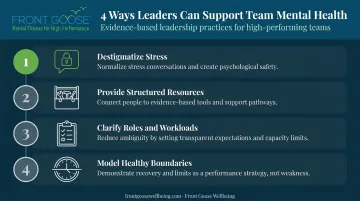
- Destigmatize stress openly — employees who can't acknowledge stress can't manage it, and leaders who model vulnerability create psychological safety.
- Give employees access to structured resources: EAPs, mental fitness training, and coaching programs provide tools that go well beyond self-help. Access without stigma matters.
- Clarify role expectations and workloads. Unclear expectations and unsustainable demands are organizational design problems, not individual coping failures.
- Model the boundaries you expect. A leader who sends emails at 11 PM implicitly signals that recovery isn't permitted.
Research on a cluster RCT involving 88 managers found that four hours of manager mental health training reduced work-related sickness absence by 6.45 hours per employee over six months. That's a measurable return from a single intervention — and it's why manager behavior sits at the center of any serious workplace stress strategy.
Megan Dittman built Front Goose Wellbeing on exactly this premise: her 25 years as a corporate HR executive at organizations like GE and Kohler inform how she works with leadership teams, because she's operated inside the systems she now helps change.
Building Resilience for the Long Game
Stress relief and resilience are not the same thing. Breathing resets the nervous system in the moment. Resilience changes how the nervous system responds over time.
Resilience is trainable. A 2018 systematic review and meta-analysis found that resilience interventions — particularly combinations of mindfulness and cognitive-behavioral techniques — can measurably improve resilience scores. Short-form mindfulness training has also been shown to protect working memory during high-demand intervals in military research, reinforcing that cognitive resilience responds to deliberate practice.
That means you can start building it now. Begin with a short self-audit:
- What's your current stress-response pattern?
- Which of the six techniques above are you not using?
- Where does recovery consistently fall off your schedule?
Pick one or two changes. Build them into your routine the same way you'd approach physical training — gradually, consistently, with real gains emerging over weeks and months.
Frequently Asked Questions
What are 10 ways to reduce stress at work?
Track your stressors, single-task, set firm work-life boundaries, use breathwork to reset, prioritize sleep and light movement, practice mindfulness, reframe stressful thoughts, take deliberate recovery breaks, communicate openly with your manager, and seek professional support when needed.
What causes the most stress in the workplace?
The most common organizational stressors are excessive workload, unclear expectations, lack of control over decisions, poor work-life balance, and insufficient support from leadership. These tend to compound over time when left unaddressed, shifting acute stress into chronic stress.
How does mindfulness help with workplace stress?
Mindfulness activates the parasympathetic nervous system, strengthens prefrontal cortex connectivity, and improves emotional regulation. Over time, it trains the brain to respond to pressure more deliberately rather than reactively. That shift matters most in high-stakes work environments where reactive responses carry real consequences.
Can workplace stress affect physical health?
Yes. Chronic workplace stress is linked to elevated blood pressure, weakened immune function, sleep disturbances, and increased cardiovascular risk. A large meta-analysis found job strain associated with a 23% higher coronary heart disease hazard.
What can employers do to reduce employee stress?
Clarify role expectations, offer flexible work policies, destigmatize mental health conversations, provide access to wellness resources, and invest in structured mental fitness training for teams. Reducing systemic stressors matters as much as teaching coping skills.
How long does it take for stress management techniques to show results?
Breathing exercises can produce immediate physiological relief. Mindfulness and resilience-building practices show measurable neurological and behavioral changes after several weeks of consistent practice. Structural brain changes have been documented after eight-week programs.