Introduction
Picture a senior executive mid-quarter: three strategic initiatives stalling simultaneously, a key hire just resigned, and the board wants answers by Friday. What separates the leader who fragments under that pressure from the one who absorbs it, adapts, and moves forward?
Not personality. Not stoicism. And not the ability to white-knuckle through it.
According to the American Psychological Association, resilience is a learned process — a dynamic capacity built from specific behaviors, thoughts, and actions that anyone can develop. And among the most evidence-backed methods for building it is mindfulness.
What follows is the science behind why mindfulness works, the specific mechanisms that make it effective under pressure, and how to start building that capacity now.
Key Takeaways
- Resilience is a trainable skill the APA confirms can be developed through learnable behaviors
- Mindfulness rewires functional brain activity, strengthening emotional regulation and reducing stress reactivity
- Reduced rumination, equanimity, self-compassion, and gratitude each produce measurable resilience gains
- Even brief daily practice builds resilience — firefighters gained more from mindfulness training than from relaxation alone
- Mindfulness-based resilience training consistently reduces burnout, stress, and anxiety across organizations
What Is Resilience — and Why High Performers Need It
The APA defines resilience as "the process of adapting well in the face of adversity, trauma, tragedy, threats, or significant sources of stress." Two words matter here: process and adapting. Resilience is not a destination or a personality type — it is an active, ongoing capacity that responds to training.
For high performers — executives, founders, athletes, military operators — this reframe is consequential. Resilience is not something you either have or lack. It is something you build — deliberately, over time, with the right training.
Types of Resilience
High performers typically need four types working in concert:
- Physical resilience — the body's ability to recover from fatigue, illness, or physical strain
- Emotional resilience — managing and recovering from difficult feelings without being destabilized
- Mental resilience — maintaining clarity, focus, and problem-solving capacity under sustained cognitive load
- Social resilience — drawing on and contributing to relationships and communities during adversity
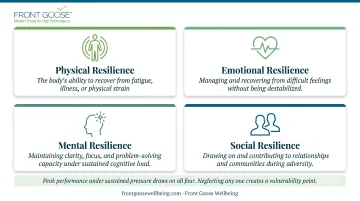
Peak performance under sustained pressure draws on all four. Neglecting any one creates a vulnerability point.
The 7 C's of Resilience
Kenneth Ginsburg's 7 C's framework — developed from decades of resilience research — maps the internal and relational capacities that underpin resilience: Competence, Confidence, Connection, Character, Contribution, Coping, and Control.
These are concrete psychological strengths, not abstract ideals. Three of them — coping, confidence, and control — are directly cultivated through regular mindfulness practice. When you train the mind to observe its own reactions without being overtaken by them, you strengthen the exact capacities the framework describes.
The Neuroscience of Mindfulness and Resilience
The brain is not static. Neuroplasticity — the brain's documented ability to reorganize and form new neural connections in response to repeated experience — means that what you practice mentally, you become neurologically. Mindfulness practice is a form of mental strength training.
What Changes in the Brain
Research using neuroimaging has mapped what happens during and after mindfulness training:
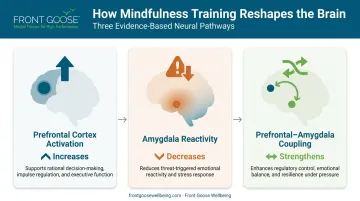
- Prefrontal cortex activation increases — this region governs rational decision-making, self-regulation, and the ability to pause before reacting
- Amygdala reactivity decreases — the brain's threat-detection center becomes less hair-trigger, producing calmer responses to stressors
- Prefrontal-amygdala coupling strengthens — higher mindfulness is associated with greater inverse coupling between these regions, meaning the rational brain exerts more regulatory control over emotional reactivity
A study by Desbordes et al. found that after an 8-week mindfulness program, participants showed reduced right-amygdala response to emotional stimuli even outside of meditation — suggesting the effect persists into daily life, not just during formal practice.
Interrupting the Stress Loop
Habitual stress responses — snapping at a colleague, shutting down in a difficult conversation, ruminating at 2am — are automatic loops driven by established neural pathways. The brain runs these patterns because they are efficient, not because they are useful.
Mindfulness interrupts those loops by inserting a moment of conscious awareness between stimulus and response. That pause is where resilience lives — and it's what separates a reactive response from a deliberate one. The good news: that capacity can be trained, and it builds faster than most people expect.
How Quickly Can Change Occur?
Zeidan et al. found that just four days of mindfulness practice produced measurable improvements in sustained attention, working memory, and executive functioning in meditation-naive adults. This was functional cognitive improvement, not structural brain remodeling — but it establishes that the benefits begin quickly.
For sustained resilience specifically, a cluster-randomized trial with 143 firefighters found that an online mindfulness program improved adaptive resilience significantly over time, with effects measured at 6 months.
Mindfulness vs. Relaxation: A Critical Distinction
This distinction matters for anyone designing training programs. In a study by Denkova et al., 121 firefighters were assigned to mindfulness training, relaxation training, or no training. Four weeks later, the mindfulness group showed significantly greater gains in self-reported resilience than both the relaxation group and the control group.
Relaxation helps — but the active, awareness-based component of mindfulness is what drives the neurological benefit. Passive rest and deliberate attention training produce different outcomes.
How Mindfulness Builds Resilience: Key Mechanisms
Neurological changes only matter when they translate to real performance. These four mechanisms show how mindfulness reshapes how you think, feel, and respond when pressure hits.
Emotional Regulation and Equanimity
Mindfulness cultivates equanimity: a stable, centered mental state that makes it harder for adversity to knock you off balance. This is not emotional suppression — it is the active capacity to observe difficult emotions without being driven by them.
Research correlating dispositional mindfulness with brain activity found that higher mindfulness produces greater prefrontal activation and lower amygdala reactivity during emotional processing. In practice: emotionally charged situations trigger less reactive, more measured responses.
For leaders navigating layoffs, board pressure, or team conflict, this is not a soft skill. It is a performance advantage.
Reduced Rumination and Acceptance of Impermanence
Rumination (replaying past mistakes, catastrophizing future events, compulsive re-thinking) is one of the most reliable predictors of poor resilience. A randomized study by Jain et al. found that mindfulness meditation reduced distractive and ruminative thoughts more effectively than somatic relaxation, and that these reductions partially mediated reductions in psychological distress.
Mindfulness also trains the recognition of impermanence: the understanding that all experiences, including painful ones, are temporary. Accepting impermanence is not resignation. It is the cognitive freedom to stop treating every setback as permanent, which directly accelerates recovery.
Self-Compassion as a Resilience Foundation
One of the most consistent outcomes of mindfulness practice is increased self-compassion, the ability to meet your own suffering without harsh judgment. This matters for resilience because shame and self-criticism after setbacks are major contributors to getting stuck.
The evidence is consistent across populations:
- A study with multiple sclerosis patients found self-compassion and resilience were both significant predictors of health-related quality of life
- Compassionate Mind Training with school staff produced reductions in burnout, depression, anxiety, and stress, with self-compassion as the key mediating factor
When high performers can treat their own failures with the same reasonableness they would offer a respected colleague, recovery accelerates.
Gratitude and Cognitive Reframing
Mindfulness creates conditions for gratitude: not as a forced positivity exercise, but as a genuine capacity to recognize value even within difficulty. Following a campus shooting, a study by Vieselmeyer et al. surveyed 359 students, faculty, and staff and found that gratitude was associated with post-traumatic growth, with resilience acting as a protective factor against post-traumatic stress.
For high performers, this translates to the ability to reframe setbacks as learning rather than failure — which is the cognitive foundation of growth.
Mindfulness Practices to Strengthen Your Resilience
Building resilience through mindfulness does not require a complete lifestyle overhaul. Small, consistent practices accumulate — gradually rewiring your stress response and sharpening your ability to recover under pressure. The following toolkit covers the core techniques with the strongest evidence base.
Mindful Breathing
Focused breathwork activates the parasympathetic nervous system — the body's recovery system — calming the stress response in real time. A randomized study by Balban et al. found that five minutes of daily breathwork over 28 days improved positive affect across all groups, with cyclic sighing producing the largest reduction in respiratory rate.
A simple protocol:
- Inhale slowly through the nose for 4 counts
- Hold briefly for 1-2 counts
- Exhale fully through the mouth for 6-8 counts
- Repeat for 3-5 minutes
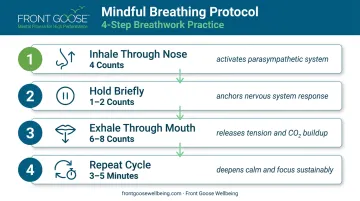
Done consistently, this protocol creates a measurable shift in how your nervous system handles stress — not by dulling your response, but by shortening its recovery arc.
Body Scan Meditation
The body scan involves systematically moving attention from feet to head, noticing physical sensations without trying to change them. It reduces physical tension, builds present-moment awareness, and interrupts the cognitive loops that sustain stress.
A study by Kogan and Bussolari found that even a single 8-minute virtual body scan reduced participant anxiety scores significantly — from 41.45 to 30.03 on the State-Trait Anxiety Inventory. One session has limits, but the result shows how quickly the technique moves the needle on physiological and psychological stress markers.
For leaders and teams looking to build these practices into their work culture, Front Goose Wellbeing's Corporate Mindfulness Training incorporates breathwork and body scan meditation as two of its four mental fitness pillars — available in single-session formats or extended cohort programs.
Mindfulness Meditation and Daily Awareness Practices
Seated mindfulness meditation — typically 10-20 minutes of focused attention on breath, body, or an anchor point — is the core formal practice. Informal practices build the same awareness muscle throughout the day:
- Mindful listening: full attention on one person, without mentally queuing your response
- Single-tasking: deliberate focus on one task before switching — cuts cognitive fragmentation at its source
- Reflective journaling — writing thoughts and feelings to process emotions and identify patterns
- 5-4-3-2-1 grounding — noticing 5 things you see, 4 you can touch, 3 you hear, 2 you smell, 1 you taste; useful for acute stress moments
Consistency matters more than duration. Ten minutes daily produces more durable change than ninety minutes once a week.
Building Resilience Through Mindfulness in the Workplace
Resilience is not just a personal concern — it is an organizational performance variable.
The APA's 2023 Work in America Survey found that 77% of employed U.S. adults reported work-related stress in the prior month, with 20% reporting lower productivity as a direct result. The WHO estimates that depression and anxiety alone account for 12 billion lost working days annually.
What the Research Shows
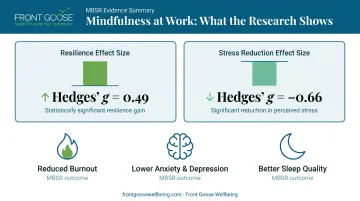
A 2018 systematic review by Janssen et al. examining MBSR programs in workplace settings found consistent evidence for:
- Reduced emotional exhaustion and burnout
- Lower stress, psychological distress, depression, and anxiety
- Better sleep quality among employees
A meta-analysis by Vonderlin et al. of randomized controlled trials reported pooled effect sizes of Hedges' g = 0.49 for resilience and -0.66 for stress — meaningful improvements by clinical standards.
Leaders Set the Tone
Leaders who practice mindfulness do more than manage their own stress. They model psychological safety and presence — the conditions under which teams take risks, communicate honestly, and recover from setbacks collectively rather than individually.
Reduced collective reactivity, better collaboration under pressure, and a culture oriented toward growth rather than blame are downstream effects of leadership behavior. This is why resilience training at the leadership level produces team-wide returns.
A Structured Approach for Organizations
Structured programming is what converts that leadership insight into organization-wide capability. Front Goose Wellbeing offers science-based corporate mindfulness training anchored on four mental fitness pillars: Mindful Awareness, Breathwork, Meditation, and Mental Rehearsal. Programs range from single-session workshops to multi-month cohort curricula, delivered in-person or virtually across the US.
Megan Dittman brings 25+ years of corporate HR executive experience at organizations including GE, Kohler, and Woolpert, paired with certifications from the Neuroleadership Institute, the Chopra Institute, and NBC-HWC accreditation from the National Board of Medical Examiners. That operating-leader credibility alongside evidence-based mental fitness training is what translates the work into measurable team outcomes.
Frequently Asked Questions
How can mindfulness build resilience?
Mindfulness trains the brain through neuroplasticity to regulate emotions more effectively and reduce automatic stress reactivity. By inserting conscious awareness between stimulus and response, it creates space for intentional, adaptive reactions rather than impulsive ones — which is the functional definition of resilience.
What are the 7 C's of resilience?
The 7 C's are: Competence, Confidence, Connection, Character, Contribution, Coping, and Control. They represent the internal strengths and relational capacities that allow individuals to adapt and recover — several of them, particularly coping, confidence, and control, are directly strengthened through regular mindfulness practice.
How long does it take to build resilience through mindfulness?
Measurable improvements in cognitive function can appear in as few as four days of practice. Sustained resilience improvements — particularly under significant stress — are more pronounced with consistent, long-term practice, with firefighter studies showing significant effects at 6 months.
Can mindfulness help with resilience at work?
Workplace mindfulness programs are well-supported by research, showing consistent reductions in burnout, stress, and anxiety, as well as improvements in emotional regulation. Meta-analyses confirm meaningful gains in both resilience and stress reduction across controlled studies.
Is resilience the same as not feeling stress?
Resilience is the capacity to recover from stress, not avoid it. Mindfulness strengthens that capacity by improving how we respond to difficult emotions — reducing the time and energy lost to reactive, unmanaged stress cycles.
What is the difference between mindfulness and relaxation for resilience?
Relaxation reduces tension in the moment but does not train the awareness-based responses that build lasting resilience. Research with firefighters showed that mindfulness training produced substantially greater resilience gains than relaxation training alone — the active, intentional attention component is what drives the neurological benefit.