Introduction
Most companies now offer some form of wellness program. Yet according to the APA's 2023 Work in America Survey, 77% of workers reported work-related stress in the prior month, and 57% reported symptoms associated with burnout. The gap between having a wellness program and having one that moves those numbers is significant.
A ping-pong table and a step challenge are not wellness programs. They're optics.
Closing that gap requires understanding what the research actually shows — not just what looks good in an all-hands presentation. This guide breaks down why most programs fall short, what high-impact alternatives look like, and how to tell whether yours is working.
Key Takeaways
- Most wellness programs fail because they're built on assumptions, not employee data
- Effective programs address physical, mental, financial, and social health together
- Leadership participation is the cultural signal that determines whether teams actually engage
- Measuring both ROI and VOI (value on investment) reveals the full picture of program impact
- Proactive mental fitness training is the performance layer most programs skip entirely
Why Most Corporate Wellness Programs Fall Short
The Access-Utilization Gap
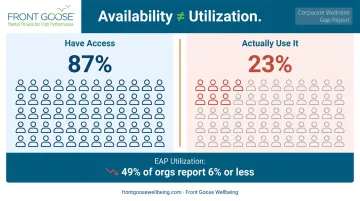
Availability and utilization are not the same thing. Gartner research cited by Harvard Business Review found 87% of employees had access to mental and emotional well-being offerings — but only 23% used them. That gap isn't primarily a marketing problem. It's a design problem.
Meanwhile, an IFEBP survey found that 49% of organizations reported EAP utilization of 6% or less. Paying for a benefit that fewer than 1 in 10 employees touches is not a wellness strategy.
Common Design Failures
Programs consistently underperform when they share these characteristics:
- Built on leadership assumptions rather than actual employee data
- Designed for one audience — ignoring variation in location, role, and life circumstance
- Focused exclusively on physical health, while financial stress and loneliness go unaddressed
- Locked behind on-site amenities that remote and deskless workers simply can't access
The Participation Trap
High enrollment numbers can mask zero real impact. A landmark randomized trial covering 32,974 employees across 160 worksites found that despite improved self-reported exercise and weight management behaviors, the program produced no significant change in clinical health measures, absenteeism, job performance, or healthcare spending after 18 months.
Participation is not impact — and treating headcount as success makes it nearly impossible to build a credible case for continued investment.
The Leadership Gap
Poor program design is only part of the picture. When executives treat wellness as HR's responsibility rather than a cultural commitment — skipping the programs they endorse, never mentioning them in team meetings — employees take that as permission to do the same. If the CHRO is running a 5K challenge no one in the C-suite joins, the signal is clear.
RAND's analysis of high-participation programs identifies visible senior leadership participation as a defining characteristic of programs employees actually use.
What Science Says About Wellness Programs That Actually Work
A Holistic Framework Is Non-Negotiable
The most credible research frameworks — from Deloitte and the WHO — define workforce well-being across physical, mental, social, and financial health together. These dimensions aren't parallel tracks. They intersect.
A worker managing debt anxiety or social isolation won't benefit meaningfully from a subsidized gym membership, no matter how good the facility is. The WHO recommends that organizations address the structural causes of poor well-being — workload, psychological climate, manager behavior — not only layer on individual resources.
What Chronic Stress Does to the Brain
A 2021 neurobiology review confirms that chronic workplace stress weakens prefrontal cortex connectivity, impairing the brain regions responsible for decision-making, focus, and emotional regulation. Sustained exposure can cause measurable structural changes in neural architecture.
This matters for program design. Stress isn't just an employee comfort issue — it's a cognitive performance issue. Programs that only offer reactive mental health access after stress has accumulated leave performance capacity on the table.
Psychological Safety Shapes Utilization
McKinsey research reports that 89% of employees consider psychological safety essential in the workplace. Yet APA data shows only 29% of workers say their manager actively encourages them to seek mental health care, while 43% worry that disclosing a mental health concern would harm their career.
Employees won't use wellness resources they fear will make them look weak. Cultural safety isn't a soft outcome — it's a prerequisite for utilization. And utilization is what determines whether program spend translates into measurable return.
ROI Varies Sharply by Program Type
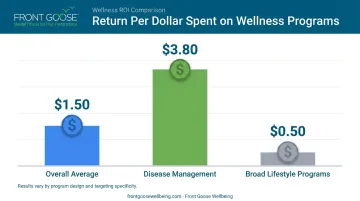
RAND's analysis of nearly 600,000 employees found wide variation in healthcare ROI depending on program type:
- Overall average: $1.50 returned per dollar spent
- Disease management programs: $3.80 per dollar
- Broad lifestyle programs: $0.50 per dollar
These are directional benchmarks, not universal guarantees — more recent randomized trials have found null effects on healthcare spending for generic lifestyle wellness programs. Program specificity determines financial return. Targeted interventions beat broad offerings every time.
Types of Corporate Wellness Programs That Actually Deliver Results
Physical Wellness
The core offerings — gym membership subsidies, virtual fitness classes, ergonomic assessments, walking meetings, activity challenges — have real value when designed for accessibility. The critical design principle: programs must be available to employees regardless of location or fitness starting point. A gym subsidy that requires a nearby partner facility excludes remote and rural workers entirely.
Mental Health and Mental Fitness Programs
Modern wellness design hinges on one critical distinction:
Mental health support (reactive): EAPs, therapy access, crisis hotlines. Necessary, but chronically underused — EAP utilization below 6% at nearly half of organizations.
Mental fitness training (proactive): Resilience workshops, mindfulness practice, stress regulation techniques, cognitive performance training. These build capacity before crisis arrives.
High-performing organizations are investing in both, but mental fitness programs — especially those grounded in neuroscience and mindfulness — show particular impact on focus, decision quality, and burnout prevention. A randomized workplace trial by Chin et al. found that structured mindfulness training significantly reduced perceived stress and buffered deterioration in coping efficacy under pressure.
Front Goose Wellbeing's Corporate Mindfulness Training reflects this performance-first approach. Programs are built on four mental fitness pillars — Mindful Awareness, Breathwork, Meditation, and Mental Rehearsal — and scale from single-session workshops to multi-month cohort curricula for corporate teams.
Financial Wellness
PwC's 2026 Employee Financial Wellness Survey found that 59% of US employees reported financial stress — and financially stressed employees are substantially more likely to be distracted at work. Presenteeism from financial anxiety is a direct productivity cost.
Financial wellness offerings worth deploying:
- Budgeting and debt management workshops
- Access to financial advisors (not just information packets)
- Student loan assistance programs
- Emergency savings tools and employer matching
Social and Community Programs
Gallup research found that 20% of employees worldwide feel lonely — rising to 25% among fully remote workers. Engaged employees are 64% less likely to report loneliness than disengaged ones.
Loneliness is an underaddressed driver of low engagement and turnover. Social wellness programs that build genuine connection compound over time as relationships deepen. Strong formats include:
- Peer support groups and employee resource groups
- Volunteer programs and community initiatives
- Wellness clubs and interest-based cohorts
Flexible and Preventive Programs
A systematic review of 16 studies found that employee-oriented flexible work arrangements reduce burnout, fatigue, and depressive symptoms. Schedule control alone mediated 23% of the effect on psychological distress in one intervention.
Flexibility addresses structural causes of stress — not just symptoms. Right-to-disconnect policies, no-meeting blocks, and return-to-work support have become high-impact wellness levers precisely because they change the conditions that generate stress, not just the responses to it.
Preventive offerings to pair with flexibility:
- Health screenings and biometric assessments
- Nutrition counseling and health coaching
- Vaccination clinics
- On-site or virtual ergonomic evaluations
Mental Fitness: The High-Performance Layer Most Programs Miss
Training vs. Treating
Elite athletes don't wait for an injury to work on conditioning. They train proactively — building capacity before performance moments demand it. The same logic applies to cognitive performance at work.
Most corporate wellness programs treat mental health reactively. They offer an EAP number when someone reaches crisis. That's important — but it's the equivalent of only having a physical therapist on call, with no strength and conditioning program.
Mental fitness training builds the cognitive capacity, emotional regulation, and resilience employees need to perform under pressure before they hit a wall. These are trainable skills:
- Focus and sustained attention under pressure
- Stress regulation in high-stakes moments
- Decision quality when the situation is ambiguous
None of them emerge from a wellness portal login.
What Science-Based Mental Fitness Training Looks Like
Programs grounded in neuroplasticity research, mindfulness practice, and evidence-based coaching techniques have demonstrated measurable stress and attention outcomes in controlled settings. Bauer et al. found that structured mindfulness training preserved sustained attention and was associated with neural plasticity — though the research notes that training context matters significantly.
Megan Dittman of Front Goose Wellbeing brings this framework directly to corporate settings. With 25 years as a corporate HR executive at organizations including GE and Kohler, plus credentials including an NBC-HWC board certification, a Neuroleadership Institute executive coaching certification, and a Chopra Institute meditation instructor certification, she designs programs that apply neuroscience-backed mental fitness techniques to high-stakes business situations — the same techniques used by Olympic athletes, military operators, and professional musicians to perform under pressure.
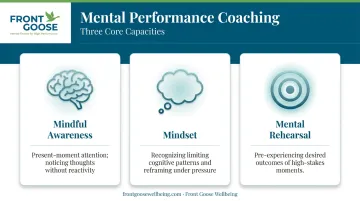
The three capacities her Mental Performance Coaching builds:
| Capacity | What It Trains |
|---|---|
| Mindful Awareness | Present-moment attention; noticing thoughts without reactivity |
| Mindset | Recognizing limiting cognitive patterns and reframing them under pressure |
| Mental Rehearsal | Pre-experiencing desired outcomes of high-stakes moments |
These capacities translate directly to performance. For corporate buyers, that means something specific.
The Performance Case
Mental fitness isn't a soft benefit — it's a performance investment. Improved focus, better emotional regulation in difficult conversations, stronger decision-making under ambiguity. These outcomes show up where it counts: leadership effectiveness, team cohesion, and retention numbers that don't require explaining to a CFO.
How to Build, Launch, and Measure Your Program
Start With Listening
Programs built on assumptions underperform. Before designing anything, gather data:
- Anonymous pulse surveys on stress, energy, and top wellness needs
- Focus groups across levels and locations
- Utilization data from existing benefits (what's already being used, and what isn't)
Identify the top three to five wellness needs your workforce actually has. Then build for those.
Launch Requirements
Good program design fails if the launch fails. Three non-negotiables:
- Secure visible leadership participation before launch — not a quote in an email, but executives actually using the offerings
- Communicate clearly and repeatedly — poor awareness is one of the most consistent drivers of low first-year utilization
- Remove friction — if accessing the program requires more than two steps, utilization drops
Measure What Matters
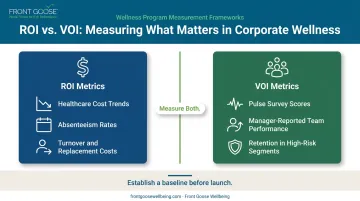
Track both quantitative and qualitative signals:
ROI Metrics (Financial):
- Healthcare cost trends
- Absenteeism rates
- Turnover and replacement costs
VOI Metrics (Value on Investment):
- Pulse survey scores on stress and engagement
- Manager-reported team performance
- Retention rates in high-risk segments
SHRM defines VOI as broadening the measurement lens beyond narrow financial returns to include engagement, morale, safety, and performance outcomes. That broader view only works if you establish a baseline before launch. Without one, there's no reference point for measuring change.
Review at regular intervals and be willing to cut low-participation offerings rather than defend them. If something isn't being used after a reasonable runway, replace it with something that will be.
Frequently Asked Questions
What's the difference between a corporate wellness program and a mental fitness program?
A corporate wellness program is broad — it covers physical, mental, financial, and social health across the workforce. A mental fitness program is a focused subset that proactively trains cognitive resilience, focus, and emotional regulation through neuroscience and mindfulness — before employees reach a crisis point.
What makes a corporate wellness program actually work vs. one that fails?
Programs that work share four traits: holistic design across multiple well-being dimensions, visible leadership participation, employee input in program design, and consistent measurement of meaningful outcomes. Programs that fail typically focus on participation headcount instead.
How do you measure the ROI of a corporate wellness program?
Track both ROI (healthcare costs, absenteeism, turnover) and VOI (engagement scores, retention, performance metrics). A clear baseline before launch is non-negotiable — without it, no meaningful comparison is possible.
How can smaller companies build effective wellness programs without large budgets?
Start with one or two high-impact offerings matched to actual employee needs — often mental health access and flexible scheduling. Partner with specialized providers rather than building in-house, then scale based on utilization and feedback.
Why is leadership participation so critical to wellness program success?
Leaders set the cultural signal for what's acceptable and valued. When managers openly use wellness resources and model healthy behaviors, employees feel permission to do the same. RAND's research on high-participation programs identifies visible senior leadership as a defining characteristic.
How long does it take to see results from a corporate wellness program?
Utilization rates and survey scores can shift within the first quarter. Absenteeism and healthcare cost improvements typically take 12–24 months to appear in data — and even then, results depend heavily on program design and targeting. Mental fitness and engagement gains tend to surface sooner when leadership models the behavior from day one.