This isn't a preparation problem. It's a skills problem.
Most keynote speakers—even seasoned ones—are trained to inform or motivate. Transformational speaking requires something different: a specific set of learnable skills that shift how audiences think, feel, and act long after the event ends. Charisma helps. Credentials matter. But neither alone closes the gap between a talk that energizes a room and one that actually changes people.
Chapman University's 2024 Survey of American Fears found that 29% of Americans are "afraid" or "very afraid" of public speaking—and that's just the speakers themselves. For audiences, the fear is subtler: investing time in a keynote and leaving with nothing that sticks.
This guide covers the core skills that separate transformational keynotes from every other kind—authentic presence, story architecture, mental fitness, and embodiment—and why the last two are the most overlooked.
Key Takeaways
- Transformational speakers create lasting shifts in mindset and behavior, not just in-the-moment emotional highs.
- Audiences must feel genuinely understood before they can be moved to change.
- Story architecture is a craft — structure determines whether a narrative transforms, not inspiration alone.
- Mental fitness—focus, calm, emotional regulation—underpins every other stage skill.
- Embodiment techniques anchor new insights in mind and body so they actually stick.
Transformational vs. Motivational vs. Inspirational: What's the Real Difference?
These three speaker types get used interchangeably on event booking sites, but the distinctions matter—especially if an organization is hiring a speaker to drive measurable change.
Here's a working framework:
| Speaker Type | Primary Goal | Duration of Impact |
|---|---|---|
| Informational | Transfer knowledge | Immediate; fades without application |
| Motivational | Create emotional charge and action energy | Days to weeks |
| Inspirational | Open a sense of possibility | Variable; dependent on follow-through |
| Transformational | Shift patterns of thought, emotion, and behavior | Durable, with the right tools |
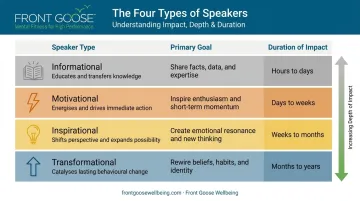
The key distinction is what happens after the applause stops. Energy generated in the room is real—but without structure, it dissipates.
Burns' 1978 leadership model (later developed by Bass) describes transformational influence as elevating followers' motivation and morality through idealized influence, intellectual challenge, and individualized relevance. Applied to keynote speaking, the same four factors apply: vision, challenging assumptions, authentic modeling, and audience-specific relevance.
Motivational speaking generates that initial charge—and that's valuable. But charge without a structural framework fades. Transformational keynotes give audiences something to carry out of the room.
For keynote pros, this is the practical test: did you deliver tools, frameworks, and experiences that persist beyond the room? Inspiration opens the door. Lasting behavior change requires something more durable—and building that in is the speaker's job.
Core Skill #1: Building Authentic Presence and Emotional Resonance
Meeting People Where They Are
Before you can shift an audience's worldview, they have to believe you understand it. "Meeting people where they are" isn't a generic acknowledgment of stress or busyness. It means specific, accurate recognition of the pressures, frustrations, and hopes your audience carries into the room.
Research from Stephens, Silbert, and Hasson at Princeton found that speaker-listener neural coupling underlies successful communication: when a speaker's brain activity became coupled with listeners' activity, comprehension improved. When coupling disappeared, so did understanding. Genuine attunement isn't just emotionally warm — it's cognitively functional.
The Expert Paradox
Audiences need to perceive you as both relatable and credibly ahead of them. Overclaim your expertise and you create distance. Over-perform relatability and you lose authority.
The balance is narrower than it looks: share authentic experience (you have faced this too) while demonstrating that you've navigated a path your audience hasn't yet taken.
Vulnerability is the mechanism here, but calibration matters. Brené Brown's framework is precise on this point: "vulnerability minus boundaries is not vulnerability." The test is whether sharing serves the audience or uses them to process the speaker's unresolved material. Stories of genuine breakdown and breakthrough build connection; stories that haven't been processed yet put the emotional weight on the listener instead of the speaker.
Voice, Cadence, and the Myth of Maximum Intensity
A 2022 study by Rodero testing 120 participants across 48 public-speaking videos found that medium pitch variation and medium gesture intensity received the strongest effectiveness and attractiveness ratings. High intensity didn't win. More isn't always better.
Effective vocal presence includes:
- Deliberate pauses that give the audience time to absorb, not just space to breathe
- Tonal variety matched to content, adjusted moment by moment rather than held at a fixed register
- Calibrated eye contact: direct gaze increased belief in ambiguous statements in one study, but increased resistance among listeners who already disagreed
Scanning the Room
Vocal control means nothing if you're not reading who's actually in front of you. The best transformational speakers scan the room continuously, spotting disengagement, resistance, or confusion and adjusting in real time.
This capacity is trainable. It requires emotional intelligence and practiced attention: the ability to stay present with the audience rather than inside your own head.
Core Skill #2: Crafting Stories That Create Lasting Change
Why Story Works Differently Than Data
Data informs. Story transports. A 2021 meta-analysis covering more than 33,000 participants found a meaningful narrative advantage over expository material—Hedges' g = 0.55 overall, with a larger effect for recall (g = 0.72). Narratives don't just get remembered better; they get processed differently. Narrative transportation theory describes how absorption in a story world allows audiences to update beliefs and shift perspectives with less resistance than direct argument tends to trigger.
This is why a transformational speaker leads with story, not slides.
The Architecture of a Transformational Story
Not every story transforms—structure is what separates the ones that do.
A transformational narrative has four components:
- Context — grounds the audience in a shared, recognizable reality
- Complication — disrupts their current thinking or assumed certainty
- Turning point — shows the specific shift in thinking or behavior the speaker underwent
- Concrete call to action — gives the audience something they can do immediately
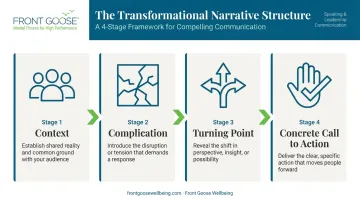
The complication is where most speakers underinvest. Inspiration opens a door; the complication creates the need to walk through it.
Sticky Anchors
Transformational speakers embed verbal and conceptual anchors—specific phrases, images, or metaphors repeated throughout the talk—that give audiences a mental hook to recall the insight days later.
Two examples from professional speakers:
- Simon Sinek's 2009 TED Talk organized the entire narrative around a single repeated question: "Why?" The phrase "People don't buy what you do; they buy why you do it" appears multiple times, creating a durable mental structure.
- Brené Brown repeats "I am here to get it right, I am not here to be right"—a phrase that reframes accountability in a way audiences recall and repeat.
Neither phrase arrived by accident. Effective anchors are engineered into the talk from the first draft.
Adaptive Storytelling
A story that lands with a frontline team may fall flat with a C-suite audience—not because the core insight differs, but because the metaphor, language, and framing need to reflect different contexts.
Transformational storytelling adapts narrative structure and reference points to the specific audience without losing the coherence of the core message. For cross-functional or multi-level audiences, this means choosing universal human experiences—failure, recovery, decision under uncertainty—rather than industry-specific ones.
Core Skill #3: Mental Fitness as the Hidden Foundation of Transformational Performance
What Stress Does to a Speaker
All the stage skills in the world erode under an unmanaged mental state. Arnsten's foundational neuroscience research shows that even mild uncontrollable stress can rapidly impair prefrontal cortex function—the part of the brain responsible for adaptive, responsive delivery. A separate meta-analysis by Shields et al. found that acute stress impairs working memory and cognitive flexibility.
For a speaker, this translates directly: anxiety before a high-stakes keynote doesn't just feel bad, it actively reduces your ability to read the room, adjust your narrative, and stay present with your audience.
Mental Fitness Is Trainable
Mental fitness—emotional regulation, sustained focus, resilience under pressure—is not a personality trait. It's a trainable capacity, grounded in neuroplasticity research: the brain forms new neural pathways in response to deliberate practice.
A 2024 review links mindfulness-based practice with measurable changes in emotion-regulation networks and amygdala reactivity. A controlled breathing review covering 58 studies found that 54 of 72 interventions significantly reduced psychometric stress and anxiety. These aren't soft claims—they're the same mechanisms used by elite athletes, military operators, and performing musicians to perform under pressure.
That science is the backbone of Front Goose Wellbeing's approach. Drawing on 25+ years inside some of the world's largest and most respected corporations, Megan Dittman delivers 60-90 minute interactive keynotes and workshops built on neuroscience-backed mental fitness and mindfulness content, tailored to each organization she works with.
Her keynote "The Performance Edge: Managing Stress & Building Cognitive Resilience" operates on a core premise: cognitive resilience is a trainable skill, and the same techniques used by Olympians and special operators transfer directly to stage performance under pressure.
Pre-Talk Rituals That Actually Work
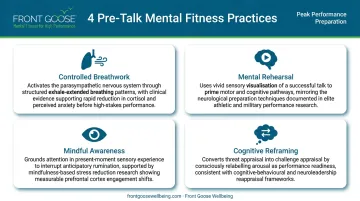
Four evidence-supported practices:
- Controlled breathwork — techniques like Nadi Shodhana (Alternate Nostril Breathing) shift the nervous system from fight-or-flight toward focused readiness; effective programs typically run at least five minutes and avoid fast-only breathing patterns
- Mental rehearsal — pre-experiencing the desired performance outcome; a randomized trial found that a 4-minute positive imagery exercise reduced anticipatory anxiety (dz = 0.53) and improved self-rated performance
- Mindful awareness — arriving present rather than inside your head; noticing and releasing reactive thoughts before stepping on stage
- Cognitive reframing — replacing pressure narratives ("I can't get this wrong") with performance-oriented ones ("I've prepared for this and I'm ready")
Embodiment and Physical Techniques That Anchor Transformation
Beyond Words and Slides
Transformation experienced only in the mind is fragile. When new insight is also encoded in the body—through movement, breathwork, shared physical exercises, or intentional stillness—the memory consolidates more deeply.
Roberts et al.'s 2022 systematic review and meta-analysis covering 145 behavioral studies found a large enactment-memory effect: g = 1.23 for physically performing described actions versus hearing them passively. The implication for keynote speakers is meaningful—when audiences do something during a talk, even briefly, they remember more of what they were taught.
Physical Staging and Non-Verbal Authority
Deliberate physical staging communicates confidence and conviction at a level words can't reach alone. Research by Maricchiolo et al. found that gesture type affected perceived persuasiveness, competence, and composure—separate from verbal content. Rodero's 2022 study reinforces that calibrated gesture intensity (medium, not maximal) produces the strongest audience response.
Practical applications:
- Use space intentionally — move toward a section of the audience when addressing a point directly relevant to them
- Hold stillness — moments of deliberate physical stillness draw attention more effectively than constant movement
- Gesture with purpose — gestures that reinforce content structure (illustrating a framework, marking a contrast) outperform decorative or nervous gesturing
Anchoring Transformation in the Body
Dual Coding Theory proposes that combining verbal content with physical or visual experience creates multiple memory pathways. When transformation is felt in mind and body at the same time, the new understanding is more likely to be recalled and acted upon after the event.
Three techniques that put this into practice:
- Guided breathwork — a 60-second breathing exercise mid-talk creates a physiological anchor tied to the surrounding content
- Mirrored gestures — a physical gesture that mirrors a key insight (open hands for possibility, a downward press for grounding) encodes the concept somatically
- Shared stillness — 10–15 seconds of collective silence after a pivotal moment lets insight settle before the next point arrives
Frequently Asked Questions
What is a transformational speaker?
A transformational speaker goes beyond sharing information or generating temporary motivation. Their goal is to create lasting shifts in how the audience thinks, feels, and behaves—changes that persist long after the event ends.
What is the difference between a motivational speaker and a transformational speaker?
Motivational speakers generate an immediate emotional charge that can fade within days. Transformational speakers combine inspiration with practical frameworks for sustained mindset and behavior change—prioritizing long-term development over short-term energy.
How do I become a transformational keynote speaker?
Becoming transformational requires building a specific skill set: authentic presence, structured storytelling, real-time audience responsiveness, and the mental fitness to perform under pressure. Every one of these capacities can be intentionally trained and refined over time.
What skills does a transformational speaker need?
The core skills include:
- Emotional resonance and authentic presence
- Transformational story architecture with sticky anchors
- Real-time audience adaptability
- Mental fitness and focus under pressure
- Embodiment techniques that help audiences encode insight beyond the event itself
What famous person is a transformational leader?
Nelson Mandela and Brené Brown are two often-cited examples. Both demonstrate the defining qualities: a clear vision, authentic communication, and the capacity to shift how others see themselves and what they believe is possible — whether speaking from a position of political power or a TED stage.
What are the 5 C's of transformational leadership?
The commonly cited 5 C's are Clarity, Communication, Commitment, Connection, and Courage (or Change, depending on the framework). On stage, these translate directly: a transformational speaker must be clear in message, present in delivery, committed to the audience's growth, connected to their reality, and willing to say what others haven't.