Introduction
Most workers aren't struggling quietly on the margins. According to Mind Share Partners' 2021 survey, cited in the U.S. Surgeon General's 2022 workplace framework, 84% of employees reported that workplace conditions contributed to at least one mental health challenge. At that scale, this is a structural problem — not an edge case.
Organizations that are getting this right have moved beyond reactive containment — the EAP-plus-sick-leave approach that treats mental health as a liability to manage. Increasingly, psychological well-being is being built into how work is designed, how leaders operate, and how performance is sustained over time.
This article covers what that shift looks like in practice: the core components of an effective mental health policy, program design best practices, why leadership behavior matters more than any benefit, and how to measure whether any of it is working.
Key Takeaways
- A workplace mental health policy provides the structural foundation — expectations, accountability, ADA compliance, and confidentiality protections
- Effective programs layer prevention, early intervention, treatment access, and recovery support; no single offering covers all four
- Manager behavior is the single strongest predictor of whether a mental health culture takes hold — training drives this, not policy alone
- Proactive programs — mindfulness, resilience training, mental fitness — outperform reactive-only approaches
- Measurement requires a baseline — without pre-program data, demonstrating ROI or justifying investment is nearly impossible
Why Workplace Mental Health Has Become a Business Priority
The business case is no longer ambiguous. The WHO estimates that depression and anxiety cost the global economy $1 trillion per year in lost productivity — roughly 12 billion lost working days annually.
The CDC adds a granular layer: depression interferes with physical job tasks approximately 20% of the time and reduces cognitive performance by about 35%. Those are operational metrics, not just wellness data points.
The Reactive vs. Proactive Distinction
Two categories define a complete mental health strategy:
- Mental health support (reactive) — EAPs, insurance coverage, sick leave, crisis lines — addresses employees after something has gone wrong
- Mental fitness (proactive) — resilience training, mindfulness, stress management — builds psychological capacity to handle pressure before it compounds into burnout or absenteeism
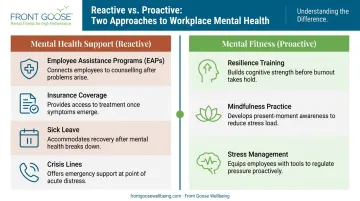
High-performing teams need both. But organizations that invest only in the reactive layer are consistently behind the curve, managing crises rather than preventing them. That gap between reactive-only programs and a full mental fitness strategy also shows up in recruiting — because employees now actively screen for it.
Workforce Expectations Have Shifted
This isn't only a performance issue — it's a talent issue. The APA's 2022 Work and Well-Being Survey found that 81% of workers said they would actively look for workplaces that support mental health when considering future job opportunities. Organizations that treat mental health as optional are effectively handing a recruiting advantage to every competitor that doesn't.
What a Strong Workplace Mental Health Policy Should Include
A workplace mental health policy is a formal, written document. It's not a wellness newsletter, a list of EAP phone numbers, or a one-page benefits summary. It sets organizational commitments, defines roles, outlines available resources, and establishes protocols for prevention, response, and return to work.
The Five Core Components
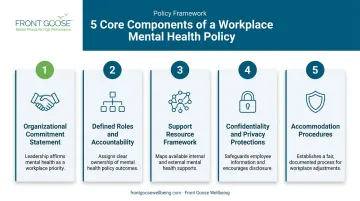
Every effective policy should address:
- Organizational commitment statement — a clear declaration that leadership prioritizes employee psychological well-being, with defined scope
- Defined roles and accountability — what leadership, managers, and employees are each responsible for
- Support resource framework — available resources and how to access them, including EAP, benefits, and internal referral pathways
- Confidentiality and privacy protections — explicit language on what's collected, who has access, and under what circumstances information may be shared
- Accommodation procedures — a clear process aligned with ADA requirements and documentation standards
ADA Compliance Is Non-Negotiable
Mental health conditions can qualify as disabilities under the ADA when they substantially limit a major life activity — even if the condition is treated or episodic. Employers may be legally required to provide reasonable accommodations, which can include modified schedules, remote work, adjusted duties, written instructions, or reduced workplace distractions.
The policy must define a clear accommodation request process. Employees need to know how to ask, what documentation is required, and what the review timeline looks like. Ambiguity on any of these points creates legal exposure and erodes the trust the policy is meant to build.
Why Confidentiality Language Determines Utilization
Employees won't use mental health resources if they fear the information will reach their manager or show up in a performance review. The policy must be explicit: what data the organization collects, who can access it, and the narrow circumstances — such as genuine safety concerns — that override confidentiality protections.
That transparency is what converts a policy from a document employees ignore into one they actually rely on.
Cross-Policy Consistency
Contradictions between a mental health policy and other HR documents signal that the organizational commitment isn't real — and employees notice. Before rollout, audit for these conflicts:
- Performance management systems that penalize health-related absences
- Communication norms or cultural expectations that reward after-hours availability
- Leave policies that create barriers to taking mental health days
Resolving these inconsistencies before launch is what separates a policy that builds culture from one that quietly damages it.
Best Practices for Workplace Mental Health Programs
No organization needs to launch everything simultaneously. The most durable programs start with two or three well-executed initiatives and scale from there.
The Four-Pillar Framework
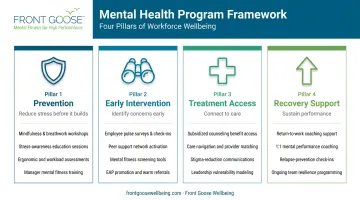
Effective programs address all four stages:
| Pillar | Goal | Example Initiatives |
|---|---|---|
| Prevention | Reduce stress before it builds | Mindfulness training, flexible work policies |
| Early Intervention | Identify concerns before they escalate | Manager training, check-in protocols |
| Treatment Access | Connect employees to care | EAP, mental health benefits, telehealth |
| Recovery Support | Help employees sustain performance after difficulty | Return-to-work planning, peer support |
Employee Assistance Programs (EAPs)
EAPs remain the most widely deployed starting point: confidential counseling, crisis support, and referrals at relatively low cost. The persistent problem is utilization. An IFEBP survey found that 49% of organizations reported EAP utilization of 6% or less.
The fixes are straightforward:
- Train managers on how to refer employees, not just that the EAP exists
- Actively promote the program through multiple channels, not just onboarding paperwork
- Remove barriers like requiring employees to schedule sessions entirely outside work hours
Mental Health Benefits and Insurance
Meaningful coverage means low copays, broad provider networks, and virtual care access. Telehealth has expanded access substantially: mental health and substance-use diagnoses accounted for 39% of all telehealth outpatient visits in 2021, per KFF data. For remote and hybrid workers especially, virtual care removes geographic and scheduling barriers that previously kept employees from accessing support.
Proactive Wellness and Mental Fitness Programs
Coverage gets employees through the door. Proactive wellness programs determine whether they build the capacity to perform before a crisis hits. Mindfulness training, resilience workshops, stress management seminars, breathwork, and mental rehearsal techniques build the cognitive and emotional capacity employees need to perform consistently under pressure.
The science supports the investment. A systematic review of workplace mindfulness-based stress reduction programs found evidence of improved employee psychological functioning. A meta-analysis of randomized workplace trials found benefits across multiple psychological outcomes.
Front Goose Wellbeing, led by Megan Dittman (a Board Certified Health & Wellness Coach and Certified Meditation Instructor from the Chopra Institute), brings this approach directly to corporate teams. Her programs are anchored in four mental fitness pillars: Mindful Awareness, Breathwork, Meditation, and Mental Rehearsal. These are the same techniques used by elite athletes, military operators, and high-level performers to stay focused under pressure, translated for corporate leadership teams.
Flexible Work Policies
Flexibility reduces chronic stress by giving employees greater autonomy over when and where they work. The U.S. Surgeon General's workplace framework specifically emphasizes "Work-Life Harmony" as a core organizational need. Options include:
- Remote or hybrid schedules
- Flexible start/end times
- Dedicated mental health days
- Compressed work weeks
One critical caveat: if senior leaders email at 10 PM, employees follow suit regardless of what the policy says. Leaders must model the boundaries they want the culture to reflect.
Psychological Safety and Anti-Stigma Culture
Programs get underutilized when employees fear judgment. Specific practices that build psychological safety:
- Regular manager check-ins that normalize conversations about workload and well-being
- Visible leadership participation in wellness activities
- Anonymous feedback channels
- Peer support groups or mental health champions
- Treating mental health as a performance topic, not a separate HR initiative
Making Leadership the Cornerstone of Mental Health Culture
Executive behavior sets the cultural tone more effectively than any policy document. When senior leaders openly discuss their own well-being, take mental health days, and model sustainable work habits, psychological safety scores rise and program participation follows. When leadership treats mental health as a compliance checkbox, employees notice. And they disengage accordingly.
What Managers Actually Need to Know
Manager training on mental health is not about turning supervisors into therapists. It's about four specific, learnable capabilities:
- Recognizing early warning signs — behavioral changes, withdrawal, declining performance, increased absenteeism
- Having supportive, non-judgmental conversations — offering help without crossing into clinical territory
- Connecting employees to resources — knowing how to refer to the EAP, HR, or the accommodations process
- Understanding confidentiality boundaries — neither oversharing nor under-supporting
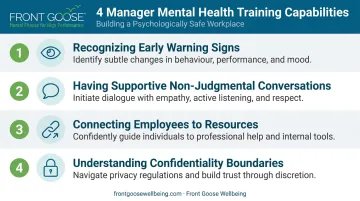
These are skills, not personality traits. They require structured training to develop.
The business case for that investment is clear. A cluster-randomized trial published in The Lancet Psychiatry tested a four-hour manager mental health training program across 128 managers and nearly 2,000 employees. Work-related sick leave fell significantly in the intervention group versus the control group — the study (conducted in the UK) estimated a return of £9.98 per £1 spent.
Despite that evidence, only 29% of workers reported in the APA's 2023 survey that their manager encouraged them to care for their mental health. The gap between what's possible and what's practiced remains wide.
Executive Mental Fitness Goes Further
For senior leaders and high-performing teams, mental fitness extends beyond basic mental health support. It means developing the capacity to stay focused under pressure, regulate emotional responses in high-stakes situations, build team resilience, and sustain performance through organizational turbulence.
Megan Dittman's work at Front Goose Wellbeing is built for exactly this level. Her 25 years as a corporate HR executive at organizations like GE and Kohler means she understands the pressures leaders actually face — not in the abstract, but from the inside. Combined with her executive coaching certification from The Neuroleadership Institute, that experience shapes programs designed to build measurable mental capacity, not just awareness.
How to Build and Roll Out Your Workplace Mental Health Program
Start With a Needs Assessment
Before designing anything, find out what the actual gaps are. Pull:
- Employee survey data on current mental health perceptions and program awareness
- Absenteeism and turnover patterns
- EAP utilization rates
- Healthcare claims data related to mental health conditions
This baseline serves two purposes: it shows where to focus first, and it gives you a measurement point to demonstrate impact later.
Phase the Implementation
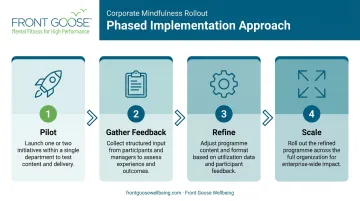
The all-at-once launch typically under-delivers. A phased approach works better:
- Pilot one or two initiatives in a single department or team
- Gather feedback from participants and managers before scaling
- Refine based on what actually got used and what didn't
- Scale the adjusted program organization-wide
Communication Is a Program Element, Not an Afterthought
Employees won't use resources they don't know about or don't trust. Build a multi-channel communication plan:
- Manager briefings that equip them to discuss resources with their teams
- Email campaigns with clear calls to action
- Intranet resource hubs employees can reference independently
- Regular reminders timed to periods of known organizational stress (budget cycles, performance review periods, etc.)
Leadership endorsement in communications consistently drives higher program uptake. A message from the CEO carries different weight than one from HR.
Resource Allocation Realities
The most impactful programs aren't always the most expensive. Several high-return interventions require modest budgets:
- Manager mental health training
- Flexible work policies
- Mindfulness and stress-reduction workshops
- EAP promotion campaigns
The ROI case is strong. Deloitte's 2024 UK employer study estimated an average return of £4.70 per £1 invested in employee mental health and well-being support — and found that prevention and early-intervention approaches consistently outperform reactive-only models. US-based research reflects similar patterns, making the investment case straightforward for most HR leaders.
Measuring What's Working
Set Baselines Before You Launch
Without pre-program data, you cannot demonstrate progress or justify continued investment. Before any initiative goes live, survey employees on:
- Current mental health perceptions
- Program awareness and trust
- Psychological safety within their team
Key Metrics to Track
Quantitative:
- EAP utilization rates
- Absenteeism and presenteeism data
- Healthcare claims related to mental health
- Employee engagement survey scores
- Voluntary turnover rates
Qualitative:
- Anonymous survey responses
- Focus group feedback
- Exit interview themes
Quantitative data reveals what is changing; qualitative feedback tells you why.
The Continuous Improvement Loop
Mental health programs that aren't revisited become outdated. Workforce composition changes, organizational stressors shift, and what resonated two years ago may not today. Review data quarterly or biannually, identify which programs are being used and which aren't, and adjust accordingly.
The NIOSH Worker Well-Being Questionnaire (WellBQ) offers a validated framework for measuring employee well-being across five domains — a practical structure for organizations that want consistent, comparable data over time.
Frequently Asked Questions
What are the workplace policies for mental health?
Workplace mental health policies are formal documents that outline an organization's commitment to employee psychological well-being, define available support resources and access procedures, establish confidentiality protections, and specify accommodation obligations under applicable law, including the ADA.
What are the best ways to support mental health in the workplace?
The most effective approaches combine a solid policy foundation with layered programs — EAPs, meaningful mental health benefits, proactive wellness and resilience training, and flexible work policies — while ensuring managers are trained to recognize and respond to early signs of distress.
Can you get a letter from a doctor to work from home due to anxiety?
Yes. Employees with anxiety or other mental health conditions may request remote work as a reasonable accommodation under the ADA. A healthcare provider's documentation is typically required as part of the employer's accommodation review process.
What should a workplace mental health policy include?
The five key components are: an organizational commitment statement, defined roles and accountability, a support resource framework, confidentiality protections, and clear accommodation procedures aligned with the ADA.
How do you measure the success of a workplace mental health program?
Track EAP utilization, absenteeism and turnover rates, employee engagement scores, and healthcare claims data — all measured against a pre-program baseline. Supplement those numbers with qualitative input from focus groups and anonymous surveys.
Does the ADA require employers to accommodate mental health conditions?
Yes. Mental health conditions that substantially limit a major life activity qualify as disabilities under the ADA. Employers must provide reasonable accommodations through an interactive process with the employee, unless doing so creates undue hardship.