
Introduction
Most professionals leave business conferences drained. Back-to-back sessions, hallway conversations, evening networking events — by day two, the brain is running on fumes. Research on prefrontal cortex function shows that extended cognitive work can more than double task-switching costs, increasing memory-based switching errors from roughly 59 milliseconds to 111 milliseconds across just three hours of demanding work. Scale that across a two-day conference, and you're making decisions and forming connections with a significantly compromised mental toolkit.
A better schedule won't solve this. A different mental approach will.
Mindfulness, applied before, during, and after an event, measurably improves focus, retention, networking presence, and the ability to turn insights into real action. The strategies below are grounded in published neuroscience — the same techniques used by elite athletes, military operators, and high-performing executives to perform under pressure. This post walks through a practical before/during/after framework so you can put them to work at your next conference.
Key Takeaways
- Even a single 10-minute mindfulness session before a conference session can improve executive attention in novice meditators
- Mindful listening creates stronger rapport — asking follow-up questions alone makes you more likeable and memorable to the people you meet
- Post-conference reflection within 24 hours dramatically increases how many insights actually make it into your work
- Google, Aetna, Intel, General Mills, and SAP have all embedded structured mindfulness programs into leadership development
- The World Economic Forum's 2024 Davos meeting included a dedicated Mindfulness in Continuum session, signaling mindfulness has reached the mainstream leadership agenda
Why Business Conferences Demand a Mindful Approach
The Cognitive Load Problem
Conferences aren't just stimulating — they're cognitively expensive. Every session, hallway conversation, and lunch decision draws from the same finite pool of mental resources. Neuroscience research links this kind of sustained high-stimulation work to impaired prefrontal cortex-dependent control, the part of the brain responsible for working memory, flexible thinking, and impulse regulation.
Decision fatigue compounds this. As mental resources deplete, the quality of choices — who to approach, which sessions to prioritize, how to respond in a panel Q&A — declines. Attendees don't always notice it happening, which makes it more dangerous.
The Mindfulness Counter-Argument
Mindfulness works on this problem at a neurological level. Eight weeks of Mindfulness-Based Stress Reduction (MBSR), averaging 27 minutes per day, was associated with increased gray-matter concentration in brain regions involved in learning, memory, and self-referential processing. Even shorter, more acute practice shows real results: a single 10-minute guided mindfulness session improved executive attentional control in novice meditators in controlled research conditions.
This matters at conferences because attention is the bottleneck. Better attention means better encoding of what speakers say, better quality networking conversations, and fewer reactive decisions made from a place of depletion.
The Corporate Performance Case
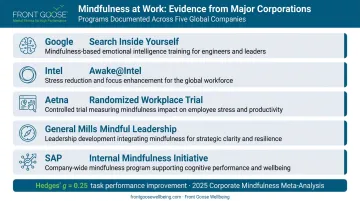
The business adoption of mindfulness is no longer niche. Documented corporate commitments include:
The business adoption of mindfulness is no longer niche. Documented corporate commitments include:
- Google's Search Inside Yourself program
- Intel's Awake@Intel course
- Aetna's randomized workplace trial
- General Mills' Mindful Leadership program
- SAP's internal mindfulness initiative
A 2025 systematic review and meta-analysis of randomized controlled trials found that workplace mindfulness programs improved task performance versus passive controls (Hedges' g = 0.25). That's a real, measurable effect.
For skeptics: this is performance science. The same mental conditioning principles used by Olympic athletes and military operators apply just as well in the conference room.
Before the Conference: Priming Your Mind for Peak Performance
Set an Intention Before You Arrive
The week before a conference, take 5–10 minutes to write down your top two or three goals. Not a list of sessions to attend — actual outcomes:
- A specific type of connection you want to make
- One decision you're hoping to get clearer on
- A key insight you want to bring back to your team
Pairing this with a few minutes of focused breathing anchors the exercise in the body, not just the calendar. This kind of purposeful framing primes the brain for selective attention — you notice relevant information more readily when you've told your mind what to look for.
Build a Daily Practice the Week Before
A single pre-conference meditation won't do much. The research is clear: 13 minutes per day for eight weeks improved attention, working memory, mood, and emotional regulation in meditation-naive adults. Four weeks at the same dose produced no significant effect. Consistency, not intensity, creates the neural conditioning that holds up under pressure.
For organizations sending teams to the same conference, Front Goose Wellbeing's corporate mindfulness training programs offer a structured way to build this foundation together before the event.
Schedule White Space Into Your Agenda
Conference FOMO is real, but packing every slot is counterproductive. The brain needs downtime to consolidate what it's just absorbed. Neuroscience research on the default mode network shows it activates during wakeful rest and plays a role in long-term memory consolidation, meaning the brain continues processing what you've learned during periods of quiet.
Build in 10–15 minute breaks between sessions. Use them to:
- Sit quietly without a screen
- Step outside for a short walk
- Do nothing — deliberately
This isn't wasted time. It's consolidation time.
During the Conference: Mindfulness Tips That Drive Better Results
Arrive With a Focused Presence Ritual
Before walking into any major session, take two to three minutes to reset. Options that work:
- Box breathing — inhale 4 counts, hold 4, exhale 4, hold 4
- Body scan — briefly notice tension in your shoulders, jaw, or hands and consciously release it
- One-sentence intention — "I'm here to understand how this topic applies to our Q3 challenge"
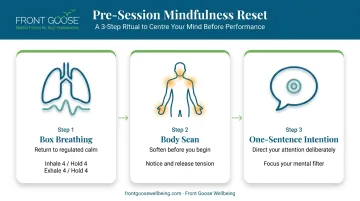
This isn't ceremonial. Transitioning from a loud hallway or overstimulating networking space into a session without any reset means carrying residual mental noise into the room. The short pause interrupts that pattern and sharpens focus for what's about to be presented.
Mindful Listening for Deeper Retention
There's a real difference between hearing a speaker and processing what they're saying. Mindful listening means:
- Phone face-down or out of reach
- Noticing when attention drifts and returning to the speaker without self-judgment
- Pausing between key points to briefly connect the insight to your own work context
On note-taking: the handwriting vs. typing debate has mixed replication results in recent research. Regardless of medium, the reflective pause between recording points is where retention actually improves. That moment of "how does this connect to what I'm dealing with?" is a lightweight mindfulness technique that strengthens memory consolidation.
Mindful Networking: Less Anxiety, Better Connections
Those same listening skills carry directly into networking — where the stakes feel higher and the mental noise gets louder. Networking triggers a genuine stress response for most people. Before entering a networking situation, try a three-breath reset: slow inhale, slow exhale, repeat. It activates the parasympathetic nervous system and shifts the body out of a mild threat state. You'll ask better questions and actually remember the answers.
The reframe that makes networking easier: treat it as curiosity practice, not performance. Harvard Business School research found that people who ask more questions — especially follow-up questions — are rated as significantly more likeable because they come across as genuinely responsive. That means listening fully before formulating a reply, and asking what you actually want to know rather than pivoting to your own talking points.

After the Conference: Sustaining Mindfulness Momentum
The implementation gap is real. Most conference insights never become action — not because the ideas were bad, but because the daily grind reclaims attention within 72 hours of returning.
A short post-conference mindfulness debrief changes this. Within 24 hours of getting home, spend 10 minutes in a quiet space asking:
- What was the single most meaningful thing I heard?
- What do I want to do differently because of it?
- What's one commitment I'm willing to make to my team?
Writing these down matters. Articulating them while they're still fresh consolidates the memory and gives you something concrete to act on, not just a vague sense that the conference was "valuable."
Sharing Insights Mindfully as a Team
When multiple people attend the same conference, the debrief has organizational power. A simple three-part structure works well:
- One key learning — something that genuinely shifted your thinking
- One intended behavior change — specific, not abstract
- One team commitment — something the group agrees to try together
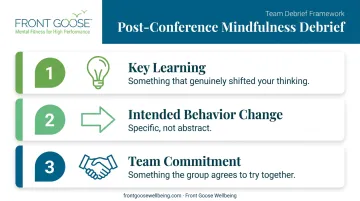
This format prevents the typical post-conference download (a 45-minute brain dump that no one acts on) and creates shared accountability. Research on team mindfulness links shared present-focused attention to lower interpersonal conflict and stronger psychological safety, both of which give new ideas a real chance to take hold.
For organizations ready to move beyond conference inspiration, Front Goose Wellbeing's corporate mindfulness training programs translate neuroscience-backed practices into structured, measurable behavior change that persists long after the event ends.
What Makes a Mindfulness Business Conference Worth Attending
Not all mindfulness conferences are created equal. The ones worth your time share a few common markers:
- Corporate speakers, not just practitioners — leaders from operating companies who can speak to implementation challenges, not only ideal-case scenarios
- Concrete implementation content — sessions that end with a roadmap, not just inspiration
- Cross-industry representation — when financial services, manufacturing, healthcare, and tech are all in the room, the conversation moves from "should we do this?" to "how do we do this well?"
Attend as a team when you can. Individual conference attendance often ends with one person evangelizing and everyone else skeptical. When colleagues experience the same sessions together, the shared reference point makes it easier to build on what was learned back at work.
The difference comes down to shared context and accountability. Teams that process the same content together are far more likely to act on it.
That broader shift is also showing up on the biggest stages. The World Economic Forum's 2024 Annual Meeting in Davos included a dedicated session titled "Mindfulness in Continuum" on the official agenda. This is no longer a fringe add-on — it's core leadership development content, and the conferences worth attending treat it that way.
Frequently Asked Questions
What companies practice mindfulness?
Google, Intel, Aetna, General Mills, SAP, and Salesforce all have documented internal mindfulness programs. Google's Search Inside Yourself program, Aetna's randomized workplace trial, and Intel's 10-week Awake@Intel course are among the most frequently cited. Each has embedded these programs into leadership development to improve performance and reduce healthcare costs.
What are the 3 C's of mindfulness?
The 3 C's are commonly referenced as Clarity (seeing situations without distortion), Calm (regulating emotional and physiological reactivity), and Compassion (including self-compassion under pressure). In business contexts, these translate to clearer decision-making, steadier leadership presence, and stronger team relationships.
How do you practice mindfulness during a business conference?
Set a one-sentence intention before each session, practice mindful listening by putting your phone away and noticing when your attention drifts, take three slow breaths before networking interactions, and build in 10–15 minute quiet breaks between sessions for consolidation.
What is the ROI of mindfulness in the workplace?
A 2025 meta-analysis of randomized controlled trials found workplace mindfulness programs improved task performance versus passive controls at Hedges' g = 0.25 — a statistically significant effect. SAP internally reported 200% ROI from its mindfulness initiative, as cited by Reuters, though this reflects SAP's internal calculation, not an independent audit.
Can mindfulness help with networking at conferences?
Yes. Mindfulness reduces the stress response that makes networking feel threatening, improves active listening quality, and promotes genuine curiosity — all of which research links to stronger rapport. Asking follow-up questions, a natural output of mindful listening, measurably increases how much people like and remember you.
How long does it take to see benefits from mindfulness at work?
Some attention and stress benefits appear after a single 8–10 minute session. Sustained improvements in attention, emotional regulation, and working memory develop over weeks of consistent practice — research points to 13 minutes per day for eight weeks as a meaningful threshold.