
Introduction
Two professionals with identical training, identical experience, and identical resources walk into a high-stakes situation. One performs. One falters. The training didn't change. The knowledge didn't change. What changed was what was happening between their ears.
That gap is what performance psychology exists to close.
Performance psychology is the applied science of optimizing how people think, feel, and behave under pressure. Originally developed for elite athletes, it now reaches well beyond the locker room into surgery suites, military units, concert halls, and boardrooms.
According to APA Division 47, the field focuses on helping people perform consistently near the upper range of their capabilities — and enjoy the process.
The same mental techniques that give Olympic athletes and military operators an edge under pressure are directly applicable to corporate leaders, executive teams, and high-performing professionals. This article breaks down how to build those skills deliberately. Not as a fixed personality trait, but as a trainable capability.
Key Takeaways
- Performance psychology applies psychological principles to optimize performance in business, medicine, sports, and the military
- Core mental skills — confidence, focus, commitment, and emotional control — are trainable, not fixed
- Techniques like visualization, self-talk, mindfulness, and pre-performance routines are backed by neuroscience
- Deloitte found that 82% of senior leaders show exhaustion levels indicative of burnout risk
- Building mental fitness follows the same logic as physical training: consistency and repetition produce results
What Is Performance Psychology?
Performance psychology is the study and application of psychological principles to optimize how individuals think, feel, and behave in high-stakes situations. The field spans a wide range of high-demand contexts:
- Surgeons managing cognitive load in the OR
- Special Operations Forces maintaining decision quality under threat
- Musicians performing under stage lights
- Executives navigating rapid decisions, team conflict, and sustained output across long days
How It Differs from Therapy
This distinction matters: performance psychology is not mental health treatment. Clinical psychology addresses disorders and restores functioning. Performance psychology starts with healthy, capable people and asks a different question — not how to restore baseline functioning, but how to extend it. The work isn't about fixing what's broken. It's about training someone to use what they already have more deliberately — including emotions like anxiety, which can sharpen focus rather than derail it.
Who It's For
The populations that benefit most directly include:
- Corporate executives and leadership teams managing high cognitive and emotional load
- Elite athletes preparing for competition and recovering from setbacks
- Surgeons, military operators, and first responders in life-and-death decision environments
- Performing artists executing under public scrutiny
This is the work that Front Goose Wellbeing brings to organizations — translating the same mental fitness techniques used by Olympic competitors and military operators into practical tools for corporate leaders and high-performing teams.
The Core Mental Skills Behind Peak Performance
Think of psychological skills the way you'd think of physical conditioning. A swimmer doesn't walk into the pool on race day hoping natural talent carries them — they've built specific capacities through structured repetition. Mental skills work exactly the same way.
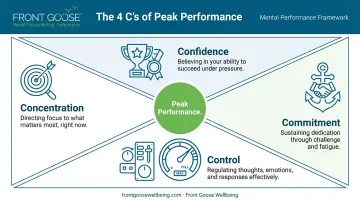
A widely used organizing framework in the field groups these capacities into four areas, often called the 4 C's: Confidence, Concentration, Commitment, and Control.
Confidence and Self-Efficacy
In performance psychology, confidence isn't about bravado. It's about a well-founded belief in your ability to execute a specific task under specific conditions. That distinction — task-specific confidence — matters.
A landmark meta-analysis by Stajkovic and Luthans across 114 work studies and more than 21,000 participants found a correlation of r=.38 between self-efficacy and work performance. An r=.38 effect size rivals the predictive strength of intelligence tests for job performance — and it's built through:
- Mastery experiences that create firsthand evidence of competence
- Quality preparation that makes execution feel familiar under pressure
- Deliberate self-talk practice that reinforces accurate, specific beliefs
Generic affirmations don't move the needle. Accumulated proof does.
Concentration and Focus
High-pressure situations are cognitively noisy. Past mistakes replay, future outcomes loom, and distractions accumulate fast. Peak performers develop something that looks like a superpower from the outside but is actually a trainable skill: the ability to narrow attention to what is controllable and present.
This isn't suppression of worry — it's redirection of attention, and it gets sharper with deliberate practice.
Commitment and Motivation
Sustained effort across setbacks, plateaus, and long timelines requires more than incentives. A 40-year meta-analysis across 212,000 participants found that intrinsic motivation — autonomy, meaning, personal values — predicts performance quality more reliably than external rewards. External rewards drive output volume; purpose drives the quality of execution when no one's watching.
Top performers connect their goals to values that don't expire when the external reward disappears.
Emotional Control and Stress Regulation
Stress is not the enemy. Unmanaged stress is. Performance exists on a curve: neither zero activation nor maximum pressure produces optimal results. There's a personal calibration point — a level of arousal at which attention sharpens, decisions quicken, and execution flows.
The goal isn't to eliminate pressure. It's to develop the capacity to stay in your optimal zone when external conditions are trying to push you out of it.
Top Performance Psychology Tips for Achieving Peak Mental Skills
Tip 1 — Visualization and Mental Rehearsal
Before the high-stakes moment, the brain can rehearse it. Visualization involves mentally running through a scenario in vivid, multi-sensory detail — not as a fantasy of perfect outcomes, but as a realistic simulation that includes obstacles and composed responses to them.
The evidence is compelling. A randomized trial of surgical trainees found that those who practiced structured mental rehearsal scored higher on technical performance measures than controls (p=.003 for each assessment). The same principle applies to business presentations, difficult negotiations, and leadership conversations.
How to practice it:
- Find a quiet environment and close your eyes
- Run through the scenario from start to finish — including challenging moments
- Visualize yourself responding with composure and competence
- Engage multiple senses: what do you see, hear, feel?
- Practice for 5-10 minutes before high-stakes situations
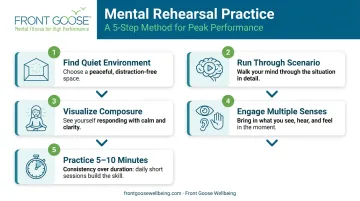
Mental Rehearsal is one of the four core pillars Front Goose Wellbeing teaches through its Mental Performance Coaching — used with executives, athletes, and performers to build this capacity systematically, not just situationally.
Tip 2 — Goal Setting with Purpose
There are two types of goals. Outcome goals focus on results: winning the deal, hitting the number. Process goals focus on behaviors within your control: the quality of preparation, the questions you ask, the composure you maintain.
High performers concentrate primarily on process goals. The goal isn't to lower expectations — it's to anchor attention where it can actually make a difference. When you're in the middle of a difficult negotiation, obsessing over whether you'll close it adds anxiety without adding capability.
Process focus keeps attention on execution. It also builds intrinsic motivation over time, because every time you execute the process well, you accumulate evidence of competence.
Tip 3 — Self-Talk and Cognitive Reframing
The inner monologue running during high-pressure moments either supports or sabotages performance. And most people have never examined it.
A meta-analysis of 32 studies found that self-talk produced a moderate mean effect size of ES=.48 on performance. Instructional self-talk — cues that direct attention and technique — worked particularly well for precise, skill-based tasks. Motivational self-talk helped with effort and endurance.
In a business context, this might look like replacing "I always freeze in front of senior leaders" with "I know this material — focus on the first question." That's not toxic positivity. The reframe doesn't deny the pressure; it changes how the brain interprets it, which directly affects cognitive functioning in the moment.
Tip 4 — Pre-Performance Routines
Routines reduce the cognitive cost of transitioning into a high-performance state. When a cue is consistent enough — a breathing sequence, a physical reset, a brief moment of focus — the brain learns to associate it with concentrated, regulated performance.
This applies to sales calls, leadership presentations, difficult conversations, and any moment where you need to show up at your best.
Even a 2-3 minute routine works. Try:
- Box breathing: 4 counts in, 4 hold, 4 out, 4 hold
- A brief scan of your physical state (tension in shoulders? jaw?)
- One clear intention for the interaction — not an outcome, a behavior
The routine signals readiness. Over time, it becomes a reliable on-switch.
Tip 5 — Mindfulness and Present-Moment Awareness
Mindfulness is frequently mischaracterized as relaxation. It isn't. It's attention training — specifically, the capacity to notice when your mind has drifted and redirect it without judgment.
A distracted mind in a high-stakes meeting doesn't just miss information. It makes worse decisions, communicates less clearly, and recovers more slowly from unexpected developments.
A 2020 meta-analysis of 56 randomized controlled trials found mindfulness training produced meaningful effects on workplace stress (g=-0.66), job satisfaction (g=0.48), and productivity (g=0.35). Six weeks of consistent practice produced measurable benefits. That's a reasonable investment for a leadership team.
Front Goose Wellbeing's Corporate Mindfulness Training programs are built around this evidence base — combining mindful awareness, breathwork, and meditation into training curricula that range from single-session workshops through multi-month cohort programs, delivered to organizations including GE Aerospace and Kohler Corp.
Tip 6 — Resilience Building and Setback Recovery
Resilient performers don't avoid failure. They have a reliable process for handling it.
The key mechanism here is cognitive reappraisal: interpreting a setback as information rather than evidence of inadequacy. In one study, participants who habitually reappraised negative feedback then outperformed comparable peers on a subsequent task. The failure didn't slow them down — it fed directly into the next performance.
A structured recovery process looks like:
- Name it: Acknowledge what happened without dramatizing it
- Extract it: What specific information does this provide?
- Control it: What is actually within your control going forward?
- Release it: Self-compassion isn't weakness — it's what prevents rumination from eating into the next performance
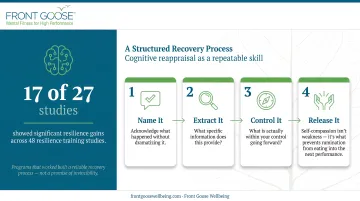
A scoping review of 48 resilience training studies found significant resilience gains in 17 of 27 studies that measured this outcome. The programs that worked shared a common thread: they didn't promise invincibility. They built a reliable recovery process. A scoping review of 48 resilience training studies found significant resilience gains in 17 of 27 studies that measured this outcome. The programs that worked shared a common thread: they didn't promise invincibility — they built a reliable recovery process.
This is the same logic behind Front Goose Wellbeing's Mindset coaching capacity, which helps executives and high performers develop cognitive reappraisal as a repeatable skill, not a one-time intervention.
Applying Performance Psychology in High-Pressure Business Settings
Deloitte's 2022 survey of more than 1,100 senior leaders found that 82% reported exhaustion indicative of burnout risk, and 51% were considering leaving their roles. That's not a minor talent management issue — it's a performance crisis at the top of the organization.
The cognitive and emotional demands on business leaders are real: rapid decisions under uncertainty, sustained output across long periods, managing team dynamics, and maintaining composure during conflict. The mental skills that help athletes compete at the highest level are directly transferable.
Embedding Techniques Without Overhauling Your Day
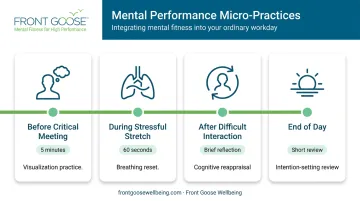
None of this requires carving out hours. Effective mental skills practice can live inside an ordinary workday:
- Before a critical meeting: 5-minute visualization of key moments and your composed responses
- During a stressful stretch: A 60-second breathing reset between back-to-back demands
- After a difficult interaction: Brief cognitive reappraisal — what happened, what it tells you, what you control
- End of day: A short reflection that processes emotional residue and sets tomorrow's intention
The Team Dimension
Individual mental fitness doesn't stay individual. Leaders who model calm under pressure and composure during conflict set a behavioral standard that teams absorb. Group cohesion, trust, and collective resilience are all downstream of the mental skills the people in the room are actively developing.
Front Goose Wellbeing's work with executive teams — including organizations across aerospace, manufacturing, and engineering — operates from a core conviction: when mental fitness is cultivated at the leadership level, it changes how the whole team performs.
The Neuroscience Behind Performance Psychology Strategies
These techniques aren't motivational theory. They're grounded in how the brain actually functions under pressure — and how it changes with practice.
What Happens Under Stress
Neuroscientist Amy Arnsten's research explains the mechanism: under high or uncontrollable stress, elevated catecholamines and glucocorticoids weaken prefrontal cortex firing and connectivity. The prefrontal cortex governs executive decision-making, focused attention, and emotional regulation. When it goes offline — even partially — decision quality drops, attention narrows in unhelpful ways, and emotional reactivity increases.
The amygdala, meanwhile, amplifies threat responses. In a predator-threat context, that's adaptive. In a quarterly review, it's counterproductive.
How Practice Changes the Brain
That stress response is real — but it's also trainable. Neuroplasticity, the brain's capacity to rewire itself through repeated experience, is what makes mental skills training durable rather than momentary.
A study by Hölzel and colleagues compared 16 participants who completed an eight-week Mindfulness-Based Stress Reduction program against a wait-list control group. Brain imaging detected increased gray-matter concentration in the left hippocampus and changes in regions associated with learning, memory, and emotional regulation.
It was a small study with a passive control — but it supports neuroplasticity as a documented mechanism, not a metaphor.
Separate research found that short-form mindfulness training protected working memory from degradation across high-demand periods in military cohorts. For leaders, that protection translates directly to performance under pressure:
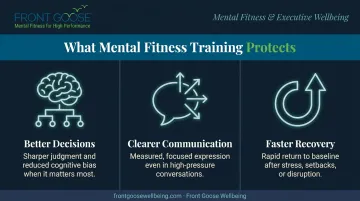
- Better decisions when complexity spikes
- Clearer communication during high-stakes conversations
- Faster recovery after disruption or setbacks
Mental fitness is a trainable neurological capability — one that responds to structured practice the same way physical fitness responds to exercise.
Frequently Asked Questions
What is the meaning of performance psychology?
Performance psychology is the science and practice of applying psychological principles to help individuals and teams perform at their best under pressure. Its scope spans sports, business, medicine, military operations, and the performing arts — wherever mental readiness directly determines results.
What does a performance psychologist do?
A performance psychologist works with individuals and teams to develop mental skills like focus, confidence, emotional regulation, and resilience through evidence-based techniques: visualization, self-talk training, mindfulness, and goal-setting. The aim is consistent, high-level performance under pressure — not clinical diagnosis or treatment.
What are the 4 C's of performance?
The 4 C's — Confidence, Concentration, Commitment, and Control — identify the core psychological capacities high performers develop to excel under pressure. They function as a practical framework for assessing and building mental readiness across demanding environments.
How is performance psychology different from sports psychology?
Sports psychology is a subset focused specifically on athletic performance. Performance psychology applies the same mental skills framework to any high-stakes domain — business leadership, surgery, emergency response, military operations, and the performing arts — wherever pressure and mental readiness interact.
Can performance psychology techniques be learned without a coach?
Many foundational techniques — mindfulness, self-talk awareness, visualization, breathing routines — can be self-taught through consistent practice. Working with a certified performance or mental fitness coach accelerates skill development and provides the accountability that makes practice stick.
How long does it take to see results from performance psychology practices?
Short-term training produces measurable changes. Six weeks of workplace mindfulness practice delivered significant stress-reduction benefits in a randomized controlled trial; eight-week MBSR programs have produced detectable changes in brain structure. Individual results depend on consistency and practice quality.