Introduction
Picture this: you're an HR manager with two weeks until an all-hands meeting. Leadership has asked you to put together a stress management presentation. You know the topic matters — employees are stretched thin and everyone can feel it. But when you open PowerPoint, the cursor blinks at you.
What do you include? How do you avoid the slide deck that gets politely applauded and immediately forgotten?
According to APA's 2023 Work in America Survey, 77% of employed U.S. adults reported work-related stress in the prior month, with nearly a third experiencing emotional exhaustion as a result. That's not a fringe issue. That's the room you're presenting to.
So the bar isn't just a polished deck — it's a presentation that actually lands. This guide gives you a practical roadmap: which slides to build, how to structure the narrative, science-backed content to include, and design choices that signal safety rather than corporate checkbox. A presentation that opens a real conversation — not one that gets filed under "wellness initiatives we've done."
Key Takeaways
- Start with empathy and a relatable hook, not definitions or data
- Structure slides around six topics: definition, health costs, performance impact, individual strategies, organizational responsibility, and next steps
- Follow a problem → impact → solution arc to keep the audience engaged
- One interactive moment meaningfully improves psychological safety and audience retention
- A presentation opens the conversation; ongoing support is what creates lasting change
Must-Have Slides: What Your Stress Management PowerPoint Should Cover
A strong stress management deck has six non-negotiable slides. Here's what each one needs to do.
Slide 1 — Define Workplace Stress
Before you can talk about solutions, employees need to see themselves in the problem. Start with a clear, human definition — not clinical language about "psychosocial hazards."
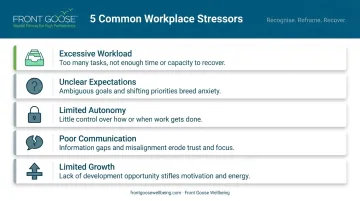
Common workplace stressors to list on this slide:
- Excessive or unmanageable workloads
- Unclear expectations or shifting priorities
- Limited autonomy over how work gets done
- Poor communication from leadership
- Limited growth opportunities or feeling stuck
The goal here is recognition. When someone in the audience thinks "that's exactly what I'm dealing with," you've earned their attention for the rest of the presentation.
Slide 2 — The Real Cost of Chronic Stress
This slide humanizes the data. Don't just list health consequences — explain what they feel like at work on a Tuesday afternoon.
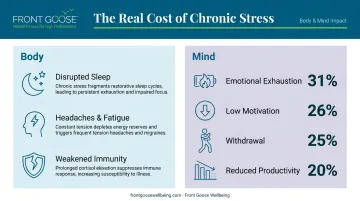
Physical effects to include:
- Disrupted sleep (a review of 38 studies found 92% reported a significant negative relationship between occupational stress and sleep quality)
- Headaches and fatigue
- Weakened immune response
Psychological and behavioral effects (from APA's survey):
- Emotional exhaustion — reported by 31% of stressed workers
- Low motivation (26%), withdrawal (25%), and irritability (19%)
- Reduced self-reported productivity (20%)
Keep this slide visual. A simple two-column layout — body vs. mind — lands better than a paragraph of text.
Slide 3 — The Stress-Performance Connection
High performers often don't recognize stress as a problem until it becomes a crisis. This slide makes the performance case.
The prefrontal cortex, responsible for working memory, decision-making, planning, and emotional regulation, is directly disrupted by both acute and chronic stress. A 2024 systematic review confirmed that shift work, occupational stress, and prolonged working hours have detrimental effects on cognitive functioning.
Translate this practically for your audience: stress doesn't just feel bad. It makes people slower, more reactive, and worse at the exact decisions their jobs require.
Slide 4 — What Individuals Can Do
The goal is a short menu of evidence-supported habits, not a lecture on self-care.
- Set boundaries around work hours — protecting recovery time is not a luxury, it's a performance strategy
- Move your body — even short bouts of physical activity reduce physiological stress markers
- Prioritize sleep — chronic sleep disruption amplifies stress reactivity
- Build social support — workplace relationships buffer stress; isolation amplifies it
- Use breathwork — five minutes of daily cyclic sighing improved positive affect and reduced physiological arousal in a randomized study of 108 adults; the technique involves a slow inhale through the nose followed by a longer exhale through the mouth
Teams that want to build these habits systematically, rather than through a single slide, benefit from structured practice. Front Goose Wellbeing's corporate mindfulness training develops breathwork, mindful awareness, and meditation as repeatable skills across workshops and multi-session cohort programs.
Slide 5 — What the Organization Can Do
This slide is critical for credibility. If the entire deck puts the burden on individual employees, you'll lose the room.
Organizations have a direct role in stress levels:
- Psychological safety is measurable: 61% of workers with low psychological safety reported daily tension or stress, compared to 27% with high psychological safety
- EAP utilization, not just access: As of March 2025, 62% of U.S. civilian workers had access to an Employee Assistance Program, but access alone isn't enough. Employees need to know what's available and feel safe using it
- Manager behavior sets the tone: consultative, supportive leadership is directly associated with lower reported stress, while authoritative leadership undermines it
- Workload design has the largest lever: a meta-analysis of organizational interventions found workload-focused programs had the greatest effect on reducing employee exhaustion
This slide shifts the framing from "your stress is your problem" to "we share responsibility for the conditions here."
Slide 6 — Resources and Next Steps
Every presentation needs a clear "what now." Without it, even excellent content evaporates by the next morning.
Include on this slide:
- Internal resources (EAP contact, wellness program details, HR point of contact)
- A simple reflection prompt: "What's one thing you'll do differently this week?"
- A team commitment activity if presenting to a group (everyone writes one commitment and shares with a partner)
- Upcoming support opportunities — workshops, manager training, or external programming
Make the next step concrete and low-effort. A QR code to an EAP sign-up or a one-sentence action prompt does more than a detailed resource list that requires follow-up research.
How to Structure Your Presentation for Maximum Impact
Getting the slide content right is half the job. How you sequence and deliver it determines whether the content lands.
Start With Empathy, Not Data
The fastest way to lose an audience is to open with a definition or a statistic. Open instead with something that makes people feel seen — before you've shared a single piece of information.
Options that work well:
- A brief, relatable scenario ("Imagine it's 4pm on a Thursday. You have 47 unread emails, a 5pm deadline, and your manager just added a last-minute request...")
- A single, surprising number delivered without commentary — let it sit for a moment
- A direct question: "Raise your hand if you've felt genuinely overwhelmed at work in the last two weeks"
Any of these signals that you understand what's already happening in the room — and earns you the attention to keep going.
Follow a Problem → Impact → Solution Arc
This narrative structure works particularly well for wellbeing topics because it mirrors how people actually process difficult information.
- Problem — stress is real, it's widespread, and it's likely sitting in this room right now
- Impact — name the costs: health, focus, retention, and organizational performance
- Solution — what individuals can do, and what the organization commits to doing alongside them
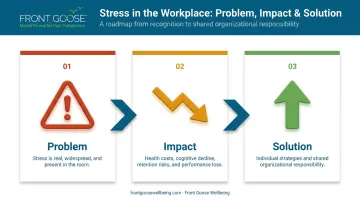
The arc prevents the session from feeling like a lecture — each section earns the next, and the audience arrives at solutions rather than just absorbing them.
Build In One Interactive Moment
Participation improves both retention and psychological safety. You don't need multiple exercises — one well-placed interaction does the work.
Good options for corporate settings:
- Anonymous pulse poll at the opening: "How stressed have you felt this week?" (scale of 1-5)
- A brief breathing exercise mid-deck — two minutes of slow breathing before the solutions section
- A virtual chat prompt: "What's your biggest work stressor right now?" (no names required)
An opening poll is particularly useful: the responses give you live, room-specific data you can reference throughout the session rather than relying solely on industry statistics.
Once you've planned your interactions, the next decision is visual design — and this is where most wellbeing decks quietly fall apart.
Design for Clarity, Not Density
Common mistakes in wellbeing decks:
- Twelve bullet points per slide
- Dense paragraphs of text read verbatim
- More than 20 slides for a 45-minute session
Practical guidelines:
- One key idea per slide
- Use visuals, not text walls
- Aim for 12-18 slides for a 30-45 minute session
- Use 24-point minimum font size — this is both an accessibility best practice and a design discipline that forces slide simplicity
Science-Backed Content to Strengthen Your Slides
Data gives a stress management presentation credibility. These are the research areas worth including.
The Neuroscience of Stress (Without the Jargon)
Grounding stress in biology shifts the frame from personal weakness to physiology. Here's how to explain it accessibly:
When the brain perceives a threat — a difficult conversation, an impossible deadline, an ambiguous email from a VP — it activates the body's stress response. The physiological effects happen fast:
- Heart rate spikes, digestion slows
- The prefrontal cortex (responsible for clear thinking, decisions, and emotional regulation) goes partially offline
- The system stays activated long after the threat has passed
For most workplace stressors, that response never fully resolves. The same system designed for short-term emergencies runs on a slow burn. Over time, this disrupts sleep, impairs memory, and makes sustained focus increasingly difficult.
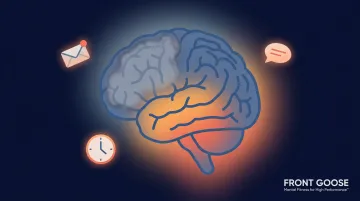
The key message for employees: this isn't a character flaw. It's biology. And biology can be trained.
Breathing as a Tool, Not a Platitude
Telling employees to "just breathe" lands as dismissive. But teaching a specific, evidence-supported technique is different.
A 2023 randomized study of 108 adults found that five minutes of daily cyclic sighing — a technique involving a double inhale through the nose followed by a slow exhale through the mouth — produced the largest improvement in positive affect compared to other breathing methods tested, including mindfulness meditation. It also reduced resting respiratory rate.
This is practical enough to demonstrate in the room. A two-minute guided practice during the presentation gives employees something they can use the next morning.
Front Goose Wellbeing's breathwork training builds on this research base, giving teams structured, repeatable practice in techniques designed to perform under real workplace pressure.
The Manager Variable
Individual techniques like breathwork address one side of the stress equation. The other is the environment employees return to after the presentation ends — and that's where management comes in.
The numbers are direct: 61% of workers with low psychological safety reported daily tension or stress, compared to 27% of those with high psychological safety. Separately, workers who said managers negatively affected their mental health were far less likely to believe in their organization's mission (43% vs. 91%).
If managers are in the room, this slide has particular weight. It makes the case that leadership behavior is a stress variable — not just a soft-skills talking point.
Turning Your Presentation Into a Workplace Action Plan
A well-built stress management presentation opens a door. It doesn't solve the problem.
The most common failure mode is treating a presentation as the initiative. Employees feel heard for about 48 hours, then the pressures that caused the stress return unchanged.
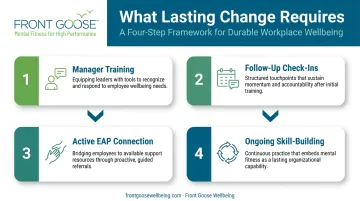
What lasting change actually requires:
- Manager training in recognizing and responding to stress signals
- Follow-up team check-ins (even 10-minute structured conversations help managers catch stress signals before they compound)
- Connecting employees to EAP or wellness resources — not just mentioning they exist, but actively facilitating access
- Ongoing skill-building in the techniques introduced during the presentation
Organizations that move beyond awareness bring in certified experts to facilitate workshops, breathwork training, and structured mental fitness programming. Front Goose Wellbeing has done this work with GE, Kohler, and mid-market leadership teams across the US — building programs rooted in the same neuroscience behind the presentation content, extended into skills employees actually practice over time.
If this presentation is the starting point for a broader wellbeing initiative, a discovery call with Megan Dittman is the right next move — she'll map a program to your team's specific needs and organizational context.
Frequently Asked Questions
What topics should a managing stress in the workplace presentation cover?
Cover workplace stress definition, its physical and psychological health effects, its impact on performance and decision-making, common causes (workload, lack of autonomy, unclear expectations), individual coping strategies, and the employer's role in creating lower-stress conditions. Each of these connects directly to what employees are already experiencing.
How many slides should a workplace stress management PowerPoint have?
Aim for 12-18 slides for a 30-45 minute session. One clear idea per slide outperforms dense decks every time — employees should leave remembering three to four key points, not scrolling through a 40-slide PDF.
How do I make a stress management presentation more interactive?
Open with an anonymous pulse poll on current stress levels, include a two-minute breathing exercise mid-session, and close with a personal commitment activity or paired reflection. Even one of these shifts the experience from passive listening to active participation.
What are the most important causes of workplace stress to address?
The five most common and impactful stressors are excessive workload, lack of control over work decisions, unclear expectations, limited growth or advancement, and poor manager-employee communication. Address these specifically — generic stressor lists lose the audience.
How can managers support employees after a stress management presentation?
Schedule brief one-on-ones in the two weeks after the presentation, normalize stress in regular team conversations, and actively connect employees to EAP or wellness resources — not just mention they exist. Manager follow-through is the single biggest variable in whether the content actually changes behavior.
What's the difference between a stress management presentation and a workplace wellness program?
A presentation raises awareness and gives employees a starting framework. A wellness program provides sustained skill-building, coaching, and accountability over weeks or months. The most effective organizations use the presentation to open the conversation, then follow it with structured programming that builds those skills over time.