

Introduction
Picture this: your company just lost a major client, two key leaders are burning out, and the board wants answers by Friday. Some leaders freeze. Others get sharper. What separates them isn't personality or raw intelligence — it's a trainable mental skill called mental toughness.
The data backs this up. Research among 534 employees found that mental toughness correlated with psychological well-being (r=.680) and organizational commitment (r=.547) — numbers that move any C-suite or HR leader from curious to convinced.
Here's what this article covers:
- What mental toughness actually means for business professionals
- The research-backed 4 C's framework coaches and leaders can apply
- The neuroscience that makes mental toughness trainable
- Five practical techniques to build it in yourself and your team
Key Takeaways
- Mental toughness is not a fixed trait — the brain physically rewires through consistent practice
- The 4 C's model (Control, Commitment, Challenge, Confidence) gives coaches a research-backed framework
- Resilience and mental toughness are related but distinct — and targeting each requires different coaching strategies
- Visualization, breathwork, and goal-setting produce documented improvements in focus, stress response, and performance under pressure
- Leaders who actively coach mental toughness create teams that stay focused and perform when pressure is highest
What Mental Toughness Really Means for High Performers
Mental toughness is the ability to stay focused and emotionally regulated even when conditions are unpredictable. It shows up not just in sport — it's what carries an executive through a hostile acquisition, a product launch going sideways, or a leadership role where the pressure simply doesn't let up.
Mental Toughness vs. Resilience
These terms get used interchangeably, but the distinction matters — especially for how you develop each one.
Resilience is about recovery — bouncing back after a significant setback. Mental toughness is broader: it sustains performance throughout pressure, with or without an acute crisis present.
A useful distinction for business leaders: resilience is recovering after a product failure. Mental toughness is the capacity to keep executing at your best during the pressure-filled launch itself — before anything has officially gone wrong.
A 2017 systematic review confirms this distinction formally: resilience presupposes significant risk or adversity, while mental toughness predicts responses in both adverse and ordinary circumstances. Training for mental toughness, then, means building a capacity that performs across the full spectrum — not just in crisis recovery.
Why It Matters at Work
In organizational settings, higher mental toughness scores are associated with:
- Greater psychological well-being
- Stronger commitment to the organization
- Higher job satisfaction
- Increased performance at senior management levels
Mental toughness also tends to increase with age and seniority. That's not coincidence — it's developed through accumulated experience, which means it can be deliberately trained.
The 4 C's of Mental Toughness: A Coaching Framework
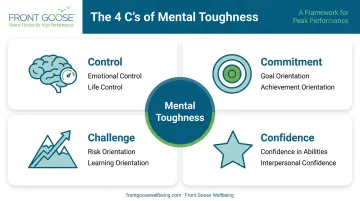
The most widely used research-backed model for understanding and developing mental toughness was introduced by Clough, Earle, and Sewell in 2002. It defines four dimensions — Control, Commitment, Challenge, and Confidence — that together predict how an individual performs under pressure. For leaders and high performers, each dimension is trainable — not fixed.
Control
Control is the belief that you have sufficient influence over yourself and your circumstances to produce outcomes that matter. It breaks into two components:
- Emotional control: how you express and regulate emotions when conditions get tense
- Life control: the conviction that your actions genuinely shape outcomes
In practice: a leader who stays measured during a tense team conflict and redirects the conversation is exercising high emotional control. A leader who escalates it is not.
Commitment
Commitment is the ability to follow through on promises made to yourself and others, even when conditions get hard. It includes:
- Goal orientation: keeping daily activities tied to a valued, specific target
- Achievement orientation: maintaining effort toward that target when obstacles appear
This is the engine of consistency in high performers. Without it, even the most talented people stop short when the work gets difficult.
Challenge
Challenge describes how an individual relates to obstacles and change. Do they see difficulty as a threat to avoid, or as an opportunity to grow?
- Risk orientation: whether change and uncertainty feel threatening or energizing
- Learning orientation: how you extract signal from setbacks instead of avoiding them
Mentally tough leaders proactively seek challenging situations. They don't just tolerate adversity — they use it as a development tool.
Confidence
Confidence is unwavering self-belief in your ability to execute, even in unfamiliar or high-stakes territory. Two forms matter here:
- Confidence in abilities: trusting that your skills and preparation are sufficient for the moment
- Interpersonal confidence: the willingness to engage others, ask for help, and build on collective strength
In one study of elite coaches, Confidence was rated the top mental toughness attribute (M=7.33), followed by Resiliency (M=4.42) and Consistency (M=4.08). Without it, Control, Commitment, and Challenge remain theoretical — they collapse the moment real pressure arrives.
The Neuroscience of Resilience: Why Mental Toughness Can Be Trained
Here's the most important thing to understand: mental toughness isn't fixed at birth. The brain changes in response to consistent mental practice — a principle called neuroplasticity.
Research by Davidson and McEwen confirms that experience shapes neural circuits underlying social and emotional behavior across the lifespan. The systems governing attention, emotional regulation, and stress response are all malleable. The research is unambiguous on this point.
What Stress Does to the Brain
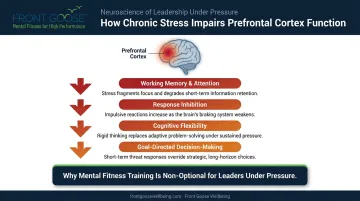
Research on the prefrontal cortex (PFC) — the brain's center for rational decision-making, working memory, and self-regulation — shows that acute stress can rapidly weaken prefrontal network connections. Chronic stress produces functional and structural changes that impair:
- Working memory and attention
- Response inhibition
- Cognitive flexibility
- Goal-directed decision-making
In plain terms: high-stakes environments literally compromise the brain's ability to think clearly if mental fitness isn't actively maintained. This is why training mental performance isn't optional for leaders operating under sustained pressure.
How Mindfulness Responds to This
Research by Tang, Hölzel, and Posner identifies three interacting mechanisms through which mindfulness strengthens the brain: attention control, emotion regulation, and self-awareness. Randomized workplace trials — including studies at Aetna and Dow Chemical — have found significant reductions in perceived stress and improvements in emotional outcomes for employees who completed mindfulness programs.
A randomized trial of 60 employees at a digital marketing firm found that an extended mindfulness program reduced perceived stress by 2.99 points (d=.48) compared to a one-day workshop. For leaders managing sustained pressure, that magnitude of stress reduction translates directly into clearer decisions and steadier performance under fire.
This is the foundation of Megan Dittman's work at Front Goose Wellbeing. Certified through the Neuroleadership Institute — which translates neuroscience research into leadership application — she structures every engagement around a three-step model: Assessment, Education, then Strength Training. The sequence is deliberate. Skeptical executives commit to practice when they understand the mechanism first.
Practical Coaching Tips for Building Mental Toughness and Resilience
These are the techniques — drawn from research and applied mental fitness training — that actually develop the 4 C's in practice.
Goal-Setting for Commitment and Control
Structured goal-setting directly builds Commitment and Control. Meta-analytic research shows that specific, difficult goals outperform vague "do your best" goals, with effects ranging from d=.42 to .80.
The key is combining two types:
- Outcome goals — the destination; what you're ultimately aiming for
- Process goals — the daily actions that get you there
Process goals build mental toughness because they sustain effort when results are uncertain. A leader focused only on quarterly targets loses momentum when the market shifts. One anchored to daily process goals keeps moving — regardless of what the scoreboard says.
The GROW model (Goal, Reality, Options, Way Forward) provides a structured coaching conversation for working through both types — particularly useful for 1:1 coaching or team goal-alignment sessions.
Visualization and Mental Rehearsal
Mental rehearsal involves vividly imagining successful execution of a challenging scenario before it occurs. The neural logic: imagery and actual performance recruit overlapping premotor, parietal, and cerebellar systems. You're rehearsing the brain, not just the mind.
A 2020 meta-analysis of imagery interventions in sports reported a medium effect size of d=.431 — meaningful, and most effective when used alongside real practice rather than as a substitute.
For executives, this translates directly:
- Mentally walk through a board presentation before you're in the room
- Rehearse a difficult conversation — the words, the tone, your composure
- Pre-experience a high-stakes negotiation from a grounded, clear emotional state
Megan Dittman's Mental Rehearsal pillar applies the same technique used by Olympic athletes and military special-operations training to corporate performance scenarios — because the brain responds the same way regardless of the context.
Mindfulness and Controlled Breathing
Mindfulness strengthens the Control dimension by building the brain's capacity for attention regulation and stress recovery. Even brief daily practice reduces reactive thinking and improves the ability to stay present under pressure.
Research on breathwork (Balban et al.) found that exhale-focused cyclic sighing produced greater mood improvements and reduced respiratory rate compared to mindfulness meditation alone — and it takes five minutes. That matters for time-pressed executives who write off longer meditation practices as impractical.
Front Goose Wellbeing's corporate programs include Breathwork as one of four mental fitness pillars, giving teams an accessible, research-supported entry point before advancing to longer practice formats.
Cognitive Reframing and Self-Talk
Reframing is the Challenge dimension in action. The process:
- Notice the thought — often catastrophizing or absolutist ("We failed. We're not capable.")
- Question its accuracy — is this fact or interpretation?
- Replace it with a more constructive reading — "This is data we can use to improve."
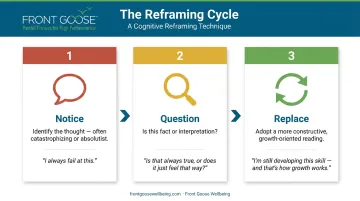
This isn't positive thinking. It's a cognitive skill that builds over time. Megan Dittman teaches this as her Mindset capacity — training clients to notice cognitive patterns before they drive reactive decisions or emotional shutdowns.
Stress-arousal reappraisal research has shown this approach produces more adaptive physiological responses and better cognitive performance under laboratory stress conditions.
Deliberate Exposure to Adversity
Mental toughness is built through challenge, not around it. Coaches and leaders can design adversity training by:
- Gradually increasing task difficulty — stretch the team without overwhelming them
- Building safe-to-fail environments where mistakes are analyzed, not punished
- Closing every setback with "what did we learn?" rather than "who's to blame?"
Research confirms that some lifetime adversity predicts better later outcomes than either no adversity or excessive adversity. The application here is calibrated challenge, not imposed hardship. Elite coaches in Australian football research reported using exactly this approach — and it translates directly to corporate team development.
How to Coach Mental Toughness in Others as a Leader
Yes, mental toughness is coachable. Research with elite coaches confirms mental toughness develops through consistent coaching behaviors, environment design, and targeted skill-building — not through natural talent alone. Elite coach studies describe the mentally tough coach as someone with a determined mindset, resilience, confidence, and strong belief in their system.
What Effective Coaching Behaviors Look Like
Leaders who successfully develop mental toughness in their teams do four things consistently:
- Model emotional consistency — their own reactions under pressure set the team's behavioral standard
- Foster autonomy — give team members ownership of their challenges rather than rescuing them prematurely
- Create psychological safety — where mistakes are reported honestly and learned from, not concealed
- Deliver feedback that's critical but constructive — honest about gaps, clear about growth paths
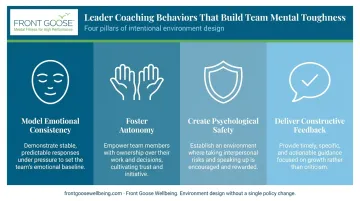
Megan Dittman's writing makes this explicit: if a leader is calm and unfrenzied, their team notices and mirrors it. Everything a leader does signals what is expected. That's environment design without a single policy change.
Start With Yourself
That mirror effect runs in both directions — which means self-awareness isn't optional for leaders doing this work. A leader cannot build in others what they haven't developed in themselves. Before coaching your team's mental toughness, audit your own 4 C's profile:
- Where is your emotional control under genuine pressure?
- How consistent is your commitment when outcomes are uncertain?
- Do you seek challenge or manage it from a safe distance?
- Does your confidence hold when you're in unfamiliar territory?
Working with a certified mental fitness coach accelerates this process — especially for high performers more accustomed to developing others than being coached themselves. Megan Dittman's approach starts with a full assessment, so leaders understand their own profile before they try to build it in anyone else.
Frequently Asked Questions
Can you coach mental toughness?
Yes. Mental toughness is scientifically recognized as trainable — not a fixed personality trait. Research with elite coaches shows it develops through deliberate practice, structured coaching environments, and consistent behavioral habits over time, not through natural talent alone.
What are the 4 C's of mental toughness?
Introduced by Clough, Earle, and Sewell in 2002, the 4 C's model is the dominant framework in mental toughness research:
- Control — belief in self-regulation and influence over outcomes
- Commitment — follow-through on goals under difficult conditions
- Challenge — viewing obstacles as growth opportunities
- Confidence — self-belief in one's ability to execute
What is the difference between resilience and mental toughness?
Resilience is the capacity to recover and bounce back after a significant setback. Mental toughness is broader — it sustains performance, focus, and emotional control throughout challenging conditions, not just in recovery afterward. Resilience requires adversity; mental toughness operates with or without it.
How long does it take to build mental toughness?
Timelines vary, but consistent mental skills training can produce noticeable shifts in stress response and focus within weeks. The deeper neural rewiring that holds under genuine pressure builds over months of regular practice.
How does mindfulness help build mental toughness?
Mindfulness strengthens the brain's capacity for attention control and emotional regulation, which directly build the Control dimension of mental toughness. Consistent practice reduces stress reactivity, making it easier to stay composed and make clear decisions under pressure — rather than reacting to it.