

The question worth sitting with is straightforward: if your mind isn't trained, how much potential are you leaving on the table?
Peak performance isn't exclusive to professional athletes. The same principles apply to executives navigating high-pressure boardrooms, founders making critical decisions under uncertainty, musicians stepping onto a concert stage, and military operators managing complex operations. The domain changes; the underlying demands on focus, resilience, and emotional control do not.
This guide covers the pillars that actually move the needle: physical foundations, the mental edge, science-backed mental fitness techniques, recovery, and how to build a personalized plan that integrates both sides of the performance equation.
Key Takeaways
- Peak performance is a trainable state, not a fixed trait — the brain adapts through consistent practice
- Physical readiness sets capacity; psychological skills shape execution; recovery determines repeatability
- Mental fitness techniques — visualization, self-talk, mindfulness, process goals — have measurable, research-supported effects
- Recovery (both physical and mental) is an active performance strategy, not downtime
- A personalized plan that embeds mental training into existing routines produces the most durable gains
What Peak Performance Really Means
Peak performance is the state in which a person consistently executes at or near their highest capability — physically, mentally, and emotionally. That definition matters because it rules out two common substitutes: working hard and training more.
Hard work without structure produces effort. More training without intentional design often produces fatigue. Peak performance requires something different: deliberate preparation across multiple dimensions, guided by an accurate understanding of what limits you.
The Brain Adapts in Response to Practice
Neuroscience research shows the brain reorganizes in response to sustained practice. A foundational review published in PMC found altered frontoparietal activation after five weeks of adaptive working-memory training and increased resting prefrontal blood flow after six weeks of attention training. The brain doesn't stay fixed. It reorganizes in response to what you consistently do.
The focus capacity you train today becomes the baseline you operate from under pressure tomorrow.
The Principles Transfer Across Domains
Peak performance looks different depending on the arena. A surgeon's version of it is not identical to an Olympic sprinter's or a chief executive's. But the underlying mechanisms are:
- Attentional control — directing and sustaining focus on what matters
- Emotional regulation — maintaining composure when stakes are high
- Resilience — recovering from setbacks without prolonged disruption
- Recovery — restoring the physical and cognitive resources that performance depletes
This is why "training for peak performance" is as relevant to a corporate leadership team as it is to an elite athlete. The skills being built are the same.
The Physical Foundations You Can't Skip
Mental training built on a depleted physical foundation will underperform. Sleep, nutrition, and structured conditioning aren't background considerations. They set the ceiling on what any mental strategy can actually deliver.
Core Physical Components
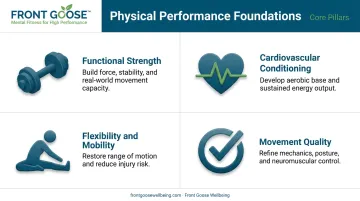
A well-designed physical preparation plan addresses four areas:
- Functional strength — movements that translate directly to your performance demands
- Cardiovascular conditioning — aerobic and anaerobic capacity appropriate to your domain
- Flexibility and mobility — range of motion that supports efficient, injury-resistant movement
- Movement quality — technique and mechanics, not just volume
Generic programming misses the point. A financial executive whose performance demands are cognitive needs a different physical preparation strategy than a rugby player whose demands are contact-based. The specificity principle applies to physical training just as it does to skill development.
Sleep and Nutrition as Performance Inputs
These aren't lifestyle variables — they are performance variables with measurable effects.
On sleep: a sports-medicine review found a 15-watt reduction in cyclists' maximum work rate following four hours of sleep restriction, alongside poorer choice reaction time in college athletes after a single night of total deprivation. The American Academy of Sleep Medicine recommends adults get at least seven hours regularly, with athlete needs scaling upward depending on training load.
Nutrition and hydration follow the same logic. The American College of Sports Medicine's position stand indicates that dehydration exceeding 2% of body mass can impair aerobic performance. A 2025 narrative review links low energy availability to deficits in reaction time, concentration, decision-making, and coordination.
The Case for Periodization
Sustained maximum effort without recovery leads to burnout or injury. Periodization — the planned manipulation of training variables across structured phases — allows the body to peak at the right moment: competition day, a major presentation, a key deliverable.
The fitness-fatigue model at the core of periodization manages accumulated stress and preserves adaptation. The result is controlled readiness — arriving sharp when it actually matters, not just logging hard days.
The Mental Edge: Why Mindset Training Is the Missing Piece
When physical abilities are comparable, what separates elite performers? The answer is psychological.
Research involving high-level athletes found that psychological measures could classify successful and unsuccessful performers with 70–85% accuracy — better than chance, and a meaningful signal about how much mental factors shape competitive outcomes. The same pattern holds in corporate and professional settings, where decision-making under pressure, sustained focus, and emotional regulation determine results.
The Neuroscience of Pressure
Under stress, the brain's architecture shifts in ways that directly undermine performance. Arnsten's research on stress signaling pathways explains the mechanism: excessive stress-related signaling weakens the persistent network firing in the prefrontal cortex that's required for working memory and top-down executive control. Simultaneously, the amygdala — driving reactive, emotionally-charged responses — becomes more dominant.
The practical consequence: under pressure, untrained performers make reactive decisions, lose attentional focus, and struggle to access their full cognitive capacity. Trained performers don't eliminate stress — they maintain prefrontal function despite it.
Mental Toughness Is Trainable
Mental toughness is not a personality trait you either have or don't. It's a developable skill set built from four components — challenge, commitment, control, and confidence. A six-week structured intervention with 62 male basketball students improved total mental toughness scores with a meaningful effect size (partial eta-squared = 0.200), confirming these capacities respond to deliberate training.
The trainable skills include:
- Sustained focus under distraction
- Emotional regulation in high-stakes moments
- Resilience after mistakes without confidence collapse
- Consistent execution under competitive pressure
Self-Awareness as the Starting Point
Before building mental skills, performers need an honest read on their current mental patterns. What are your emotional triggers? Where does your attention go under pressure? How do you respond to setbacks?
Several tools create this self-knowledge and make subsequent mental training far more targeted:
- Performance journaling — tracking emotional patterns and attentional shifts after high-stakes situations
- Structured reflection — reviewing what triggered reactive responses and what supported focused execution
- Guided assessment — working with a coach to surface blind spots that self-reporting misses
Megan Dittman's work at Front Goose Wellbeing is built around exactly this starting point. With 25 years as a corporate HR executive at organizations like GE Aerospace and Kohler Corp, plus coaching certifications from The Neuroleadership Institute and the Chopra Institute, she brings a methodology that connects neuroscience-backed mental training to the real pressures executives, athletes, and high-performing teams face daily.
Science-Backed Mental Fitness Techniques to Elevate Your Game
Visualization (Mental Imagery)
Mentally rehearsing performance activates many of the same neural pathways as physical practice. A 2022 review of meta-analyses found imagery effects on motor and strength tasks with a standardized mean difference of 0.47 (95% CI: 0.30–0.63) — a real, measurable benefit.
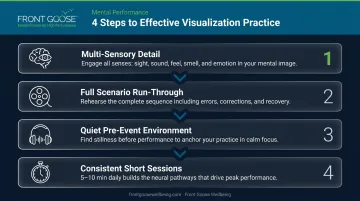
How to do it effectively:
- Use multi-sensory detail — sights, sounds, physical sensations, emotions
- Run the full scenario, including recovering from mistakes
- Practice in a quiet environment before high-stakes events
- Keep sessions focused and consistent (5–10 minutes daily beats occasional long sessions)
Mindfulness and Controlled Breathing
A meta-analysis of 32 randomized controlled trials across 1,788 athletes found mindfulness interventions produced effect sizes of d = 0.50 for mindfulness outcomes and d = 0.81 for flow and acceptance-related outcomes.
For in-the-moment pressure, controlled breathing is a fast physiological reset. Box breathing — inhaling, holding, exhaling, and holding for equal counts — is widely used by military and law-enforcement personnel. A 2023 systematic review links controlled breathing protocols to greater parasympathetic nervous system regulation, with effective sessions lasting at least five minutes.
Put it to work in moments like these:
- Before a high-stakes negotiation or presentation
- Between plays or during a timeout in competition
- Any moment you need to interrupt a stress spiral and reset
Self-Talk and Cognitive Reframing
A meta-analysis of 32 studies found self-talk produced a standardized mean difference of 0.48 (95% CI: 0.38–0.58) across performance outcomes. Two types matter:
- Instructional self-talk: Technical cues that guide execution ("drive through the heel," "shoulders down")
- Motivational self-talk: Confidence and effort statements that sustain intensity ("you've prepared for this")
The thought-stopping + reframe technique is a practical application: when a negative or distracted thought appears, mentally say "stop," then replace it with a predetermined instructional or motivational cue. Done consistently, it rewires the default patterns your mind runs under pressure.
Process Goals Over Outcome Goals
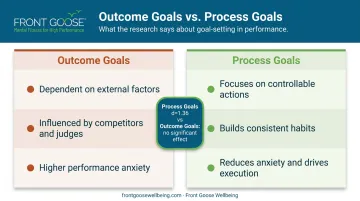
A 2024 review of 27 studies found process goals produced an effect size of d = 1.36 — substantially larger than performance goals (d = 0.44) and outcome goals (which showed no significant effect).
The reason is control. Consider the difference:
- Outcome goals depend on factors outside your influence — what competitors do, how judges score, how markets move
- Process goals — execute this technique, follow this preparation sequence, hold this communication standard — keep attention on variables you can actually affect
That shift reduces performance anxiety and builds the consistent habits that eventually produce breakthrough outcomes.
Concentration and Focus Training
Attentional control is the ability to direct focus deliberately and sustain it against distraction. Practical training approaches:
- Single-point focus exercises (sustained attention on one object or task for progressively longer intervals)
- Pre-performance routines that anchor attention before high-demand moments
- Deliberate practice of returning attention when it wanders (the act of noticing distraction and redirecting is itself the training)
Recovery and Resilience: The Hidden Pillars of Sustained Performance
Recovery is not passive downtime. It is an active component of performance that determines whether gains made in training actually translate to output over time.
Physical vs. Mental Recovery
| Recovery Type | Key Components |
|---|---|
| Physical | Sleep quality and duration, nutrition, rest days, mobility work |
| Mental | Decompression, stress reduction, emotional processing, attention restoration |
Both matter. Neglecting mental recovery while maintaining physical protocols undermines the cognitive function that physical readiness is meant to serve.
Sleep data underscores the stakes: after 30 hours of total sleep deprivation, team-sport athletes showed muscle glycogen of 209 ± 60 mmol/kg dry weight, compared to 310 ± 67 mmol/kg after eight hours of normal sleep. The physiological cost of poor recovery is measurable, not theoretical.
Building Resilience Through Mindset
Resilience is not built by "toughening up" or pushing through pain without acknowledgment. It is built through deliberate mental habits:
- Treating failure as diagnostic — identifying what happened, what it reveals, and what adjusts next
- Maintaining self-worth independent of any single-performance outcome
- Actively reassigning meaning to setbacks rather than accepting the first interpretation
A 2024 neurobiology review links chronic unmanaged stress to impaired learning, memory, attention, cognitive flexibility, and decision-making through structural changes in the prefrontal cortex, hippocampus, and amygdala. Resilience practices aren't just psychological comfort — they protect the cognitive infrastructure that performance depends on.
Brief Practices That Move the Needle
A 2018 experiment found improved allocation of attentional resources after a single 10-minute mindfulness session in healthy novices. Even brief, consistent mental recovery practices between high-demand periods produce measurable attention benefits.
Five to ten minutes of controlled breathing or mindfulness between performance blocks isn't a luxury — it's a recovery tool with an evidence base behind it. This is exactly how Front Goose Wellbeing structures mental fitness programs for organizations like GE Aerospace and Kohler Corp — embedding short, evidence-based practices into the performance day rather than treating recovery as something separate from it.
Building Your Personal Peak Performance Plan
Start With an Honest Self-Assessment
Before adding anything to your routine, evaluate where you actually stand across four dimensions:
- Physical conditioning — strength, endurance, mobility relative to your domain's demands
- Mental focus — attentional control, susceptibility to distraction, performance under pressure
- Emotional regulation — how you respond to setbacks, pressure, and high-stakes moments
- Recovery habits — sleep quality, nutrition consistency, mental decompression practices
Pick one or two high-leverage areas to address first. Trying to improve everything simultaneously is a reliable path to improving nothing.
Embed Mental Training Into What You Already Do
Mental fitness doesn't need a separate hour carved out of an already full schedule. It integrates across three phases of every session:
- Warm-up — Two to three minutes of visualization. Run through your best-case execution with multi-sensory detail before the work begins.
- During practice — Embed self-talk cues into the hardest moments, not just the easy reps.
- Cool-down — Three to five minutes of reflection journaling: what worked, what didn't, what you'll adjust.
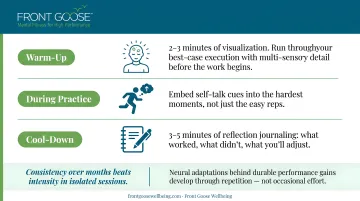
Consistency over months beats intensity in isolated sessions. The neural adaptations behind durable performance gains develop through repetition — not occasional effort.
When to Work With a Coach
Self-directed practice builds the foundation — but a qualified mental fitness professional adds what's harder to manufacture alone: structure, accountability, and objective feedback on blind spots.
For executives, athletes, founders, or professionals looking for a structured, science-based approach, Front Goose Wellbeing's Mental Performance Coaching follows a three-step process — Assessment, Education, and Strength Training — built on neuroscience, mindfulness, and health coaching. A discovery call with Megan Dittman is the starting point.
Frequently Asked Questions
How do I train for peak performance?
Peak performance training combines physical conditioning, mental fitness techniques (visualization, self-talk, mindfulness), and intentional recovery — all structured around your specific goals and demands. Each element reinforces the others, which is why integrated training consistently outperforms single-focus approaches.
What is the role of mental fitness in peak performance?
Mental fitness governs focus, emotional control, resilience, and decision-making under pressure — the factors that most often separate elite performers when physical abilities are comparable. A trained mind holds its edge when stakes are highest, which is exactly when untrained minds tend to lose ground.
How does mindfulness improve performance?
Regular mindfulness practice strengthens attentional control and improves emotional regulation, which together support calmer, more focused execution under pressure. Research across 32 randomized trials with 1,788 athletes found meaningful effects on mindfulness and flow-related outcomes.
Does peak performance training apply to business professionals, not just athletes?
Yes. The same mental fitness principles — goal-setting, focus training, resilience building, stress management — apply directly to executives, leaders, and corporate teams. Organizations implementing structured mental fitness programs have reported meaningful improvements in productivity and reductions in stress-related performance degradation.
What are the best recovery strategies for high performers?
Start with consistent, quality sleep — at least seven hours for adults. Layer in dedicated mental recovery through mindfulness or decompression practices, nutrition habits that support brain function, and brief breathwork between demanding performance blocks.
How long does it take to see results from mental fitness training?
Some benefits — improved focus, reduced pre-performance anxiety — can appear within weeks of consistent practice. Deeper changes in resilience, emotional regulation, and sustained peak performance typically develop over months of integrated training.