That's a missed opportunity. A well-designed retreat — one built around the right topics — can reset a leadership team's direction, rebuild trust, and give individual leaders tools they'll still be using six months later.
This article covers 8 high-impact topics for a leadership retreat, chosen because they address both the strategic and human dimensions of leadership. The combination is what creates lasting engagement and measurable performance gains.
Key Takeaways
- Choose retreat topics based on where your team actually needs to grow — not what looks good on an agenda
- The strongest retreats blend strategic content with inner leadership development — vision and culture alongside resilience and emotional intelligence
- Mental fitness — including stress management and focus under pressure — is increasingly central to high-performance retreats
- Without a follow-through structure, retreat insights dissolve within weeks
Why the Right Topics Make or Break a Leadership Retreat
A leadership retreat is structured time for leaders to step away from daily operations and work on the business and themselves — not just in it. That distinction matters. A regular leadership meeting drives decisions about current priorities. A retreat should shift how leaders think, relate, and lead.
Without the right content, it becomes an expensive team lunch.
The data on leadership development transfer is sobering. ATD research across more than 800 training projects found that customized training alone changed on-the-job behavior for only 20% of participants on average. A 2024 evidence-informed review puts that transfer rate as low as 5% for programs that lack reinforcement and relevance.
When retreat content doesn't connect to what leaders are actually wrestling with, engagement drops and nothing sticks.
Great retreat topics should produce three outcomes:
- Deeper self-awareness in individual leaders
- Stronger alignment and trust across the team
- A clear sense of direction and renewed motivation to lead
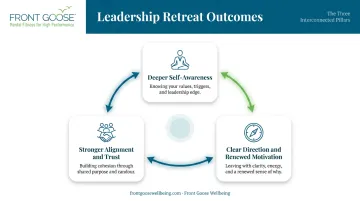
Topics that hit all three don't just fill the agenda. They change how leaders show up when they get back.
8 High-Impact Topics for a Leadership Retreat
Reconnecting with Purpose: Leading from the "Why"
Before leaders can inspire their teams, they need clarity on what drives them personally. This topic invites leaders to articulate their individual leadership purpose — and examine whether their day-to-day decisions actually reflect it.
Simon Sinek's Golden Circle framework is a widely-used starting point: WHY (the core purpose or belief), HOW (the principles that guide actions), and WHAT (the products or results delivered). The leadership application is to communicate and act from WHY outward.
The urgency is real. In Deloitte's survey of more than 4,000 UK employees, 84% said meaningful work mattered to them — but only 52% felt that leadership behavior and organizational culture actually matched what their employers claimed to stand for. That gap between stated purpose and enacted purpose erodes trust fast.
Practical retreat exercise:
- Each leader writes a personal "why" statement — one concise sentence that captures what they're fundamentally trying to accomplish as a leader
- Leaders share their statements with the group, unprompted and undefended
- The team then examines: Where do individual purposes connect to the organization's mission? Where are the gaps?
This conversation can surface misalignments that have been driving friction for months.
Mental Fitness and Resilience Under Pressure
Mental fitness — the capacity to maintain clarity, focus, and calm under sustained pressure — is now a core leadership competency, not a wellness perk. The distinction matters for how this topic is framed and received.
A qualitative study on leader vitality cited a 2021 US survey in which 72% of senior leaders reported experiencing burnout. That's not a wellness statistic. That's a performance and retention crisis at the leadership level.
This is where expert facilitation makes a significant difference. Front Goose Wellbeing's science-based approach — grounded in neuroscience and delivered by Megan Dittman, a certified executive coach from The Neuroleadership Institute and Certified Meditation Instructor from the Chopra Institute — gives leadership teams practical tools they can apply immediately back at work.
Her four-pillar mental fitness framework covers:
- Mindful Awareness — training present-moment attention and non-reactive observation
- Breathwork (Pranayama) — breathing sequences that regulate emotional and physiological states in high-pressure moments
- Meditation — including Primordial Sound Meditation and Vipassana for deeper cognitive reset
- Mental Rehearsal — pre-experiencing desired performance outcomes, drawn from elite sport and military practice
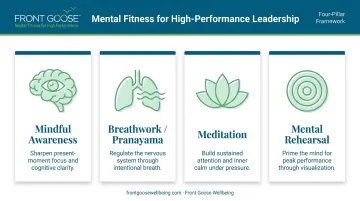
The differentiator here: Megan spent 25 years as an HR executive at organizations including GE, Kohler, and Woolpert before building this work. She frames every technique as a performance tool — not a relaxation exercise. As Fernando Almeida, VP at GE Aerospace, noted after one of her programs, she excels at "bringing science and practice together in the form of tools to focus on mindfulness, reduce stress and improve performance."
That combination — operational credibility plus certified technique — is what makes this session land differently than a standard wellness workshop.
Emotional Intelligence and Self-Awareness
Emotional intelligence (EQ) in a leadership context is the ability to recognize and regulate your own emotions while reading and responding effectively to the emotions of others. It directly shapes team morale, conflict resolution, and psychological safety.
Here's the uncomfortable reality: research by Tasha Eurich found that 95% of people believe they are self-aware, but only 10–15% actually meet the research criterion. Most leaders assume they're self-aware. Most are wrong.
Goleman's analysis of 3,871 executives found that leadership style — which is rooted in EQ competencies — accounted for nearly one-third of financial results in the underlying research.
Retreat activities that develop EQ:
- 360-degree feedback exercises using external or peer assessment (not self-ratings)
- Empathy mapping from an employee's perspective — what does your team actually experience working for you?
- Structured reflection on one moment when your emotional response affected team performance, positively or negatively
- Small group discussion: What triggers you under pressure, and what does that look like to people around you?
The goal isn't to make leaders feel bad. It's to close the gap between how they see themselves and how their teams experience them.
Strategic Vision and Future-Proofing the Organization
In one survey of 10,000 senior leaders, 97% identified strategic thinking as the most important leadership behavior for organizational success. In a separate survey, 96% said they didn't have enough time for it.
The gap is structural, not coincidental. The day-to-day pulls leaders into operational mode, and strategic thinking gets permanently deferred. A retreat is one of the few protected spaces where this work can actually happen.
This topic should include honest conversation about:
- Emerging industry trends and potential disruptions
- Whether the leadership team's current capabilities match what the next 3–5 years will demand
- Where the organization is investing attention versus where the real strategic bets need to be placed
Structured exercise: Each leader independently identifies the top 3 changes they believe will reshape their industry in the next five years. The group then shares, debates, and consolidates — building a shared list of strategic priorities that everyone owns.
The exercise reveals both alignment and blind spots. Often, the gaps between what different leaders see as the biggest threats are more instructive than any single person's list.
Psychological Safety and Building Team Trust
Psychological safety — the shared belief that team members can speak up, take risks, and admit mistakes without fear of punishment — is among the most consistently researched predictors of high-performing teams.
Edmondson's foundational research on 51 work teams established the link: psychological safety enables learning behavior, and learning behavior drives team performance. Google's Project Aristotle, which analyzed 180 teams, ranked it first among five team-effectiveness dynamics.
Teams with higher psychological safety brought in more revenue, used more diverse ideas, and were rated effective twice as often by executives.
This should be treated as a leadership accountability topic, not a culture aspirations exercise. The honest question isn't "Do we value psychological safety?" It's "What specific behaviors are we each doing that make it harder for people to speak up?"
Retreat format that works:
- Each leader privately identifies one behavior they exhibit that might reduce psychological safety for their team
- These are shared openly — without defense or explanation
- The group makes specific, behavioral commitments (not value statements) to change
This kind of conversation is uncomfortable. It's also exactly what separates teams that talk about trust from teams that have it.
Mindful Leadership and Stress Management
Mindfulness in a leadership context trains the attention and emotional regulation systems so leaders stay clear-headed, decisive, and empathetic when the pressure is highest — which is precisely when those qualities tend to disappear.
Workplace research supports this: studies show mindfulness practice reduces cortisol, anxiety, and perceived stress in working professionals. The leader-specific performance research is still maturing, but the directional evidence is consistent — leaders who build these practices show better emotional regulation and more deliberate decision-making under pressure.
Practical retreat formats for this topic:
- A guided session led by a certified instructor covering breathwork, mindful awareness, or meditation — not a summary of concepts, but actual practice
- Discussion: How does chronic stress actually show up in your leadership? In your relationships? In your decisions?
- Personal reflection: What's your current stress load, and what's your honest coping pattern?
The goal isn't to turn executives into meditators. It's to give them one or two immediately usable techniques — a breathing protocol before a high-stakes meeting, a three-minute attention reset between back-to-back calls — that reduce the cognitive cost of sustained pressure.
Building a High-Performance Team Culture
Culture is defined by what gets rewarded, what gets tolerated, and what leaders actually do — not what's posted on the wall. McKinsey research found that organizations with higher-performing cultures generated 3x the shareholder returns of lower-performing peers — and defined culture through shared behaviors and underlying mindsets, not values statements.
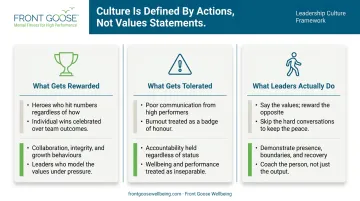
This topic invites the leadership team to audit their actual culture: what behaviors are being rewarded, what's being tolerated, and what's quietly getting in the way of peak performance.
Group exercise:
- Each leader answers two questions in writing: What did our culture produce this year that we're proud of? and What did it allow that we'd rather change?
- These answers are shared and discussed without defensiveness
- The team agrees on 3 specific cultural commitments for the year ahead — not values, but observable behaviors leaders will model differently
The distinction between values and behaviors is critical. "We value transparency" is easy to say. "In our next all-hands, each of us will share one area where we're uncertain about the right answer" is a commitment.
Communication, Conflict, and Candid Conversations
Most leadership teams avoid direct feedback and hard conversations. Lencioni's Five Dysfunctions model identifies fear of conflict as the second breakdown after absence of trust — and the downstream effects compound quickly into lack of commitment, accountability avoidance, and poor results.
Research supports this: when psychological safety is high, task conflict and performance are positively associated. Teams that can disagree productively make better decisions. Teams that can't develop a subtle groupthink that nobody names.
Practical retreat exercise — feedforward: Marshall Goldsmith's feedforward technique asks leaders to request future-focused suggestions rather than reviewing past mistakes. The format: one leader names a specific behavior they want to develop, and peers offer suggestions focused only on what could help going forward — no critique of what went wrong, no defending past choices.
This structure lowers defensiveness and generates far more actionable input than traditional feedback sessions. It's also a muscle — the first time feels awkward, and that's the point.
How to Choose the Right Topics for Your Leadership Retreat
The best starting point is a pre-retreat survey or 1:1 conversations with leadership team members. The gap between where the team is and where it needs to be should drive topic selection, not what sounds impressive on an agenda.
Simple decision framework for each candidate topic:
| Criterion | Question |
|---|---|
| Relevance | Does this address a real, current challenge the team is facing? |
| Balance | Does it address both strategic and human dimensions of leadership? |
| Applicability | Can leaders use this within 30 days of the retreat? |
Topics that fail even one of these criteria belong off the agenda.
Once the topic list is set, think carefully about who delivers each session. Bringing in an external facilitator for at least one or two sessions makes a meaningful difference:
- Reduces in-group bias and defensiveness
- Creates space for more candid conversation
- Brings specialized knowledge in areas like mental fitness, emotional intelligence, or the neuroscience of leadership that most internal leaders don't hold
That last point matters for topic selection too. If your agenda includes mental fitness or cognitive resilience, the facilitator's credibility directly affects how C-suite participants engage. Megan Dittman, founder of Front Goose Wellbeing, brings 25 years as a corporate HR executive alongside certifications in neuroscience-based coaching and mindfulness — a combination that frames mental fitness as a performance discipline rather than a wellness add-on, which tends to land better with skeptical senior leaders.
From Retreat Room to Real Results: Following Through
The most common failure point of leadership retreats isn't the content — it's what happens after. Insights dissolve within weeks because no accountability structure exists to sustain them.
A 2023 management-development study found that implementation-intention statements — specific plans about when, where, and how a behavior will occur — encouraged transfer in 67% of participants. Vague intentions produce nothing. "I'll be more transparent" goes nowhere. "In our weekly team meeting every Monday, I'll share one area where I'm uncertain" produces change.
Close the retreat with these commitments:
- Each leader states one specific behavioral commitment tied to a retreat topic — name a behavior, not a value
- Each commitment includes a named trigger (when?) and a named action (how?)
- Schedule the follow-up check-in date before everyone leaves the room
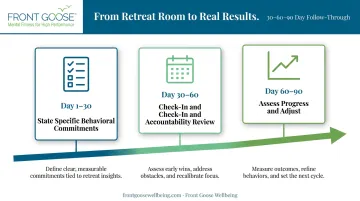
Build a 30-60-90 day action plan as the final session:
- Identify the 3 topics that produced the clearest action items
- Assign owners for each commitment
- Schedule a 60-day check-in session before the retreat ends
Teams that leave with named owners, scheduled dates, and specific behaviors consistently outperform those that leave with enthusiasm alone.
Conclusion
The topics a leadership team chooses for a retreat signal what they believe matters. Teams that invest in both strategic clarity and inner leadership development — purpose, resilience, mental fitness, emotional intelligence — come back with sharper focus, stronger cohesion, and the tools to sustain that momentum once they're back at work.
If your team is ready to build a retreat around science-backed mental fitness and leadership development, Front Goose Wellbeing designs and facilitates custom executive retreats that integrate mindfulness with strategic alignment and team development. Schedule a discovery call with Megan Dittman to scope your retreat agenda and explore what a customized program can do for your team: frontgoosewellbeing.com.
Frequently Asked Questions
What to do at a leadership retreat?
The best retreats balance structured learning (strategic discussions, skill-building sessions, self-reflection exercises) with informal connection that deepens trust. Include at least one session focused on inner leadership development — mindfulness, emotional intelligence, or personal purpose — alongside strategy and team culture work.
What are good topics for leadership meetings versus leadership retreats?
Regular leadership meetings cover project updates, performance metrics, and near-term decisions. Retreat topics go deeper: organizational vision, team culture, psychological safety, personal leadership purpose, and mental fitness. Retreats are the only setting where the deeper work gets protected time.
What are the 3 C's of leadership?
Most commonly cited as Competence, Character, and Commitment — though some models use Communication, Collaboration, and Courage. A well-designed retreat can assess and strengthen all three through self-reflection, peer feedback, and targeted skill-building.
How do you choose the right topics for a leadership retreat?
Start with a pre-retreat survey or 1:1 conversations to surface real pain points. Then select topics that address strategic gaps and interpersonal dynamics — ensuring at least one session focuses on personal leadership development rather than what merely sounds impressive.
What is the difference between a leadership retreat and a team-building event?
A team-building event focuses on connection, fun, and morale. A leadership retreat goes deeper — addressing strategy, leadership development, culture, and the mindset shifts required to lead more effectively at an organizational level.