Introduction
Workplace stress has crossed from personal burden to measurable business liability. According to Gallup's 2026 State of the Global Workplace report, 50% of employees in the U.S. and Canada experienced significant stress during the previous day — and that number doesn't account for the stress people push through without naming it.
The financial stakes are real. The WHO estimates that depression and anxiety alone cost the global economy $1 trillion in lost productivity every year. Behind that figure are missed deadlines, error-riddled outputs, disengaged teams, and executives making reactive decisions they'd never make at full capacity.
Not all stress is the same problem — and the difference matters. A tight deadline can sharpen focus. An unrealistic workload sustained for months does something different entirely: it degrades the cognitive machinery employees need to do their jobs well.
Understanding that distinction is where performance strategy starts.
Key Takeaways
- Chronic stress suppresses the prefrontal cortex — the brain region governing decisions, focus, and emotional control
- The WHO links stress-related mental health conditions to $1 trillion in annual global productivity losses
- High-stress employees carry 46% higher healthcare costs than their low-stress counterparts
- Behavioral warning signs precede self-reporting — early recognition lets leaders intervene before performance erodes
- Mental fitness is a trainable, proactive capacity — built before burnout, not after
How Work Stress Disrupts Employee Performance: The Science Behind It
The Brain Under Pressure
When someone perceives a threat — a hostile email, an impossible deadline, an ambiguous performance review — the amygdala triggers the body's stress response. As Harvard Health explains, this cascade is designed for survival, not for completing a financial model or leading a difficult conversation.
The problem is what happens to the prefrontal cortex (PFC) in the process. A foundational review by Arnsten (2009) found that even mild uncontrollable stress can impair PFC function — the region responsible for working memory, attention regulation, behavioral inhibition, and cognitive flexibility. Stress amplifies the amygdala's signal while quieting the rational brain.
This is the biological reason stressed employees make more errors, lose track of priorities, and struggle to stay composed in meetings.
Acute vs. Chronic Stress: Where Performance Turns
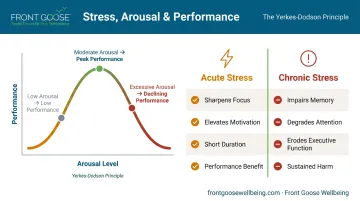
Not all stress impairs performance. The Yerkes-Dodson principle describes an inverted-U relationship between arousal and output: moderate challenge sharpens motivation and focus, particularly on complex tasks. A well-structured deadline, a competitive pitch, a high-stakes presentation — these can activate the kind of pressure that elevates performance.
Chronic stress operates differently. When pressure is sustained without adequate recovery, research on the effects of chronic stress documents impairments across memory, attention, and executive function. A meta-analysis by Shields et al. (2016) found that acute stress specifically impaired working memory and cognitive flexibility — two capacities that underpin nearly every job function.
The Sleep Amplifier
Chronic occupational stress compounds through sleep. A systematic review found that most studies examining occupational stress showed a negative association with sleep quality. Sleep deprivation then hits performance through a second wave:
- Poorer attention — sustained focus degrades even on familiar tasks
- Degraded memory consolidation — learning and skill retention slow
- Slower judgment — decision speed and accuracy both decline
- Reduced adaptability — capacity to adjust when circumstances change erodes
The result is a compounding cycle — stress impairs sleep, and poor sleep reduces the cognitive capacity needed to manage stress effectively. Employees start each day already operating below their baseline.
Interpersonal Performance
That cognitive erosion doesn't stay contained to individual output — it spills into how people work together. High or persistent stress degrades team dynamics directly. High or persistent stress is associated with increased social withdrawal and aggression, creating friction in collaborative work. For leaders whose effectiveness depends on reading a room, regulating tone, and building trust, this matters enormously.
The Measurable Impact of Stress on Workplace Productivity
The Scale of the Problem
The WHO estimates that depression and anxiety cause 12 billion lost workdays annually, costing the global economy $1 trillion in productivity. While this reflects the full spectrum of mental health conditions — not stress alone — occupational stress is a significant driver of both.
Deloitte's analysis of UK employers found that poor mental health costs organizations £24 billion annually through presenteeism alone — part of a £51 billion total employer burden in the UK. The US picture is comparably severe. Presenteeism — showing up while mentally depleted — is harder to detect than absenteeism, but the output loss is just as real.
Three Mechanisms That Hurt Output
Stress reduces productivity through distinct pathways:
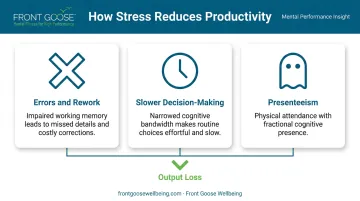
- Errors and rework — Impaired working memory means employees miss details, misread instructions, and produce output that requires correction. The first-pass quality drops.
- Slower decision-making — Chronic stress narrows cognitive bandwidth, making even routine choices slower and more effortful. Analysis paralysis is a stress symptom, not a personality trait.
- Presenteeism — Stressed employees attend meetings and hit their desks, but their cognitive presence is fractional. The work gets done, just more slowly and less accurately.
These cognitive impairments don't stay contained — they compound into a broader pattern that shows up in engagement scores and business results.
The Engagement Connection
Employee engagement is one of the clearest proxies for productivity. Gallup's Q12 meta-analysis quantifies the gap:
- 18% higher sales productivity in top-quartile vs. bottom-quartile engagement units
- 14% higher production productivity in top-quartile units
- 23% higher profitability overall
Stress is a leading driver of disengagement. Employees who are chronically overwhelmed withdraw effort, communication, and initiative — the exact behaviors that move those numbers.
Healthcare Costs
A multi-employer HERO analysis found that healthcare expenditures are 46% higher for high-stress employees than for their low-stress counterparts. That cost lands directly on organizational budgets through insurance premiums, disability claims, and the downstream effects of physical illness on attendance and performance.
The Hidden Organizational Costs Leaders Often Overlook
Turnover Is Expensive — and Stress Drives It
Voluntary attrition is one of the most direct and underestimated financial consequences of unmanaged workplace stress. Gallup estimates replacement costs at approximately 40% of salary for frontline employees, 80% for technical professionals, and 200% for leaders and managers.
Gallup also reports that 42% of voluntary turnover is preventable, based on employees' own accounts of why they left. Stress-driven attrition falls squarely within that preventable category — which means organizations are absorbing significant replacement costs that proactive intervention could eliminate.
Culture Erosion
When chronic stress becomes normalized, it erodes the conditions that enable good work:
- Psychological safety declines — Stressed teams communicate less candidly, cover mistakes rather than surface them, and avoid the productive conflict that drives innovation
- The performance standard drifts — When exhaustion becomes the baseline, "good enough" expands to fill the gap
- Institutional knowledge walks out — Burned-out employees who leave take expertise and relationships with them
APA's 2024 Work in America Survey illustrates the psychological safety gap clearly: workers in lower-safety environments reported stress on a typical workday at 61% versus 27% for those in higher-safety settings — and rated their own productivity nearly 30 points lower.
The Leadership Multiplier
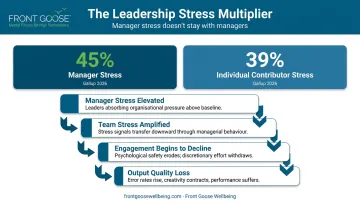
Research on leader-to-follower burnout transmission confirms what most experienced leaders already sense: stress does not stay contained at the individual level. A leader who communicates reactively, makes hasty decisions under pressure, or withdraws from their team degrades performance across everyone reporting to them — not just their own output.
Gallup's 2026 data puts numbers to this: managers reported 45% previous-day stress versus 39% for individual contributors. The gap matters because managerial stress is a direct upstream input to team-level stress, engagement, and output quality.
Recognizing When Stress Is Harming Your Team
NIOSH's foundational job-stress guide identifies several early organizational warning signs: absenteeism, tardiness, intentions to quit, and low morale. At the individual level, watch for:
- Sudden drop in work quality from someone who previously performed well — a stress signal, not a skills gap
- More errors on familiar tasks, since stress impairs working memory rather than competence
- Pulling back from meetings, volunteering less, and withdrawing from colleagues
- Uncharacteristic arguments or passive conflict with peers or direct reports
- Rising sick days and tardiness — behavioral data worth diagnosing, not disciplining
These signals typically appear before an employee self-reports feeling overwhelmed — which means managers who know what to look for can intervene before performance suffers further.
Surfacing stress early requires deliberate structure, not guesswork. These tools create the conditions for honest signals to reach you:
- Regular one-on-one check-ins with an explicit opening for the employee to set the agenda
- Anonymous pulse surveys that ask about workload, clarity, and support — not just satisfaction
- Reviewing absenteeism data as an organizational health indicator, not a compliance issue
Science-Based Strategies to Protect Performance Under Pressure
Mental Fitness vs. Stress Management
The distinction matters. Traditional stress management is reactive — it deploys coping techniques after stress has already accumulated. Mental fitness is proactive: a trainable capacity built before pressure arrives.
Megan Dittman, founder of Front Goose Wellbeing, frames it through the lens of physical training: "Your mind is a performance tool. Let's strength train it."
The foundation is neuroplasticity — the brain's ability to form new neural pathways through consistent practice. Just as physical training produces structural adaptation in the body, mental fitness practice produces durable changes in how the brain processes stress and sustains focus.
The same mental rehearsal techniques used by Olympic athletes and military special-operations personnel translate directly to corporate leadership — managing high-stakes negotiations, leading through organizational change, or sustaining clear judgment when everything is moving fast.
Neuroscience-Backed Interventions
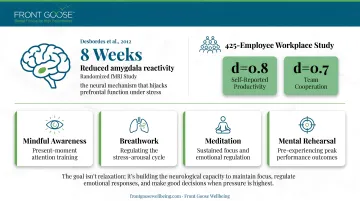
The evidence base for mindfulness as a cognitive performance tool is growing. A randomized fMRI study (Desbordes et al., 2012) found that eight weeks of mindful-attention training reduced amygdala reactivity — the precise neural mechanism that hijacks prefrontal function under stress. A 425-employee workplace field study reported effect sizes of d=0.8 for self-reported productivity and d=0.7 for team cooperation following mindfulness training.
Front Goose Wellbeing's corporate programs build on four mental fitness pillars — Mindful Awareness, Breathwork, Meditation, and Mental Rehearsal — each targeting a different dimension of the stress-performance relationship. The goal isn't relaxation; it's building the neurological capacity to maintain focus, regulate emotional responses, and make good decisions when pressure is highest.
Structural Changes That Reduce Stress at the Source
Individual skill-building only goes so far. When organizational structure generates stress faster than people can absorb it, no amount of mindfulness training closes the gap. Effective structural interventions include:
- Clarify roles and accountabilities — ambiguity is one of the most consistent occupational stressors, and removing it costs nothing
- Normalize recovery time — breaks, vacation, and meeting-free blocks are the recovery that makes sustained high performance possible, not a drag on it
- Design workloads that demand without depleting — the key variable is whether employees have enough capacity to recover between peak periods
The ROI Case
Deloitte's UK analysis estimates an average return of £4.70 for every £1 invested in workforce mental health and wellbeing. This positions stress reduction not as a wellness perk but as a performance investment with a documented return — one that executives and HR leaders can defend in budget conversations.
Frequently Asked Questions
How does stress affect employee performance at work?
Stress impairs the prefrontal cortex, which governs decision-making, focus, and emotional regulation. Chronic exposure compounds this effect — leading to more errors, slower output, and disengagement that builds over time rather than resolving on its own.
Can some level of work stress actually improve performance?
Yes, within a range. The Yerkes-Dodson principle describes how moderate challenge can sharpen motivation and focus, particularly on complex tasks. The problem is when stress becomes chronic or excessive: at that point it consistently degrades cognitive function rather than activating it.
What are the early warning signs that workplace stress is hurting productivity?
Watch for declining work quality, increased errors, withdrawal from team interactions, irritability, and rising absenteeism. These signals typically appear before an employee self-reports feeling overwhelmed, and they respond best to early, non-punitive intervention.
What is the financial cost of workplace stress to businesses?
The WHO attributes $1 trillion in annual global productivity losses to depression and anxiety. Separately, high-stress employees carry healthcare costs 46% higher than low-stress workers, a quantifiable burden that sits directly in organizational budgets.
How can leaders reduce stress without reducing performance expectations?
The goal is building employees' capacity to meet high standards, not lowering those standards. Mental fitness training, clearer role expectations, psychological safety, and structured recovery time sustain performance while protecting wellbeing.
What is mental fitness and how is it different from stress management?
Stress management is reactive: it addresses stress after it appears. Mental fitness is proactive: it builds the neurological and psychological capacity to maintain focus, regulate emotions, and perform under pressure through consistent, science-based practice. With regular practice, the brain builds lasting capacity rather than just managing symptoms in the moment.