Introduction
High-stakes leadership is a cognitive endurance sport. Constant context-switching, high-pressure decisions with incomplete information, and the emotional labor of managing diverse teams place demands on the brain that previous generations of leaders simply didn't face at the same scale.
Research from Microsoft's 2025 Work Trend Index found that 52% of leaders describe their work as fragmented, with workers encountering a meeting, email, or chat interruption every two minutes during core hours. Meanwhile, Deloitte's 2023 survey of 1,050 C-suite leaders found 75% were seriously considering quitting for better well-being support.
The brain wasn't built for this without training and recovery. That's where meditation enters — not as a relaxation technique, but as a science-backed mental fitness tool that directly builds the cognitive capacities leaders need most: self-awareness, emotional regulation, focus, and sharper decision-making under pressure.
What follows covers the neuroscience behind why this works, which leadership skills benefit most, and how to build a practice that actually fits an executive's schedule.
Key Takeaways
- Meditation strengthens the prefrontal cortex — the brain region governing judgment, impulse control, and executive decision-making
- Regular practice measurably improves focus, emotional intelligence, and resilience under pressure
- Harvard, INSEAD, and the Wharton School have each published research confirming meditation's leadership benefits
- Even 15 minutes of focused breathing can measurably reduce decision bias in executives
- Google, Aetna, and General Mills have all built structured mindfulness programs with documented performance outcomes
What Modern Leadership Demands From Your Brain
Leadership today isn't just strategically complex — it's neurologically costly.
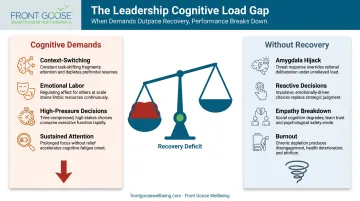
The cognitive load leaders carry goes beyond sheer volume. It's the constant switching between contexts, the emotional regulation required in difficult conversations, and the relentless stream of decisions that collectively exhaust the brain's executive resources.
Task-switching research cited by the American Psychological Association suggests switching costs can consume as much as 40% of productive time, with the largest impact occurring during complex or unfamiliar tasks.
The Physiological Cost
When cognitive demands outpace recovery, the brain's threat-detection system takes over. This is what Daniel Goleman called "amygdala hijack" — the fight-or-flight response temporarily overriding rational thought. Research links emotion regulation directly to amygdala-prefrontal coupling — and leaders who default to suppression (rather than reappraisal) consistently show poorer interpersonal outcomes under pressure.
In practice, this shows up as:
- Reactive decisions made from frustration rather than analysis
- Communication breakdowns during high-pressure conversations
- Empathy and active listening dropping out of high-stakes conversations
- Accelerating burnout from sustained cortisol elevation
The Gap Between Good and Great
All of that physiological strain lands in the same place: performance under pressure. The difference between a good leader and a great one often comes down to a single capacity — regulating internal state when stakes are highest. Not personality. Not IQ. The ability to stay responsive rather than reactive.
That capacity is trainable. And building it intentionally — through structured mental fitness practice — is precisely what separates leaders who sustain high performance from those who burn through it.
The Neuroscience Behind Meditation and Leadership
Meditation works because it physically changes the brain. Those changes map directly onto the cognitive functions leaders need most.
What Happens in the Brain
Harvard Medical School-affiliated research has documented measurable structural changes from meditation practice:
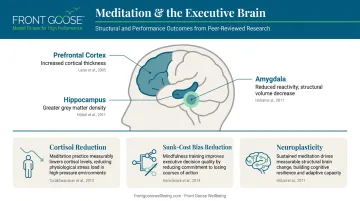
- Lazar et al. (2005): Long-term meditators showed thicker right anterior insula and prefrontal regions — areas associated with attention, interoception, and executive function
- Hölzel et al. (2011): After 8 weeks of Mindfulness-Based Stress Reduction (MBSR), participants showed increased gray-matter concentration in the hippocampus, posterior cingulate cortex, and temporoparietal junction
These are the brain regions governing attention, self-awareness, and perspective-taking — all core leadership functions.
Cortisol and the Stress Response
Meditation also acts on the physiological stress system. In one study of medical students, mean serum cortisol dropped from 381.93 to 306.38 nmol/L after a four-day mindfulness program. A 2017 meta-analysis of 45 randomized trials confirmed significant cortisol reduction overall, though the magnitude varies by study design.
The practical implication: meditation helps leaders move from reactive to responsive by down-regulating the threat response before it hijacks decision-making.
Neuroplasticity: Leadership Skills Are Trainable, Not Fixed
That stress-reduction effect is the entry point to something deeper: neuroplasticity, the brain's capacity to form new neural pathways through repeated practice. As Front Goose Wellbeing's founder Megan Dittman explains to executive clients:
"Just like with physical fitness, the more we lift weights, the stronger our muscles become. With mindfulness, we practice mental fitness and strength train the brain."
Leadership capabilities like focus, emotional regulation, and sound judgment are not fixed traits. They are trainable capacities.
Reducing Decision Bias
Research published in Psychological Science by Hafenbrack, Kinias, and Barsade (INSEAD and Wharton) found that across four studies, mindfulness reduced sunk-cost bias. In one experiment, just 15 minutes of focused breathing produced a measurable reduction in this cognitive error — the tendency to throw good resources after bad because of prior investment.
For leaders who must cut failing initiatives, pivot strategies, or make unsentimental resource decisions, this is one of the most practically significant findings in the meditation-leadership literature.
Key Leadership Skills Meditation Directly Strengthens
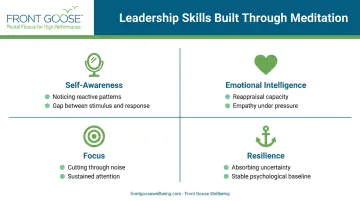
Self-Awareness
MIT Sloan Management Review reported that the Stanford GSB Advisory Council rated self-awareness as the most important capability for leaders to develop. Meditation is its most direct training tool.
Sitting practice trains sustained, non-judgmental attention on internal states — thoughts, emotions, and physical sensations. Over time, leaders begin to notice reactive patterns before they become behavior. That gap between stimulus and response is where leadership happens.
Emotional Intelligence and Regulation
A randomized workplace study found that Transcendental Meditation produced statistically significant improvement in total emotional intelligence scores alongside reduced perceived stress. That effect shows up in real conversations, under real pressure.
Meditation builds what researchers call reappraisal capacity: the ability to observe an emotion without being controlled by it. For leaders, this means:
- Staying grounded during difficult conversations
- Communicating with greater empathy under pressure
- Reducing the interpersonal fallout that reactive leadership creates
Focus and Cognitive Clarity
Attention is a limited resource — and it's trainable. Meditation is, at its core, focus training. The practice is simple: notice when your mind wanders, then return attention to the breath or chosen anchor. Done repeatedly, this builds the attentional muscle leaders need to:
- Cut through noise in complex situations
- Stay present in conversations rather than planning responses
- Resist distraction during strategic thinking
- Prioritize clearly rather than reactively
Resilience and Equanimity
Regular practice builds a stable psychological baseline — steady enough to function well under pressure without becoming rigid. Leaders who meditate consistently report measurably greater capacity to:
- Face setbacks without catastrophizing
- Absorb uncertainty without freezing
- Recover from criticism without losing momentum
In high-volatility environments, that internal steadiness is operationally significant: stress responses are contagious, and a leader's regulated state directly shapes team performance.
Ego Management and Openness to Input
Jim Collins' Good to Great research identified Level 5 leaders as combining personal humility with fierce professional will. Unchecked ego, by contrast, closes off the information flow leaders need to make good decisions.
Meditation cultivates what Zen practitioners call "beginner's mind" — the willingness to release the need to be right. Leaders who practice this consistently report greater capacity for genuine listening, openness to challenging feedback, and the kind of team trust that grows when people feel heard rather than managed.
How Meditating Leaders Show Up Differently at Work
The behavioral shifts aren't subtle, and they aren't personality changes. They're downstream effects of specific neural changes.
Observable Behavioral Shifts
Leaders who meditate regularly tend to demonstrate:
- More deliberate communication — fewer reactive statements they later regret
- Greater presence in meetings — actually listening rather than composing their next point
- Stronger conflict navigation — staying regulated when conversations get heated
- More considered decisions — pausing between stimulus and response
These behaviors aren't cultivated through willpower. They emerge from a nervous system trained to pause before acting — and that pause is where leadership actually lives.
The Team-Level Ripple Effect
Leader emotional state is contagious. Research links leader mindfulness to measurable improvements in employee well-being, leader-member relationships, interpersonal fairness, and team performance — findings consistent with the meta-analysis data below.
When a leader regulates their own state, they create conditions where their team can focus, collaborate, and perform.
Organizational Examples
Several major organizations have made structured mindfulness investment a corporate strategy:
| Organization | Program | Verified Outcome |
|---|---|---|
| Search Inside Yourself (SIY) | Peer-reviewed improvements in mindfulness and emotional function measures | |
| Aetna | Mindfulness + yoga for 239 employee volunteers | Randomized trial showed viable stress-reduction effects |
| General Mills | Seven-week program for 123 directors and managers | Self-reported improvements in decision-making and listening quality |
A 2023 meta-analysis of 91 workplace randomized trials estimated standardized effect sizes of 0.41 for work-related factors and 0.54 for stress reduction — meaningful population-level effects, even accounting for study variability.
Building a Meditation Practice That Fits a Leader's Life
Starting Small: Practical Entry Points
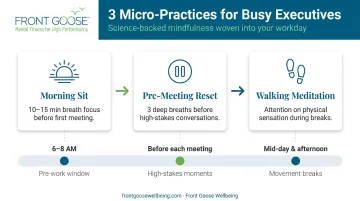
Consistency matters more than duration. Three micro-practices that work for busy executives:
- 10-15 minute breath-focused sit before your first meeting — sets the attentional tone for the day before the demands pile on
- A brief grounding moment before a high-stakes conversation — three deep breaths with attention on the body can interrupt a reactive spiral before it starts
- Walking meditation during a break — attention on physical sensation rather than the next agenda item; a real cognitive reset
Research supports this approach. A 2023 PLOS ONE experiment found that a single 10-minute mindfulness session produced acute improvements on cognitive performance measures.
Choosing the Right Type of Meditation
There's no universally superior form. The most effective type is the one you'll actually sustain.
- Breath-focused mindfulness: Well-researched, accessible, no learning curve
- Transcendental Meditation (mantra-based): Structured, twice-daily, documented EI and stress benefits in workplace settings
- Body scan: Useful for physical stress awareness and releasing tension between demanding blocks
- Movement-based practices (yoga, walking): Lower barrier to entry for leaders who struggle with sitting still
Start wherever resistance is lowest.
When to Bring in Outside Expertise
Apps and books are a fine starting point. For leaders who want measurable performance outcomes, working with someone who understands both the neuroscience and the corporate environment accelerates the results.
Megan Dittman of Front Goose Wellbeing brings 25 years as a corporate HR executive alongside Chopra Institute meditation and Neuroleadership Institute coaching credentials. The programs range from one-on-one Mental Performance Coaching to Corporate Mindfulness Training and executive leadership retreats — all designed around how leaders actually operate under pressure.
The first step is a discovery call with Megan: a straightforward way to find the right fit between your schedule, your goals, and a structured program.
Frequently Asked Questions
What are the 5 C's of leadership?
The 5 C's commonly include Competence, Character, Commitment, Communication, and Courage — though the specific list varies by source and institution. Meditation directly supports character, communication quality, and composure under pressure, making it a practical tool for developing several of these dimensions at once.
What are the 4 P's of leadership?
One well-documented framework from the Harvard Center for International Development defines the 4 P's as Perception, Process, People, and Projection. Meditation sharpens self-perception, improves how leaders show up for their people, and builds the groundedness needed to project confidence under pressure.
Can meditation really make you a better leader?
Yes — peer-reviewed research from Harvard-affiliated institutions, INSEAD, and Wharton shows meditation improves the specific capacities that define leadership effectiveness: attention control, emotional regulation, and resistance to cognitive biases like sunk-cost thinking. Each of these translates directly into measurable decisions and behaviors.
How long does it take to see leadership benefits from meditation?
Studies show acute cognitive and decision-bias effects after as little as 10-15 minutes of focused practice. Structural brain changes and durable behavioral shifts typically develop with consistent practice over 8-12 weeks — a timeline consistent with the strongest neuroimaging evidence available.
What type of meditation is best for leaders?
Both mindfulness-based and mantra-based practices have research support for leadership-relevant outcomes. For most leaders new to practice, breath awareness or guided sessions offer the lowest barrier to entry and a well-established evidence base — making consistency far easier to build.
How can organizations bring meditation training to their teams?
Organizations can start with internal wellness initiatives or partner with a certified corporate mindfulness provider to design programs around specific leadership goals. Look for providers who measure proximal outcomes — attention control, emotional regulation, leader behavior — rather than promising unverified ROI figures. Structured programs consistently outperform standalone apps when measurable leadership results are the goal.