

Introduction
Picture a product launch that collapses three weeks before go-live. Leadership is scrambling, the roadmap is shredded, and two key engineers have just resigned. In one team, people go quiet, blame circulates, and the manager starts cc'ing everyone on emails to protect herself. In another team, the conversation shifts within 48 hours from "what went wrong" to "what do we do next" — and they ship a revised version six weeks later.
What separates these two teams is resilience. And it wasn't something either team was born with.
Research published in PMC confirms that adaptive resilience is a trainable capacity: a six-week workplace mindfulness program produced significant resilience gains at six-month follow-up (effect size 0.73). The brain's neuroplasticity means resilience isn't a fixed trait — it's a skill set that can be deliberately built.
This article covers what resilience actually looks like in high-performing teams, the four qualities that define it, why leaders must develop it in themselves first, and practical strategies drawn from organizational research and neuroscience-based mental fitness training.
Key Takeaways
- Resilience is a collective, trainable capability — not a fixed personality trait
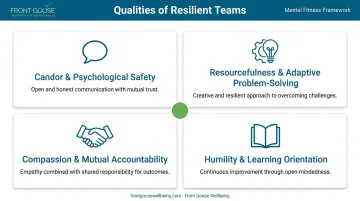
- Four qualities define resilient teams: candor, resourcefulness, compassion, and humility
- How a leader regulates their own emotions sets the ceiling for the entire team's resilience
- Resilience is built during stability, not just activated during crisis
- Mental fitness practices accelerate resilience by creating lasting neural change
What Is Team Resilience (and Why Most Teams Don't Have It)
Team resilience isn't just everyone on a team being individually tough. It's the collective capacity to absorb shocks, adapt to adversity, maintain performance under pressure, and emerge from setbacks stronger — not merely intact.
The distinction matters. Individual resilience means a person copes. Team resilience means a unit adapts together — through shared systems, mutual support, and a culture that treats disruption as solvable.
Why It's Rarer Than Leaders Think
Most teams operate in "default mode": each person managing their own stress in silos, while the group as a whole stays fragile. McKinsey's research found that only 43% of respondents reported a positive team climate — the strongest driver of psychological safety. That means the majority of teams are missing the foundational condition for collective resilience.
The Real Cost of Low Resilience
That psychological safety gap has a direct price tag. The consequences show up in burnout rates, cognitive degradation, and lost productivity:
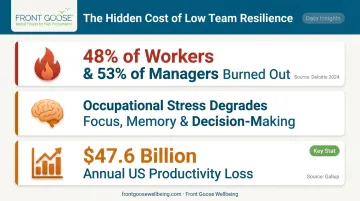
- Burnout is widespread. Deloitte's 2024 global study of 14,000+ respondents found 48% of workers and 53% of managers described themselves as burned out.
- Cognitive performance degrades. A systematic review found occupational stress associated with poorer cognitive functioning — affecting focus, memory, and decision-making.
- Productivity erodes at scale. Gallup estimates that employees with fair or poor mental health average nearly 12 unplanned absence days per year compared to 2.5 for others — translating to $47.6 billion in annual US productivity loss.
Low-resilience teams don't just struggle during crises. They burn talent, lose decision quality, and make the next disruption harder to absorb than the last.
The 4 Core Qualities of Resilient Teams
These aren't fixed personality traits. Each one can be cultivated through deliberate leadership practice and mental fitness disciplines.
Candor and Psychological Safety
Resilient teams tell each other the truth. Problems surface early, concerns get named, and honest feedback flows without fear of repercussion. That's only possible when psychological safety exists.
Google's Project Aristotle studied 180 teams and found psychological safety was the single most important dynamic of effective teams. High-safety teams generated more revenue, were rated effective twice as often by executives, and had lower voluntary turnover.
When people trust there are no negative consequences for honest dialogue, teams solve problems before they become crises — instead of discovering them after the damage is done.
Resourcefulness and Adaptive Problem-Solving
Resilient teams don't freeze when conditions shift. They redirect energy toward solutions rather than dwelling on problems. Research on team voice climate found that teams with strong candor cultures were better at identifying problems early and acquiring resources early — playing offense rather than defense.
That orientation shows up in how teams frame challenges: not as existential threats, but as workable problems worth solving.
Compassion and Mutual Accountability
Resilient teams are built on genuine care — not just professional courtesy. Members share both credit and responsibility. Success is a collective project, not a competition for individual recognition.
This mutual accountability reduces the burnout and isolation that comes from solo performance pressure. When people know their teammates have their back, they take on harder challenges and recover faster from setbacks.
Humility and a Learning Orientation
Resilient teams can say "I don't know" without it feeling like failure. They ask for help, acknowledge mistakes, and treat setbacks as data rather than defeat. A 2019 meta-analysis confirmed that learning-goal orientation is significantly related to performance adaptation — teams that prioritize learning over looking competent consistently outperform those that don't.
Humility prevents teams from hiding struggles until they become unmanageable. It creates the conditions for continuous iteration — and that capacity to keep adjusting is what separates teams that recover from teams that collapse.
Leaders Must Build Their Own Resilience First
A team's resilience ceiling is often the leader's own. When a leader spirals under pressure — doom-framing situations, going dark on communication, absorbing anxiety and radiating it downward — the team loses its anchor.
The research is direct: in a study of 228 leader-follower dyads, leader workplace anxiety predicted follower emotional exhaustion, which in turn reduced contextual performance. Leadership mood isn't private. It transmits.
Communicate a Clear Narrative, Not a Managed One
The most stabilizing thing a leader can do during uncertainty isn't false optimism. It's neutral framing: "Here is what we know. Here is what is still undecided. Here is what we are doing next."
This gives teams cognitive stability — a clear enough picture to act on — without catastrophizing or sugarcoating. People can tolerate uncertainty far better when they trust the person in charge is tracking it honestly.
Create Certainty Where You Can
When everything feels unstable, small anchors matter enormously:
- Honor scheduled one-on-ones — canceling them signals loss of control
- Maintain meeting rhythms and team rituals
- Preserve predictable touchpoints that reduce cognitive load
These aren't small gestures. They signal that the leader controls what is controllable, which is what teams need most when conditions are volatile.
Take Your Stress Up and Out
Leaders who process anxiety downward — venting to direct reports, catastrophizing in team settings — transfer cortisol, not confidence. The discipline is directing stress upward and outward: to peers, executive coaches, mentors, or professional networks.
This is a trained skill, not a sign of weakness. Front Goose Wellbeing's Mental Performance Coaching builds this capacity in executives specifically — the ability to regulate under pressure and redirect stress before it moves downward through the organization.
Focus on What's in Your Control
Chronic focus on externalities exhausts teams. Resilient leaders train attention on where their energy can produce results. This matters neurologically: chronic threat responses impair judgment and narrow thinking. When leaders redirect attention to controllable actions, they preserve the team's capacity for creativity and problem-solving under pressure.
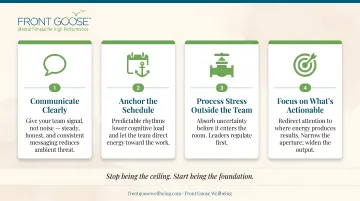
Communicate clearly, anchor the schedule, process stress outside the team, and focus on what's actionable. These four practices are how leaders stop being the ceiling — and start being the foundation their teams build on.
Practical Strategies to Build Team Resilience That Actually Work
Knowing what resilient teams look like is one thing. Getting there requires specific behaviors — ones that shape culture over time and show up in daily interactions. The most effective strategies work at both levels simultaneously.
Normalize Change as the Operating Environment
Leaders who treat every disruption as an exception inadvertently train teams to fear change. The reframe is simple but needs to be consistent: adaptability is a core operating skill, not something teams switch on during a crisis.
Practical language shifts include:
- Instead of "once things settle down..." → "as we adjust to this next phase..."
- Instead of "this is a temporary challenge..." → "this is the kind of shift we'll navigate together..."
- Build contingency thinking into planning cycles so teams treat "what if" as standard operating procedure, not panic
Build Visible Feedback Loops and Candor Rituals
Informal feedback stays invisible. Structured feedback builds culture. Concrete practices that work:
- Energy check-ins: Open meetings with a 1–5 energy or wellbeing rating from each member — low scores get noticed and addressed
- Candor breaks: Designated moments where concerns can be voiced without consequence
- Short retrospectives: After wins and failures, asking "what did we learn?" as a standing agenda item
When feedback has a structure and a schedule, it stops being optional — and that consistency is what psychological safety is actually built on.
Delegate Leadership and Distribute Ownership
Resilient teams don't have a single point of failure at the top. When leaders deliberately assign decision-making authority to team members, they build adaptive capacity across the whole group — not just at the top.
This approach also prevents leader burnout. Key advantages of distributed ownership:
- Gives team members genuine confidence through real accountability
- Removes decision-making bottlenecks during high-pressure periods
- Creates a team where five people can act, rather than one where everything stalls waiting for a single call
Invest in Resilience During Good Times
Resilience is built during stability, not activated during crisis. Think of it like strength training: you build the muscle before the competition, not during it.
Good-times practices include:
- Celebrating milestones deliberately (not just moving to the next task)
- Running skills workshops when the team isn't under active pressure
- Story-sharing sessions that deepen trust across the hierarchy
- Quarterly "scenario planning" conversations that normalize the idea of disruption
Model and Protect Recovery and Recharge
Sustained high performance requires deliberate recovery. Chronic stress shifts the brain toward habitual, reactive responding — reducing sensitivity to new information and narrowing decision-making capacity. Recovery isn't a soft benefit — it's a cognitive performance variable. Leaders who protect it are directly protecting the quality of their team's thinking under pressure.
Concrete behaviors leaders can model:
- Taking actual breaks and naming them as intentional
- Leaving after-hours messages unread until the next day — and saying so
- Acknowledging when they need recovery and taking it
The Neuroscience Edge: How Mental Fitness Accelerates Team Resilience
Resilience is a neurological capacity, not just a mindset. Neuroplasticity means the brain physically changes in response to repeated practice. When team members consistently practice regulated breathing, mindfulness, and cognitive reframing, they build neural pathways that support calmer, more focused responses under pressure.
Science-based mental fitness practices are the mechanism that makes behavioral strategies stick — skip them, and even well-designed team interventions tend to fade within weeks.
What the Evidence Shows
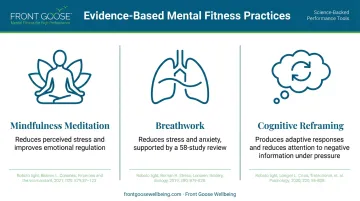
A meta-analysis of 56 randomized workplace trials involving nearly 2,700 participants found that mindfulness-based programs significantly improved employee stress, burnout, and well-being. Specific practices with supporting evidence include:
- Mindfulness meditation: Reduces perceived stress and improves emotional regulation
- Breathwork: Regulated breathing reduces stress and anxiety, per a systematic review of 58 studies
- Cognitive reframing: Laboratory research shows reframing arousal as "functional" produces more adaptive responses and reduces attention to negative information under pressure
Embed Practices Into Team Routines
The critical variable: not which practice, but how it's delivered. Mental fitness practices produce the most resilience gains when they are:
- Brief — 2–5 minutes per session is enough; 30-minute blocks create scheduling resistance
- Consistent — daily or weekly repetition builds the neural pathways that occasional practice cannot
- Leader-modeled — when leaders practice visibly, adoption rates across the team increase substantially
- Built into meeting culture rather than offered as optional wellness resources
Front Goose Wellbeing builds these delivery variables directly into every corporate engagement. Programs integrate mindful awareness, breathwork, meditation, and mental rehearsal into existing leadership routines rather than adding a separate wellness track. The curriculum structure is deliberately designed to counter the forgetting curve — so the skills teams build in a session are the same ones they're using six months later.
How to Know It's Working: Signs of a More Resilient Team
Resilience gains show up behaviorally before they show up in metrics.
Behavioral signals to watch for:
- Team members raise problems earlier, before they become crises
- Interpersonal friction decreases during high-pressure periods
- Recovery time after setbacks shortens noticeably
- People ask for help across the team hierarchy — not just from peers
Measurable indicators leaders can track:
- Reduced sick days and unplanned absences
- Improved engagement scores on quarterly pulse surveys
- Lower voluntary turnover, especially among high performers
- Quality of output during disruption periods (not just during calm ones)
Tracking Progress Over Time
Gallup's Q12 meta-analysis found that top-quartile engagement business units had 78% lower absenteeism and 21% lower turnover than bottom-quartile units — engagement and resilience aren't identical, but they move together when culture improves.
Many organizations run validated wellbeing assessments quarterly — tools like Gallup's Q12 or the WHO-5 Wellbeing Index — to track baseline changes over time. Consistent instruments matter here: switching surveys mid-program makes it impossible to separate genuine culture shifts from measurement drift.
Frequently Asked Questions
How do you build a resilient team?
Start by establishing psychological safety, then intentionally practice the four core qualities — candor, resourcefulness, compassion, and humility — through concrete rituals and habits. Resilience is built into everyday team interactions, not reserved as a crisis-only response.
What are the 4 things resilient teams do?
Resilient teams consistently do four things:
- Communicate with candor, even when it's uncomfortable
- Meet challenges with resourcefulness rather than avoidance
- Hold each other with genuine compassion and mutual accountability
- Approach setbacks with humility and a learning orientation
Why is resilience important in the workplace?
Resilient teams sustain performance during disruption, experience lower burnout rates, make better decisions under pressure, and recover faster from setbacks — each with measurable impact on retention, productivity, and profitability.
Can team resilience actually be trained?
Yes. Neuroplasticity means the brain physically changes in response to repeated mental practice. Resilience skills — including stress regulation, cognitive flexibility, and adaptive thinking — improve with deliberate, consistent training, as research at organizations like Google and Aetna has demonstrated through documented productivity and stress-reduction gains.
What role does a leader play in building team resilience?
The leader is the foundation. Their emotional regulation, communication under pressure, and willingness to model vulnerability and learning directly shape the team's collective capacity for resilience — and an unregulated leader under pressure will erode that capacity just as quickly as a grounded one builds it.
How does mental fitness connect to team resilience?
Mental fitness practices — mindfulness, breathwork, cognitive reframing — build the neurological capacity for calm, focused thinking precisely when pressure is highest, making it easier to apply resilience skills instead of defaulting to reactive, threat-mode behavior.