Introduction
Every organization has employees who show up physically but are mentally somewhere else entirely. They're present on the calendar but absent in capacity — stuck in fog, running on empty, unable to bring their best thinking to the work that matters most.
According to the WHO, depression and anxiety cost the global economy an estimated $1 trillion annually in lost productivity, with roughly 12 billion working days lost each year. For employers, that's a business performance crisis hiding inside a benefits line item.
What most organizations offer in response is reactive: an Employee Assistance Program buried in the benefits guide, a crisis hotline, maybe a mental health day here and there. These matter, but they're not enough.
The most forward-thinking employers are building mental fitness programs: proactive, science-backed systems that develop resilience, focus, and performance capacity before problems arise.
This guide walks through what an effective workplace mental health program looks like, what it takes to build one, and how to know if it's working.
Key Takeaways
- A workplace mental health program is an employer-sponsored set of initiatives designed to support employee well-being and drive measurable business outcomes — spanning EAPs, counseling access, mental fitness training, and flexible policies.
- Strong programs address four stages: prevention, early intervention, treatment access, and recovery support.
- 57% of employees dissatisfied with mental health support planned to leave within a year, making this a retention issue, not just a wellness issue.
- Managers are the single most powerful lever in building a mentally healthy, high-performing culture.
- Start with high-impact, lower-cost initiatives (manager training, mindfulness programs, flexible scheduling) before scaling to broader program investments.
What Is a Mental Health Program in the Workplace?
A workplace mental health program is an employer-sponsored initiative (or coordinated set of initiatives) designed to support employees' psychological well-being, reduce work-related stress and burnout, and maintain access to care. It covers everything from Employee Assistance Programs and insurance benefits to manager training, wellness initiatives, and crisis support.
These programs have shifted from HR afterthoughts to core strategic priorities. The data makes clear why: a Mind Share Partners survey of 1,500 full-time U.S. workers found that 76% reported at least one mental health symptom in the prior year, and 84% said at least one workplace factor negatively affected their mental health.
Mental Health vs. Mental Fitness
Most programs address mental health reactively. Mental fitness goes a step further — it's the proactive layer. Here's how the two differ:
| Mental Health Programs | Mental Fitness Training | |
|---|---|---|
| Focus | Identifying, treating, and supporting diagnosable conditions | Building capacity before problems arise |
| Approach | Reactive and crisis-focused | Proactive and performance-focused |
| Methods | EAPs, therapy access, benefits, crisis support | Mindful Awareness, Breathwork, Meditation, Mental Rehearsal |
| Outcome | Reduces harm and supports recovery | Builds resilience, focus, and performance under pressure |
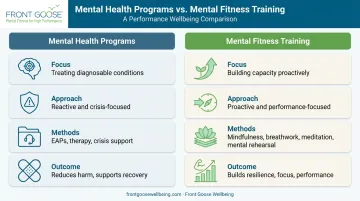
Think of it like physical training: you don't wait until you're injured to start exercising.
This distinction matters most for high-performing organizations, where the gap between functioning and thriving has a direct impact on competitive performance.
At Front Goose Wellbeing, Megan Dittman builds every corporate program around the mental fitness model: proactive capacity-building anchored in four pillars — Mindful Awareness, Breathwork, Meditation, and Mental Rehearsal.
Why Workplace Mental Health Programs Are a Business Imperative
The business case for investing in mental health is strong, and it runs across multiple performance dimensions.
Productivity
Untreated depression doesn't just affect mood — it affects output. According to the CDC, depression disrupts an employee's ability to complete physical job tasks about 20% of the time and reduces cognitive performance approximately 35% of the time. Gallup's research estimates that poor employee mental health generates $47.6 billion annually in U.S. productivity losses from unplanned absences alone.
Retention and Recruitment
Mental health benefits are now a talent differentiator. Key data points:
- 57% of employees dissatisfied with their employer's mental health support planned to seek another job within a year, compared to 33% overall (APA, 2023)
- 81% of workers said they would look for workplaces that support mental health when evaluating future opportunities
- Among Gen Z employees, 61% said they would strongly consider leaving for significantly better mental health benefits
Each of those figures represents a quantifiable attrition risk — and a direct recruiting cost when roles turn over.
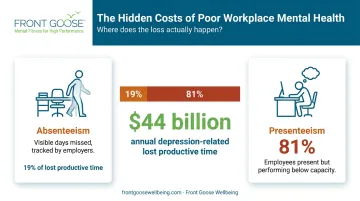
Absenteeism and Presenteeism
Two distinct cost drivers often get collapsed into one:
- Absenteeism: employees who miss work due to mental health conditions
- Presenteeism: employees who show up but perform below capacity due to mental health challenges
A foundational U.S. study estimated depression-related lost productive time at $44 billion annually — with 81% attributable to presenteeism, not absence. When employees push through instead of getting support, the cost doesn't disappear — it moves from a visible absence record to an invisible drag on output and decision quality.
Healthcare Costs
Employees with behavioral health conditions carry a disproportionate healthcare burden. Milliman's analysis found that people with behavioral health conditions represented 56.5% of total healthcare spending and averaged 3.5 times the annual cost of those without such conditions. Early access to mental health support reduces downstream utilization — making it a sound financial decision, not just a humane one.
Culture and Employer Brand
Organizations that visibly invest in mental health build psychological safety, reduce stigma, and attract stronger candidates. The U.S. Surgeon General's Framework for Workplace Mental Health & Well-Being (HHS, 2022) confirms this is now a public health and organizational health priority — one that belongs in the same strategic conversation as compensation, benefits design, and leadership development.
Key Components of an Effective Workplace Mental Health Program
No single initiative covers all needs. Effective programs combine multiple components that address different employee needs and risk levels.
Employee Assistance Programs (EAPs)
EAPs are the most widely used workplace mental health resource, providing confidential short-term counseling and referral support. They're a solid baseline — but persistent low utilization is the central challenge. Studies suggest utilization rates at many organizations fall between 2% and 8%.
To improve EAP effectiveness:
- Communicate availability through multiple channels repeatedly — not just during onboarding
- Train managers to recommend EAPs directly and without stigma
- Normalize use by framing EAPs as a performance resource, not a crisis service
Pre-post EAP research has shown meaningful reductions in missed work hours and at-work productivity losses, though controlled studies show mixed results on absenteeism specifically.
Coverage and access shape whether employees actually use these resources — which is where benefits design becomes the next critical lever.
Mental Health Benefits and Insurance Coverage
Comprehensive coverage for therapy, psychiatry, and behavioral health — including virtual care options — directly reduces barriers to treatment. The Mental Health Parity and Addiction Equity Act (MHPAEA) requires covered group plans to apply equal financial requirements to mental and physical health benefits. Parity compliance is both a legal baseline and a retention advantage.
Telehealth has become increasingly important: in 2024, 23% of firms with at least 50 workers added in-network telehealth providers specifically to reduce mental health access barriers.
Even with strong benefits in place, reactive coverage only goes so far. The programs that move the needle on performance — not just utilization — invest in building mental fitness proactively.
Mental Fitness Training and Mindfulness Programs
Science-based mental fitness training — encompassing mindfulness, meditation, breathwork, stress regulation, and mental rehearsal — helps employees perform at higher levels consistently, building the cognitive resilience that prevents crisis rather than just responding to it.
Megan Dittman of Front Goose Wellbeing has spent 25 years as a corporate HR executive at organizations including GE Aerospace and Kohler Corp, and now delivers this training to leadership teams and organizations nationwide. Participants report reduced stress, greater confidence, and measurable shifts in how leaders show up for their teams.
Manager and Leadership Training
Managers are the organization's most underutilized mental health asset. Yet a 2024 NAMI/Ipsos survey found that 7 in 10 senior-level employees had received no workplace training on how to talk with their teams about mental health.
Effective manager training covers:
- Recognizing early behavioral warning signs of distress
- Conducting check-ins that go beyond task status
- Mental Health First Aid certification
- Connecting employees to resources confidentially and without stigma
- Modeling mentally healthy behaviors (boundaries, transparency, self-care)
Because a single manager's behavior sets the psychological tone for an entire team, investing in their skills scales further than almost any other program component.
Flexible Work Policies and Psychological Safety
These are low-cost, high-impact program components:
- Flexible scheduling and remote/hybrid options reduce chronic stress triggers
- Designated mental health days reduce the hidden cost of presenteeism
- A culture where employees can speak openly prevents the compounding damage of silence
Gallup found that employee wellbeing varied more by management quality than by work location — reinforcing that policy flexibility only works when the cultural conditions support it.
How to Start a Mental Health Program at Work: Step-by-Step
You don't need to build everything at once. Here's a practical launch sequence.
Step 1 — Assess your workforce's needs. Use anonymous surveys, focus groups, and existing HR data (absenteeism, turnover patterns, healthcare utilization) to identify your organization's specific stressors and gaps. Build on evidence, not assumptions.
Step 2 — Define goals and scope. Set measurable objectives: reduce absenteeism by X%, improve engagement scores, increase EAP utilization. Determine what to launch now versus phase in later. Starting with two or three high-impact initiatives beats an overambitious rollout that stalls.
Step 3 — Structure around four pillars. Build your program to address:
- Prevention — reduce stress before it accumulates
- Early intervention — identify and address concerns before they escalate
- Treatment access — create clear pathways to care
- Recovery support — help employees return to and sustain performance
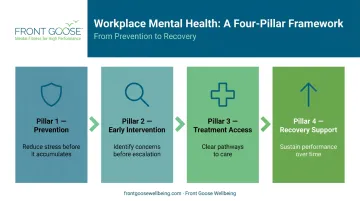
Map current resources to each pillar to identify gaps.
Step 4 — Communicate clearly and reduce stigma. A program that employees don't know about, trust, or feel safe using delivers zero value. Use multiple channels — team meetings, internal newsletters, manager briefings, and all-hands updates — and reinforce confidentiality at every touchpoint. An external facilitator — such as Front Goose Wellbeing's corporate mindfulness workshops or speaking engagements on stress and cognitive resilience — can also shift the conversation in rooms where internal voices carry less weight.
Step 5 — Engage leadership at every level. The most successful programs have visible, active senior sponsorship. Leaders who model healthy boundaries, openly discuss well-being, and champion the program signal that mental health is a real priority — not a policy document collecting dust.
The Role of Leaders and Managers in Workplace Mental Health
Managers are the front line of workplace mental health. They spot behavioral changes before HR does, set the workload expectations that create or relieve stress, and ultimately determine whether psychological safety is genuine or just a policy on paper.
Research reinforces the stakes. Employees who considered their managers poor communicators were 23% more likely to report mental health decline during periods of organizational stress. That communication pressure extends beyond meetings — after-hours email drives greater emotional exhaustion and measurably worse work-family balance.
What Effective Mental Health Leadership Looks Like
- Modeling boundaries: taking time off, limiting after-hours communication, acknowledging their own stress openly
- Conducting real check-ins: asking "how are you doing?" and meaning it — not just "what's the status?"
- Completing Mental Health First Aid training: so they can recognize warning signs and respond appropriately
- Connecting employees to resources: without judgment, without delay, and with privacy intact
The Manager's Own Mental Health
Leaders are not immune to burnout. Gallup found that 35% of managers reported burnout "very often" or "always" — compared to 27% of individual contributors. Any program that serves only individual contributors while ignoring the people who lead them is overlooking a critical gap.

Mental wellness programs and support resources must explicitly include managers and executives, not just the teams they manage.
How to Measure the Success of Your Workplace Mental Health Program
Measurement without a baseline is meaningless. Before launching any initiative, document your current state across key indicators.
Metrics to Track
| Category | Specific Metrics |
|---|---|
| Quantitative | Absenteeism rates, turnover/retention rates, EAP utilization, healthcare claim costs |
| Engagement | Employee engagement scores, satisfaction survey results |
| Qualitative | Focus group feedback, psychological safety survey results, manager observations |
| Program reach | Training completion rates, session attendance, resource downloads |
The Continuous Improvement Cycle
Measurement is not a one-time audit. Build in quarterly or biannual reviews, share anonymized aggregate results with leadership, and make visible adjustments based on what the data shows. The CDC's Workplace Health Model structures this as four stages:
- Assess current workforce health and program gaps
- Plan initiatives based on what the data reveals
- Implement with defined timelines and accountability
- Evaluate outcomes — then feed results back into the next planning cycle
Programs that adapt based on what the data shows consistently outperform static ones. When employees see their feedback reflected in program changes, trust in organizational commitment grows — and that trust drives the retention outcomes you're measuring in the first place.
Frequently Asked Questions
What is a mental health program in the workplace?
A workplace mental health program is an employer-sponsored set of coordinated initiatives — EAPs, mental health benefits, wellness training, manager education, and flexible policies — designed to support employees' psychological well-being and reduce burnout. These programs range from single-component efforts to comprehensive multi-pillar strategies that improve performance and retention.
How do you start a mental health program at work?
Begin by assessing employee needs through anonymous surveys and HR data. Define measurable goals, then launch one or two foundational initiatives — manager training or a mindfulness and wellness program are strong starting points. Communicate clearly to reduce stigma, and build in evaluation from day one so you can track improvement over time.
What are examples of workplace mental health programs?
Examples include Employee Assistance Programs (EAPs), mental health days, mindfulness and meditation training, Mental Health First Aid workshops, flexible work policies, psychological safety initiatives, and science-based mental fitness coaching programs like those offered by Front Goose Wellbeing.
What is the difference between mental health and mental fitness in the workplace?
Mental health programs typically focus on identifying, treating, and supporting mental health conditions — a reactive model. Mental fitness takes a proactive approach: building resilience, focus, and stress regulation capacity before problems arise, much like strength training builds capacity before an injury occurs.
How do you measure success of a workplace mental health program?
Track EAP utilization rates, absenteeism and turnover data, employee engagement scores, and healthcare cost trends — always compared against a pre-program baseline. Combine quantitative metrics with qualitative feedback for a complete picture.
What is the role of managers in supporting employee mental health?
Managers shape psychological safety, model healthy behaviors, recognize early warning signs of distress, and connect employees to resources. Training managers in mental health awareness and Mental Health First Aid is one of the highest-impact investments any organization can make.