Key Takeaways
- 77% of U.S. workers report work-related stress monthly — yet most organizations respond with perks, not skills
- Effective training addresses both individual coping skills and leadership behavior, not just one level
- Training that works covers five areas: stress awareness, mindfulness, cognitive reframing, leadership behavior, and habit formation
- Techniques like box breathing show measurable effects within days — lasting cultural change typically takes 4–6 months
- WHO research shows every $1 invested in mental health treatment returns $4 in productivity
Why Workplace Stress Demands a Structured Training Response
Workplace stress is easy to overlook until it becomes a crisis. Unlike a physical safety hazard, it doesn't trigger an alarm or stop a production line. It shows up instead as missed deadlines, quiet disengagement, unexplained turnover, and leaders who can't figure out why their best people keep leaving.
According to APA's 2023 Work in America Survey, 77% of employed U.S. adults reported work-related stress in the prior month, with 57% citing negative effects including lower productivity, irritability with coworkers, and feeling ineffective. These aren't fringe numbers. They describe the majority of your workforce on any given day.
The Three Stressors Training Can Actually Fix
The American Institute of Stress and NIOSH research both point to working conditions — not individual personality — as the primary driver of job stress. The solution, then, is partly structural. Three organizational stressors show up consistently across industries:
- Employees who lack clear role expectations can't perform consistently or recover from setbacks effectively
- 84% of U.S. workers blame poorly trained managers for creating unnecessary stress — a management problem, not a personality problem
- Most employees face mounting pressure with no training on how to regulate their response to it
A single yoga class or EAP poster doesn't address any of these. What creates change is structured, repeated practice — training that works with the brain's neuroplasticity, the documented capacity to form new stress-response patterns through consistent repetition.
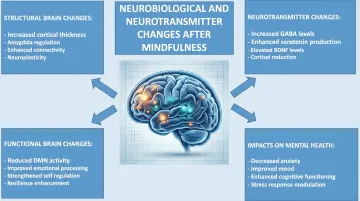
The evidence is concrete: an eight-week mindfulness program studied at Harvard/MGH showed measurable increases in gray-matter density in stress-regulation areas of the brain after participants practiced approximately 27 minutes daily — not a wellness perk, but behavioral reprogramming.
What Stress Management Training for the Workplace Actually Means
Workplace stress management training is a structured, evidence-based program that equips employees and leaders with cognitive, behavioral, and physiological skills to recognize, regulate, and reduce stress. Unlike therapy or an EAP — both reactive supports that engage after stress becomes a crisis — this training is proactive. It builds the skills people need before they hit a wall.
Two Levels Every Program Must Cover
Most programs underinvest in one of two levels — and that's typically where they fall short:
Employee-level training builds individual capacity:
- Recognizing personal stress signals early
- Using evidence-based regulation techniques (breathing, mindfulness, reframing)
- Developing emotional resilience and recovery skills
Leadership-level training shapes the environment:
- Identifying early burnout signals in team members
- Modeling healthy stress behaviors visibly and consistently
- Creating psychologically safe conditions where people can speak up before they break down
Employees can learn every regulation technique available — but if their manager sends emails at 11 PM and packs the calendar without breathing room, the training is fighting the culture. Individual skills and organizational behavior have to move in the same direction.
Core Components of an Effective Stress Management Training Program
Component 1: Stress Awareness and Recognition
Training must start here. Without self-awareness, no technique sticks.
Employees need to recognize their own stress signals across four dimensions:
- Physical — tension, shallow breathing, fatigue
- Cognitive — racing thoughts, difficulty concentrating
- Emotional — irritability, anxiety, emotional numbness
- Behavioral — withdrawal, procrastination, increased errors
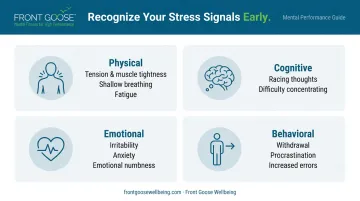
Most people only notice stress when it's already severe. The goal is to catch it much earlier.
A useful framework draws on organizational stress research distinguishing physical demands, task demands, role demands, and interpersonal demands — helping participants see that their stress has identifiable sources, not just a vague sense of being overwhelmed.
Component 2: Mindfulness and Attention Training
Mindfulness-based practices train the prefrontal cortex to interrupt automatic stress reactions. Research shows that mindfulness is associated with greater prefrontal activation and reduced amygdala reactivity — the neurological signature of better emotional regulation under pressure.
That neurological evidence shapes how Front Goose Wellbeing approaches this work. Founder Megan Dittman combines Chopra Institute-certified mindfulness instruction with executive coaching grounded in the Neuroleadership Institute's neuroscience-of-leadership framework — a pairing that bridges contemplative depth with the performance language corporate audiences actually respond to.
Component 3: Cognitive Reframing and Resilience Skills
Stress is as much about interpretation as physiology. Cognitive reframing teaches employees to identify automatic negative thoughts and consciously challenge them — interrupting the stress cycle by changing how the brain reads a situation, not just the situation itself.
This connects to Stress Inoculation Training (SIT), a cognitive-behavioral approach developed by Meichenbaum with three phases: problem framing, skills acquisition and rehearsal, and application through graded exposure. The "inoculation" works because repeated, coached encounters with managed stressors build the mental flexibility to recover faster from real ones.
Component 4: Manager and Leader Training
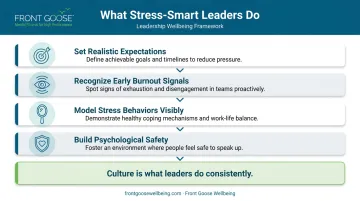
Individual skills matter — but culture is set at the manager level, and this is where most programs fall short. A dedicated leadership track should cover:
- Setting realistic performance expectations
- Recognizing early burnout signals in team members (before it becomes a crisis)
- Modeling stress management behaviors openly — not just talking about wellbeing
- Building psychological safety so employees can flag overload without fear
Culture is what leaders do consistently, not what they say in an all-hands. When leaders normalize "I need a moment to think" or start meetings with a brief reset, those behaviors define what the team considers acceptable.
Component 5: Practical Application and Habit Formation
Training creates change only when it's repeated. A single workshop produces awareness at best. Lasting behavioral change requires:
- Spaced learning — practice distributed across weeks, not packed into one day
- Skill application exercises between sessions
- Micro-practices embedded in daily routines (a 2-minute breathing reset before high-stakes meetings, for example)
Front Goose Wellbeing offers formats ranging from single-session workshops through multi-month cohort curricula — each structured so that skills compound over time rather than fade after day one.
Science-Backed Techniques Every Program Should Teach
Box Breathing (Controlled Breathing)
The protocol: Inhale for 4 counts, hold for 4, exhale for 4, hold for 4. Repeat.
This isn't just a relaxation trick. Slow, intentional breathing activates the parasympathetic nervous system, shifting the body out of the fight-or-flight response and lowering cortisol within minutes. A randomized study of 40 adults found significantly lower cortisol in the breathing-trained group after 8 weeks compared to controls.
It requires no equipment and can be done at a desk before a difficult conversation. Few techniques are this low-friction to use mid-workday.
Mindfulness-Based Attention Practices
Breathwork calms the acute stress response. Mindfulness builds the longer-term capacity to regulate it. Brief structured exercises — 2 to 5 minutes of focused attention on breath, body, or a single task — reduce rumination and strengthen stress regulation over time.
Consistency matters more than duration. Daily 3-minute practices outperform monthly hour-long sessions. That reality makes mindfulness highly compatible with corporate schedules when it's framed correctly.
Cognitive Restructuring
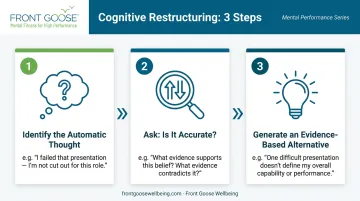
Most workplace stress lives in the interpretation layer — not the situation itself. Cognitive restructuring targets that layer directly through a three-step process:
- Identify the automatic thought
- Ask whether it's accurate
- Generate an evidence-based alternative
The situation doesn't have to change for the stress response to shift. That's what makes this technique so practical for high-pressure roles.
Strategic Micro-Breaks
NIOSH recommends frequent brief breaks, roughly every one to two hours during demanding work, as more effective at preventing cognitive fatigue than waiting until depleted. The key addition: psychological detachment during those breaks. Stepping away from screens and work-related thoughts produces significantly more recovery than passive scrolling.
Progressive Muscle Relaxation (PMR)
Chronic stress stores tension in the body, and PMR addresses it directly by tensing and releasing muscle groups sequentially to produce measurable physical relief. A systematic review covering 46 studies and 3,402 adults found PMR generally reduced stress, anxiety, and depression. For employees in deadline-driven, high-pressure roles where stress is felt physically, this is a valuable addition to the toolkit.
How to Implement Stress Management Training at Your Organization
Step 1: Assess Your Stress Landscape
Don't design training based on assumptions. Use pulse surveys, exit interview data, absenteeism trends, or focus groups to identify the actual stressors in your organization. OSHA's workplace stress guidance recommends this diagnostic step first. Skipping it is why so many programs generate activity without generating results.
Step 2: Choose a Format That Fits Your Culture
| Format | Best For | Tradeoff |
|---|---|---|
| In-person workshops | Team cohesion, high-engagement content | Scheduling complexity at scale |
| Virtual live sessions | Distributed teams, rapid deployment | Harder to sustain attention |
| Self-paced e-learning | Reinforcement, reference material | Low completion rates without accountability |
| Blended (recommended) | Lasting behavior change | Requires more planning upfront |
Blended approaches (live instruction, on-demand reinforcement, and peer accountability) show the strongest outcomes for sustained change.
Step 3: Engage Leadership First
Training fails when it's rolled out to employees while leaders remain untrained and unchanged. Start with a leadership cohort. It builds internal champions, signals organizational seriousness, and most critically, models the behaviors that make the employee training land.
Front Goose Wellbeing's programs are built specifically for this leadership-first approach. Megan Dittman spent 25+ years as a corporate HR executive at organizations including GE and Kohler, so the curriculum addresses the pressures leadership teams actually face — not a generic employee wellness audience.
Step 4: Measure, Iterate, and Sustain
Track impact using pre/post stress assessments, productivity metrics, absenteeism rates, and engagement scores. Set a 6-month review cycle to reinforce skills and update content.
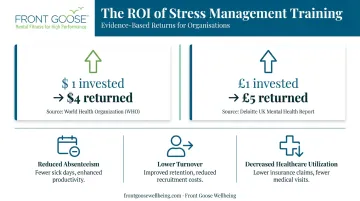
That measurement data also builds the internal ROI case for continued investment. WHO research shows every $1 invested in treating depression and anxiety returns $4 in better health and productivity. Deloitte's UK workforce research found approximately £5 returned for every £1 invested in broader employee mental health programs. Stress management training isn't a cost center. It's one of the higher-ROI line items in an HR portfolio.
Practical Daily Tips to Reinforce Training
Habits formed between sessions matter as much as the sessions themselves. The practices below give individuals, leaders, and organizations concrete starting points — organized by role so each group knows exactly where to focus.
For individual employees:
- Identify your top two personal stress triggers each week
- Schedule one protected recovery break daily — not optional, not movable
- Use a 2-minute box breathing reset before high-stakes meetings
Leadership behavior sets the cultural tone. These micro-practices signal that mental fitness is a team norm, not a personal quirk.
For team leaders:
- Open team meetings with a one-minute grounding reset
- Normalize "I need a moment to think" as a sign of good judgment, not weakness
- Avoid after-hours communication unless genuinely urgent — and define "urgent"
Sustainable wellbeing requires structural support, not just individual effort. Organizations can embed these practices at the systems level.
For organizations:
- Communicate role expectations clearly during onboarding, not just in performance reviews
- Build recognition systems that value sustainable performance, not just heroic effort
- Make wellbeing a standing agenda item in regular manager check-ins
Frequently Asked Questions
What should workplace stress management training include?
Effective programs cover five areas: stress awareness and self-recognition, mindfulness and attention training, cognitive reframing and resilience skills, a dedicated leadership track, and repeated practice for habit formation. Programs that address both individual skills and organizational conditions — including management behavior — consistently outperform those focused on one level alone.
How long does stress management training take to show results?
Techniques like box breathing show physiological effects within days. Lasting behavioral change — new habitual responses to pressure — typically requires 4 to 8 weeks of consistent practice. Measurable organizational outcomes, including shifts in absenteeism and engagement scores, generally appear at the 3 to 6 month mark.
What is the ROI of stress management training?
WHO research shows every $1 invested in treating depression and anxiety returns $4 in productivity gains. Deloitte's UK-based analysis found roughly £5 returned for every £1 spent on mental health programs — a ratio that holds across global markets. Training also reduces absenteeism, turnover, and healthcare utilization, costs that compound fast in mid-market and enterprise organizations.
What is the difference between stress management training and an EAP?
EAPs provide support after stress has escalated into a crisis. Stress management training builds the cognitive and behavioral skills employees need before that point. Both serve a role, but effective training reduces how often employees require EAP intervention in the first place.
Can stress management training prevent employee burnout?
Yes, when applied consistently. Training targets the early coping deficits — poor stress recognition, limited regulation skills, cognitive rigidity — that accumulate into burnout. Pairing individual skill-building with supportive leadership practices delivers the sharpest reduction in burnout risk.
How do you get leadership buy-in for stress management training?
Lead with productivity, retention, and ROI — not wellness alone. Use data from Gallup, APA, or your own turnover figures to quantify the cost of unmanaged stress, then propose a pilot starting with the leadership team itself. Leaders who experience the training firsthand reliably shift their view from HR initiative to performance investment.