
Introduction
According to the APA's 2023 Work in America Survey, 77% of workers reported work-related stress in the previous month — with emotional exhaustion, lower motivation, and reduced productivity among the most common effects. That's not a fringe problem. It's the baseline for most professionals right now.
Workplace mindfulness isn't a personality trait or a luxury for people with extra time. It's a trainable mental skill — the practice of bringing intentional, non-reactive awareness to your tasks, conversations, and decisions throughout the day. No retreat required. No special equipment.
Organizations that have embedded consistent practice report 20–37% productivity gains and 30–40% reductions in stress. What's less obvious is how to actually build that practice into a demanding workday without disrupting everything else.
That's what this article covers: the neuroscience behind why mindfulness moves the performance needle, techniques you can apply today, and what leaders can do to make it stick across their teams.
Key Takeaways
- Mindfulness is a science-backed, trainable skill that measurably improves attentional focus and work-life balance
- Simple daily practices like breath awareness, single-tasking, and structured breaks deliver results without disrupting your workflow
- Consistency drives lasting change; a single workshop or a week-long app trial won't move the needle
- Leaders who model mindfulness create organizational permission for others to follow
- Structured programs with credentialed facilitators produce deeper, measurable results
Why Workplace Mindfulness Matters: The Science Behind It
What Stress Actually Does to Your Brain
Chronic workplace stress physically impairs performance — not just how it feels, but how the brain functions. Research on stress neuroscience shows that elevated stress hormones weaken prefrontal cortex connectivity, degrading working memory and top-down cognitive control. In plain terms: sustained stress makes it harder to think clearly, prioritize well, and regulate emotional reactions.
Most high-performing professionals operate in some level of chronic stress most of the time, and those costs compound. Mindfulness counteracts this through what researchers describe as a proposed parasympathetic pathway — deliberate attention practices shift the nervous system away from threat-response mode, creating the neurological conditions for clearer thinking. The mechanism is still being studied; the functional outcomes are not.
What Sustained Mindfulness Training Actually Produces
A randomized controlled trial published in the Journal of Occupational Health Psychology (Slutsky et al., 2019) assigned 60 employees at a Midwestern firm to either a six-week daily mindfulness program or a single half-day seminar. The results:
- Six-week group: Significantly greater improvement in attentional focus and significantly greater reduction in work-life conflict
- Half-day group: Comparable perceived productivity gains, but no significant advantage in focus or work-life boundaries
- Key finding: Sustained training outperformed the single-session format on the outcomes that matter most for professional performance
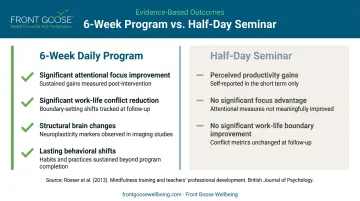
The brain plasticity research explains the difference. After eight weeks of mindfulness practice, Hölzel et al. found increased gray-matter concentration in regions associated with learning, memory, and emotional regulation — structural changes in the brain's capacity to sustain attention and manage reactivity, not just subjective improvements in how people feel.
The Attention Problem Is Getting Worse
Remote work, always-on communication, and notification culture have compounded the baseline stress problem. Microsoft's 2023 Work Trend Index — drawn from a survey of 31,000 people across 31 countries — found that 68% of respondents lacked enough uninterrupted focus time during the workday. Fragmented attention isn't a personal failing. It's a structural feature of modern work that mindfulness practice directly addresses.
Practical Mindfulness Tips You Can Start Today
These six practices require no apps, no meditation cushions, and no extra hours in your day.
1. Breath Awareness Before You Begin
Before opening email or starting a task, take 60–90 seconds to focus on slow, deliberate breathing. Consider it a mental gear shift: it resets your nervous system from reactive mode to intentional mode, and it takes less time than most people spend scrolling before starting work.
2. Single-Task Intentionally
Multitasking feels productive. Research from Ohio State found that media multitasking gave participants a sense of accomplishment — but actually interfered with cognitive goals. Feeling busy and being productive are two different things.
Pick one task. Set a time block. Close unrelated tabs and silence notifications. This is the single highest-leverage habit for knowledge workers who want to produce better work in less time.
3. Use Structured Breaks as a Performance Strategy
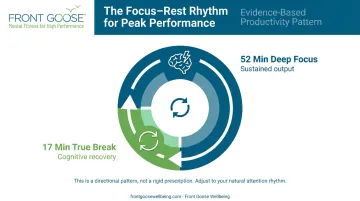
DeskTime's observational analysis of productive users found an average pattern of roughly 52 minutes of focused work followed by 17 minutes away. That's not a universal prescription — it's a directional signal that your brain has natural rhythms worth respecting.
Separate UC Irvine research found that interrupted workers compensated by working faster, but reported greater stress and effort.
Set a timer. Take actual breaks. That's not laziness. That's how sustained output works.
4. Batch Your Email
Reactive inbox-checking fragments your attention repeatedly throughout the day. A UC Irvine field study found that removing email access reduced stress as measured by heart rate monitoring. Designate two or three specific windows for email rather than responding to every notification. When you enter each window, do it with intention — not as a reflexive response to a ping.
5. Practice Active Listening
Most professionals spend meetings mentally composing their response while the other person is still talking. This is autopilot, not engagement. Mindful listening means fully processing what's being said before formulating a reply. The practical result: fewer miscommunications, stronger working relationships, and meetings that actually move things forward.
6. Use Transitions as Reset Moments
The walk between meetings, the commute, refilling water — these micro-transitions are free mindfulness opportunities. Noticing physical sensations (feet on the floor, ambient sounds, breath) during transitions prevents the brain from carrying stress from one context into the next. You arrive at each task fresher than if you'd stayed locked in reactive mental chatter throughout.
Mindfulness for High-Stakes Work Moments
Before Meetings: The Minute to Arrive
SAP's Global Mindfulness Practice developed a simple pre-meeting protocol: spend 60 seconds settling the mind, setting an intention, and checking your physical state before joining. This brief pause reduces reactive responses and sharpens participation quality.
It takes no extra calendar time. Use the last minute you would have spent scrolling your phone anyway.
- Settle: Three slow breaths to lower baseline activation
- Intend: One sentence — what do you want to contribute or accomplish?
- Notice: Are you tense, distracted, or already primed to react?
During Conflict or Pressure
Mindfulness training alters amygdala connectivity, building a neurological buffer between stimulus and reaction. In a tense moment, the practical application is straightforward:
- Slow your breath — this is the fastest physiological intervention available
- Label the emotion internally — "I'm feeling defensive" creates cognitive distance from the feeling
- Delay your response by a beat — not suppressing, not venting, just pausing long enough to choose
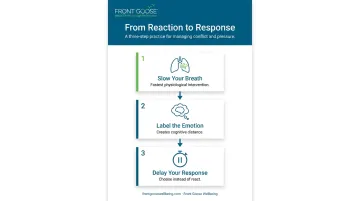
That pause is where judgment lives — and it's trainable.
For Deep Work
Mindfulness trains sustained attention, which is the prerequisite for the focused, high-quality work that actually moves projects forward. Treat these blocks with the same protection you give a key client meeting:
- Block 60–90 minutes device-free on your calendar
- Use a 2-minute breath-focus anchor at the start to enter focused state faster
- Decline non-urgent interruptions during the block — not forever, just for now
End-of-Day Wind-Down
A 2–3 minute end-of-day practice — breath focus or a brief mental review of what went well — signals the brain to transition out of work mode. Research on low-dose mindfulness interventions found improvements in both sleep quality and duration.
Better sleep compounds directly into next-day cognitive performance. Done consistently, the wind-down becomes one of the highest-return two minutes in your day.
How Leaders Can Build a Mindfulness Culture at Work
Culture doesn't change because a program exists. It changes because of what leaders visibly do.
Lead by Example
Jeff Weiner, former LinkedIn CEO, reported blocking 90 minutes to two hours of unscheduled reflection time daily and openly credited it with shifting his leadership style from reactive to compassionate. The principle holds broadly: when senior leaders practice and discuss mindfulness visibly, it reduces stigma and creates permission for others to follow.
Research on wellness program participation consistently shows that perceived senior-leader support is one of the strongest predictors of employee engagement. Leadership behavior sets the cultural norm — and mindfulness is no exception.
Design for Accessibility
A workplace mindfulness culture doesn't require a meditation room or a company-wide app rollout. Practical starting points:
- Two-minute centering exercises at the start of team meetings
- A shared internal resource page with brief guided practices
- A voluntary lunch-and-learn on attention management
- Manager training on creating uninterrupted focus time for teams

The goal is meeting people where they are. Broad participation matters more than perfect enthusiasm.
When Organizations Are Ready to Go Deeper
For organizations ready to invest in structured programming, science-based corporate mindfulness training — delivered by credentialed facilitators who understand both the neuroscience and the organizational context — produces more consistent results than self-directed approaches. That's the model Front Goose Wellbeing follows with clients like GE Aerospace and Kohler Corp. Scott Deloretta, Executive Director at GE Aerospace, described the training as doing "a fantastic job bringing science and practice together in the form of tools to focus on mindfulness, reduce stress and improve performance."
Measure What Matters
Successful programs track outcomes before and after training: well-being scores, self-reported focus quality, absenteeism rates, and engagement metrics. Tracking these metrics validates whether the program is working and gives HR and finance leaders the evidence needed to sustain investment over time.
Common Workplace Mindfulness Mistakes to Avoid
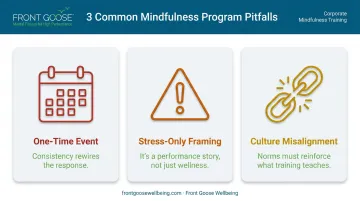
Treating it as a one-time event. The Slutsky et al. study is direct on this point: only the group assigned to six weeks of daily practice — not the half-day seminar participants — showed significant improvements in attentional focus and work-life conflict. Consistency is the mechanism. A single workshop can introduce the concept. Sustained daily practice is what rewires the response.
Framing it only as stress management. Mindfulness does reduce stress. But limiting the conversation to stress undersells its value and may cause high-achievers to dismiss it as something for people who can't handle pressure. The more accurate frame: mindfulness sharpens decision-making, reduces reactive behavior under pressure, and builds the cognitive resilience under sustained pressure. That's a performance story, not just a wellness story.
Offering programs in a culture that rewards overwork. If an organization invests in mindfulness training while leadership implicitly rewards constant availability, reactive behavior, and visible busyness, the cultural message cancels the program's impact.
Mindfulness initiatives succeed when organizational norms align with what's being taught — how meetings are structured, how managers respond to after-hours messages, and how recovery time is treated all send signals that either reinforce or undercut the training.
Conclusion
The brain can be trained to perform with greater clarity and fewer wasted cycles — even under the exact pressures modern professional life creates. The science supports this. The practices are accessible. What stops most people is simply starting and staying consistent.
Pick one tip from this article and commit to it for two weeks. Start with the 60-second breath anchor before tasks, or try batching your email into designated windows. Two focused weeks of a single practice will teach you more than two months of scattered effort.
For leaders and organizations ready to go deeper, Megan Dittman at Front Goose Wellbeing brings 25 years of corporate HR executive experience alongside certifications in neuroscience-based coaching, meditation, and health and wellness — which means she speaks the language of organizational life and performance, not just wellness. A discovery call is the fastest way to find out what a structured program could do for your team.
Frequently Asked Questions
How is mindfulness used in the workplace?
Workplace mindfulness involves intentionally bringing focused, non-reactive awareness to tasks, interactions, and decisions throughout the workday. Common practices include breath-focus anchors before tasks, mindful meeting openers, single-tasking blocks, and structured email management — none of which require extra time outside of existing work activities.
What are common principles or frameworks of workplace mindfulness?
Core principles include present-moment awareness, non-reactivity, intentional attention, and single-tasking. Evidence-based frameworks used in organizational settings include MBSR (Mindfulness-Based Stress Reduction), an eight-week structured program created by Jon Kabat-Zinn, and the Unified Mindfulness system developed by Shinzen Young, which emphasizes Concentration Power, Sensory Clarity, and Equanimity.
Can mindfulness lower blood pressure?
Yes. A 2023 randomized clinical trial found that a mindfulness-based program adapted for elevated blood pressure produced clinically relevant systolic pressure reductions compared to standard care. This is a complementary benefit, not a medical treatment — it works through the body's stress-regulation systems.
How long does it take to see benefits from workplace mindfulness?
Research by Slutsky et al. found that six weeks of daily practice produced significant improvements in attentional focus and work-life conflict — a single half-day seminar did not. Meaningful stress reduction and attentional depth build through consistent daily practice, even in short sessions.
What are the easiest mindfulness practices to start at work?
Three options that require no extra time or equipment:
- 60-second breath focus before starting any task
- "Minute to arrive" before meetings — set an intention and notice your physical state
- Hourly 30-second check-in — a brief pause to reconnect with the breath
All three work immediately and build the habit foundation for deeper practice.
Can mindfulness improve leadership effectiveness?
Yes — mindfulness strengthens the capacities that leadership actually requires: emotional regulation, active listening, composure under pressure, and strategic clarity. Leaders who practice mindfulness respond rather than react in high-stakes moments, which directly affects team trust, communication quality, and decision outcomes — often visibly within weeks of consistent practice.