Introduction
You spend roughly a third of your life at work. Yet for most employees, the idea of discussing mental health with a manager or HR partner still feels riskier than pushing through burnout in silence.
The numbers make that hesitation understandable. According to the 2024 Work in America Survey by the American Psychological Association, 39% of employed adults worry that disclosing a mental health condition would negatively affect them at work. A 2025 NAMI poll put that figure even higher, at 42%. These aren't irrational fears — they reflect real gaps in how most organizations prepare their people.
Awareness campaigns help, but they don't close that gap. Training does. When employees know how to recognize warning signs early, practice daily mental fitness habits, and handle difficult conversations without fear of retaliation, the culture shifts in measurable ways.
What follows is a practical guide to mental health training at work: how to spot early warning signs, build sustainable mental fitness habits, and create the kind of psychological safety where asking for help is the norm, not the exception.
Key Takeaways
- Mental health training reduces burnout and sharpens performance at every level
- Spotting warning signs early — in yourself and colleagues — can prevent crises before they escalate
- Mindfulness, breathwork, and cognitive reframing are daily habits you can train, not one-time events
- You don't need a title to build psychological safety — individual behavior shifts team culture
- Approaching HR or a manager about mental health is a practical skill, not a last resort
Why Mental Health Training in the Workplace Matters
Most organizations treat mental health support as a reactive resource — an Employee Assistance Program (EAP) number buried in the benefits handbook, a crisis hotline mentioned once during onboarding. That infrastructure matters, but it only works when employees already feel capable of reaching for it.
Training is what makes support resources usable.
The Cost of Doing Nothing
The data on untreated workplace mental health is consistent — and the costs are measurable:
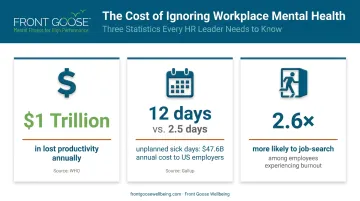
- Depression and anxiety account for an estimated 12 billion lost workdays and $1 trillion in lost productivity annually, according to the WHO
- Gallup estimates that employees with fair or poor mental health miss nearly 12 unplanned days per year, compared to 2.5 days for their peers — a gap that costs US employers an estimated $47.6 billion annually in missed work alone
- Burned-out employees are 2.6 times more likely to be actively job-searching, driving turnover costs at every level
Presenteeism — being physically present but mentally checked out — drives additional productivity loss that doesn't appear in absence data at all.
The Utilization Problem
The gap between having resources and using them is stark. Despite 82% of surveyed employers offering an EAP, utilization remains low — among one large sample of public-health workers, only 11.7% used their EAP, and nearly a third didn't know whether their employer offered one at all.
Stigma is part of the reason. Skill gaps are another. Employees who haven't learned to recognize their own warning signs — or who don't know how to start a conversation — rarely reach for support until a situation has already become a crisis.
Training changes that calculus. When employees know how to identify early warning signs, name what they're experiencing, and take a concrete first step, support resources get used before a crisis point — not after.
Warning Signs Every Employee Should Know
Recognizing warning signs early is one of the highest-value skills any employee can develop. The goal isn't to diagnose — it's to notice meaningful changes and respond with care.
Signs to Watch for in Yourself
These patterns, especially when they persist over time and aren't explained by workload alone, deserve attention:
- Persistent fatigue that sleep doesn't seem to fix
- Increased irritability or emotional reactions that feel out of proportion
- Difficulty concentrating or making decisions that used to feel routine
- Withdrawing from team conversations or avoiding collaborative work
- Noticeable decline in the quality or consistency of your own output
Signs to Watch for in a Colleague
NAMI identifies several observable changes worth noting in others:
- Prolonged sadness or irritability
- Excessive worry or expressions of hopelessness
- Withdrawal from social interaction
- Extreme mood shifts
- Changes in sleep or eating patterns
At work, watch for sustained changes from someone's usual pattern. One difficult day rarely signals a problem. A stretch of missed deadlines from someone who previously hit every one, or weeks of silence from someone who was once engaged — those shifts are worth attention.
The APA Foundation's Notice. Talk. Act. at Work framework offers a clear starting point: notice possible concerns, start a conversation, and connect the person with available support.
What Not to Do
When you notice something, avoid:
- Diagnosing or labeling what you think is happening
- Discussing your concerns with others who aren't involved
- Pressuring someone to open up before they're ready
Instead, offer a private, low-pressure check-in: "I've noticed you seem a bit off lately — is everything okay? I'm here if you want to talk." That kind of simple, direct offer is often enough. Most people just need to know someone noticed.
What Effective Workplace Mental Health Training Looks Like
A single lunch-and-learn about stress raises awareness. It rarely changes behavior. What actually works is training that builds real skills, reaches employees at different levels, and gets reinforced over time.
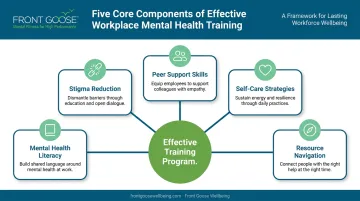
Core Components Every Program Should Cover
Effective employee-level training addresses:
- Mental health literacy — understanding common conditions like anxiety, depression, and burnout at a basic level
- Stigma reduction — examining assumptions that keep people from seeking help
- Peer support skills — how to have a supportive conversation without overstepping
- Self-care strategies — practical techniques employees can apply independently
- Resource navigation — where to go and how to access support when needed
Mental Health First Aid
One of the most widely adopted evidence-based frameworks is Mental Health First Aid (MHFA) at Work. Available in 29 countries and used by more than 5 million people in the United States alone, MHFA teaches employees to recognize warning signs, approach someone with care, offer initial support, and connect them to professional help.
A 2021 systematic review found strong evidence that MHFA improves trainee knowledge, reduces stigma, and increases confidence to help — a meaningful starting point, even if it doesn't guarantee changed behavior in every case.
Why One-and-Done Falls Short
Sustained training changes behavior in ways a single workshop simply cannot. Effective programs layer in:
- Refresher sessions at regular intervals
- Micro-learning formats designed for busy schedules
- Peer champion networks that reinforce skills day-to-day
Peer networks carry the day-to-day load, but managers need their own targeted preparation. Those who receive it are better positioned to have compassionate conversations, offer reasonable adjustments, and connect team members with professional support — without inadvertently overstepping or dismissing concerns.
Tailoring for Different Employee Groups
Sustained, layered training only delivers its full value when it speaks to the actual pressures employees face. Remote workers, shift workers, and high-performing teams carry stressors that generic programs often miss entirely. Training that acknowledges those specifics — isolation for remote employees, irregular hours for shift workers, sustained performance pressure for elite contributors — produces higher engagement and more lasting behavior change.
Mental Fitness Techniques Employees Can Practice Every Day
Mental fitness is distinct from mental health treatment. Think of it the way you'd think about physical fitness: you don't wait for an injury to start working out. You train consistently so that when stress arrives, you have something to draw on.
Mindfulness and Structured Breathing
Brief mindfulness practice has measurable short-term benefits. Research published in PMC found that a single 10-minute guided mindfulness session improved executive attentional control in participants with no prior meditation experience.
A simple starter technique for busy employees:
- Before your next meeting, set a two-minute timer
- Breathe in for a count of four, hold for four, exhale for six
- Notice three things you can hear in your environment
- Return to work
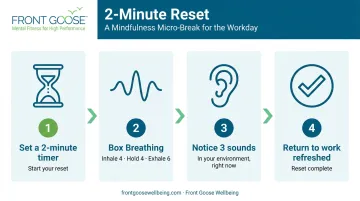
Two minutes between tasks won't eliminate stress, but it does interrupt its accumulation — and that's the point.
Cognitive Reframing
Under pressure, the brain defaults to unhelpful patterns: catastrophizing ("this will ruin everything"), all-or-nothing thinking ("if this isn't perfect, I've failed"), or personalization ("this is all my fault"). Cognitive reappraisal — consciously shifting how you interpret a stressful situation — is a learnable skill, not an innate trait.
The practice looks like asking: "What's another way to see this situation?" or "What would I tell a colleague who came to me with this problem?"
Front Goose Wellbeing's Mental Performance Coaching builds this capacity as part of its Mindset pillar — training high performers to recognize their own cognitive patterns and redirect them before pressure dictates the response.
Recovery Rituals
Micro-breaks matter. A meta-analysis of 22 studies found measurable improvements in energy and fatigue recovery from scheduled recovery breaks during the workday. These aren't signs of low productivity — they're performance infrastructure.
Practical examples:
- Five-minute walk between back-to-back calls
- Consistent end-of-day routine that signals closure — closing your laptop in a specific room, a short walk, or a brief journal entry
- No-phone lunch three or more days per week
The challenge with any of these techniques is consistency. Willpower doesn't hold under prolonged stress — structure does. Structured programs like Front Goose Wellbeing's science-based mental fitness training combine neuroscience-based coaching with certified mindfulness instruction, giving employees a repeatable system and the accountability to use it.
How to Build Psychological Safety as an Employee
Psychological safety is Amy Edmondson's term for a "shared belief held by members of a team that the team is safe for interpersonal risk taking." Google's Project Aristotle, which studied 180 teams, identified it as the single most important factor in team effectiveness.
Its relevance to mental health is direct: the APA's 2024 data shows that disclosure worry drops from 57% in lower-safety workplaces to 22% in higher-safety ones. The environment people work in shapes whether they seek help at all.
You don't need a title to contribute to that environment.
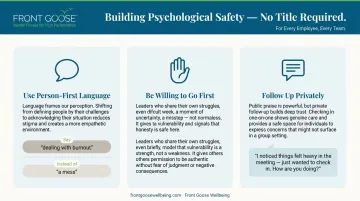
Three Behaviors Any Employee Can Model
Use person-first language. "She's dealing with burnout" lands differently than "she's a mess lately." Language shapes perception — and teams pick up on the cues their members set.
Be willing to go first. When you share a genuine challenge in a team setting — a project you found harder than expected, a week that wore you out — you lower the perceived risk for everyone else. One honest moment shifts the group's sense of what's permissible.
Follow up privately. If a colleague had a visibly hard day, a brief message afterward ("Tough meeting — you holding up okay?") takes almost no effort and communicates that someone noticed and cared.
These behaviors compound. When more employees model openness, fewer people suffer in silence, and the use of mental health resources increases. The resources themselves haven't changed — the culture around accessing them has.
How to Talk About Mental Health at Work Without Fear
Fear of professional consequences is the most common reason employees don't seek support. That fear is rational — but understanding your protections and preparing well for the conversation can meaningfully reduce the risk.
Know Your Legal Protections
Two protections most employees don't fully understand:
- ADA accommodations: You don't need to disclose a diagnosis — only that an adjustment is needed for a medical condition. The employer is entitled to understand the functional limitation, not the clinical label.
- EAP confidentiality: Employers typically receive only aggregate utilization data, not individual identifiable information. If you're unsure, ask HR how your organization's EAP handles confidentiality before you call.
A Practical Approach for Talking to HR or Your Manager
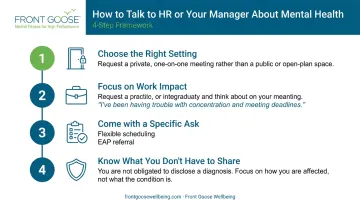
Preparing beforehand matters. Here's a straightforward framework:
- Choose the right setting — a private meeting, not a hallway conversation. Request time specifically for this discussion.
- Focus on work impact — describe how you're being affected at work, not your diagnosis: "I've been struggling to concentrate and meet my usual deadlines over the past few weeks."
- Come with a specific ask — flexible scheduling, a temporary workload adjustment, or an EAP referral are all reasonable starting points; vague requests are harder for managers to act on.
- Know what you don't have to share — you are not required to give a clinical label to receive support.
A productive HR conversation ends with three things: clarity on available resources, a discussion of reasonable adjustments, and defined next steps. If you're walking out with less than that, it's reasonable to follow up in writing.
Frequently Asked Questions
What are the 5 C's of mental health?
The 5 C's — Competence, Confidence, Connection, Character, and Caring — come from Positive Youth Development research. Applied at work, they mean building skills and self-belief, sustaining meaningful relationships, acting with integrity, and supporting others' wellbeing.
How do you improve employee mental health?
Sustainable improvement combines organizational action (training programs, manager preparation, genuine psychological safety) with individual practice (daily mental fitness habits and help-seeking skills). Neither works in isolation — culture and individual skills reinforce each other.
How do you talk to HR about mental health?
Start with work impact, not diagnosis. Describe how you're functioning at work, bring a specific request or accommodation need, and know that you're not required to share a clinical label. Requesting a private meeting gives the conversation the space it deserves.
What are signs that an employee needs mental health support?
Watch for sustained changes from someone's baseline: declining performance or attendance, withdrawal from team interactions, increased emotional reactivity, or verbal expressions of being overwhelmed or hopeless. One bad day isn't a signal — a pattern is.
What is Mental Health First Aid in the workplace?
Mental Health First Aid is an evidence-based training program that teaches employees and managers to recognize signs of mental health challenges, respond with appropriate initial support, and guide colleagues toward professional help before a crisis escalates.
How does mental health training benefit employee performance?
Effective mental health training reduces stress reactivity, sharpens focus, and builds resilience — all of which show up directly in output and engagement. Science-based mental fitness programs, like those offered by Front Goose Wellbeing, go further by developing repeatable skills rather than one-time awareness, so results hold under real workplace pressure.